
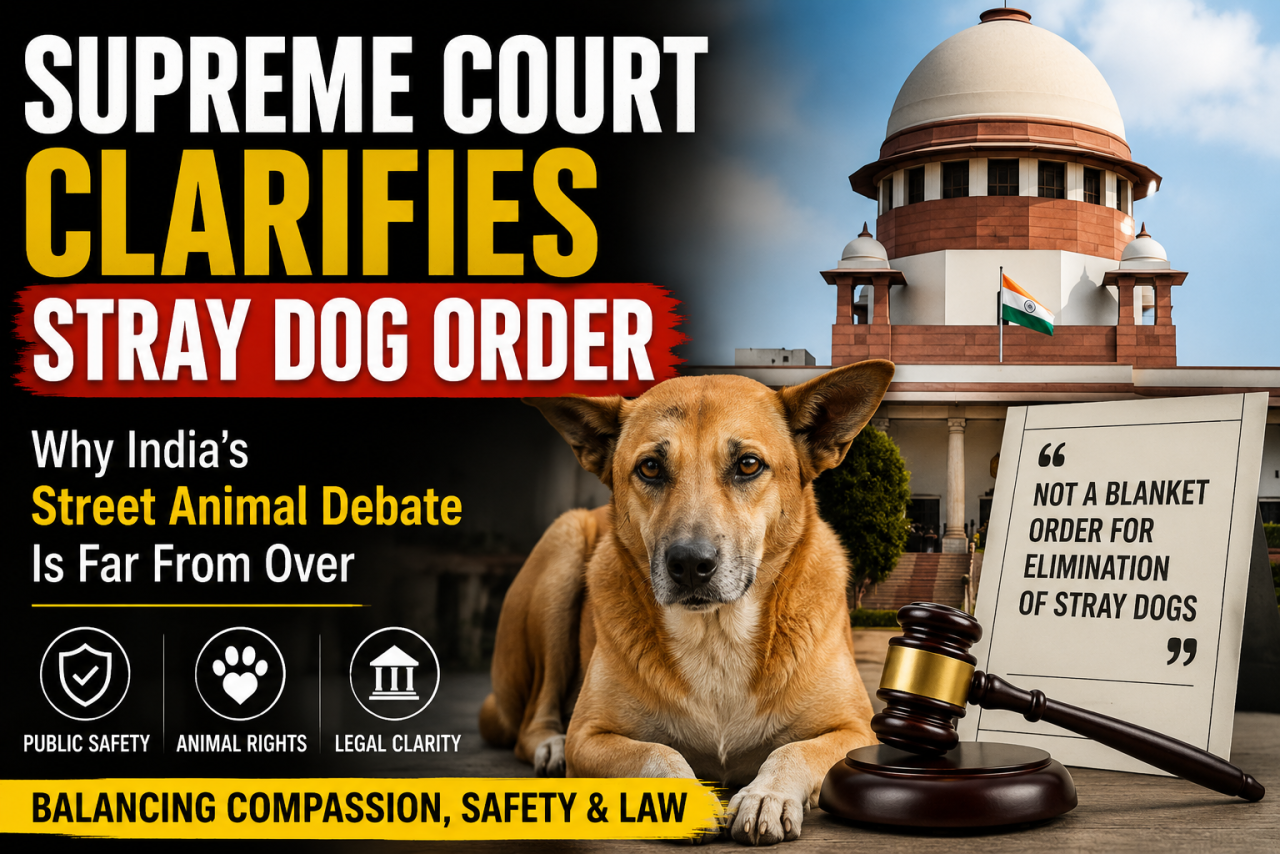
A Supreme Court clarification has reignited India’s emotional debate over stray dogs, public safety, and the limits of urban governance.
India’s long-running debate over stray dogs has once again entered the national spotlight after the Supreme Court clarified that its previous observations should not be interpreted as a blanket order to eliminate stray dogs. The clarification comes amid growing public concern over dog bite incidents, rabies cases, and the challenge of balancing public safety with animal welfare.
The issue has triggered intense reactions across cities and towns, where residents, animal welfare groups, municipal authorities, and policymakers often find themselves on opposing sides. At the center of the controversy lies a difficult question: how can India protect both human lives and animal rights in increasingly crowded urban spaces?
What the Supreme Court Said
According to reports, the Supreme Court recently observed that its earlier comments on stray dog management were being misunderstood in public discussions and media narratives. The bench reportedly stressed that its remarks did not amount to a judicial mandate for mass removal or elimination of stray dogs.
The court also noted that matters related to stray dog management are already being monitored by various High Courts across the country. Since these proceedings are ongoing, affected parties remain free to approach jurisdictional High Courts for relief and implementation-related concerns.
The clarification came during proceedings linked to the implementation of animal birth control measures and stray dog management policies. The court’s remarks aim to prevent misinterpretation of judicial observations that could inflame public sentiment or encourage unlawful action against animals.
Why the Stray Dog Issue Has Become So Sensitive
India has one of the world’s largest populations of free-roaming dogs. In many cities, stray dogs are a visible part of daily urban life. While some communities feed and care for them, others view them as a growing threat due to rising dog bite incidents and concerns over rabies transmission.
The debate intensified in recent years after several reported attacks on children and elderly citizens. Viral social media videos and local news reports have amplified public anger, often creating pressure on municipal bodies to take immediate action.
At the same time, animal rights organizations argue that cruelty or mass displacement of dogs violates both Indian law and internationally accepted welfare standards. Under Indian regulations, stray dogs cannot simply be removed or killed except under limited circumstances involving severe disease or extreme danger.
This legal and ethical tension has turned stray dog management into one of India’s most emotionally charged civic issues.
The Core Problem Is Urban Governance
The stray dog crisis is not merely an animal issue. It reflects deeper failures in urban governance.
Unmanaged garbage dumps, open food waste, poor sterilization coverage, and inconsistent municipal policies have allowed stray dog populations to expand in many regions. Experts have repeatedly pointed out that dogs thrive where food waste is easily available. Without proper waste management, sterilization efforts alone often fail to deliver long-term results.
Many municipalities also lack adequate funding, trained veterinary staff, and functioning animal birth control infrastructure. As a result, sterilization programs remain uneven across states.
In theory, India already has a framework for managing stray dogs through the Animal Birth Control (ABC) Rules. These rules focus on sterilization, vaccination, and release of dogs back into their original territories. However, implementation has been inconsistent.
The Supreme Court’s clarification indirectly highlights this gap between law and execution. Courts can issue observations and guidelines, but sustainable outcomes depend on administrative efficiency at the local level.
Public Safety vs Animal Rights
The real challenge lies in balancing two legitimate concerns.
On one side are citizens demanding safer neighborhoods, especially after dog bite incidents involving children. India continues to report a significant number of rabies-related deaths annually, making public health a serious concern.
On the other side are animal welfare activists who warn against panic-driven responses. They argue that mass relocation or killing of dogs can worsen the problem by creating territorial instability, allowing unvaccinated dogs from nearby areas to move in.
Scientific studies in several countries have shown that stable, vaccinated, and sterilized dog populations are often easier to manage than uncontrolled replacement cycles. This is why many animal welfare groups support long-term vaccination and sterilization rather than aggressive removal campaigns.
Yet critics argue that these programs are moving too slowly to address immediate safety fears in densely populated urban zones.
Media Narratives and Misinformation
One important aspect of the Supreme Court’s clarification is its concern over how judicial remarks are interpreted publicly.
In the age of viral headlines and social media outrage, partial court observations are frequently circulated without legal context. This can create confusion and polarize public opinion. In the stray dog debate, selective interpretations have often fueled hostility either against animal lovers or against residents demanding safety.
The court’s intervention appears aimed at restoring legal clarity and preventing emotionally charged misinformation from shaping public policy.
What India Needs Going Forward
India’s stray dog challenge cannot be solved through outrage alone. It requires coordinated policy, scientific planning, and civic responsibility.
Several reforms are urgently needed:
- Expansion of sterilization and vaccination programs
- Better urban waste management systems
- Faster response mechanisms for aggressive dog complaints
- Public awareness on responsible feeding practices
- Increased funding for municipal veterinary infrastructure
- Data-driven monitoring of dog populations and rabies cases
Equally important is the need for constructive dialogue. The issue is often framed as a battle between “animal lovers” and “public safety advocates,” when in reality both concerns can coexist.
A Debate About the Kind of Cities India Wants
The stray dog controversy ultimately reflects a larger question about Indian urban life. As cities expand rapidly, conflicts over public spaces, sanitation, and civic responsibility are becoming more common.
The Supreme Court’s clarification serves as a reminder that complex social problems cannot be solved through oversimplified narratives. Judicial observations alone cannot replace effective governance, scientific planning, and community cooperation.
India’s challenge is not only to manage stray dogs humanely but also to build cities where compassion and public safety are treated as complementary goals rather than competing priorities.
India’s long-running debate over stray dogs has once again entered the national spotlight after the Supreme Court clarified that its previous observations should not be interpreted as a blanket order to eliminate stray dogs. The clarification comes amid growing public concern over dog bite incidents, rabies cases, and the challenge of balancing public safety with animal welfare.
The issue has triggered intense reactions across cities and towns, where residents, animal welfare groups, municipal authorities, and policymakers often find themselves on opposing sides. At the center of the controversy lies a difficult question: how can India protect both human lives and animal rights in increasingly crowded urban spaces?
What the Supreme Court Said
According to reports, the Supreme Court recently observed that its earlier comments on stray dog management were being misunderstood in public discussions and media narratives. The bench reportedly stressed that its remarks did not amount to a judicial mandate for mass removal or elimination of stray dogs.
The court also noted that matters related to stray dog management are already being monitored by various High Courts across the country. Since these proceedings are ongoing, affected parties remain free to approach jurisdictional High Courts for relief and implementation-related concerns.
The clarification came during proceedings linked to the implementation of animal birth control measures and stray dog management policies. The court’s remarks aim to prevent misinterpretation of judicial observations that could inflame public sentiment or encourage unlawful action against animals.
Why the Stray Dog Issue Has Become So Sensitive
India has one of the world’s largest populations of free-roaming dogs. In many cities, stray dogs are a visible part of daily urban life. While some communities feed and care for them, others view them as a growing threat due to rising dog bite incidents and concerns over rabies transmission.
The debate intensified in recent years after several reported attacks on children and elderly citizens. Viral social media videos and local news reports have amplified public anger, often creating pressure on municipal bodies to take immediate action.
At the same time, animal rights organizations argue that cruelty or mass displacement of dogs violates both Indian law and internationally accepted welfare standards. Under Indian regulations, stray dogs cannot simply be removed or killed except under limited circumstances involving severe disease or extreme danger.
This legal and ethical tension has turned stray dog management into one of India’s most emotionally charged civic issues.
The Core Problem Is Urban Governance
The stray dog crisis is not merely an animal issue. It reflects deeper failures in urban governance.
Unmanaged garbage dumps, open food waste, poor sterilization coverage, and inconsistent municipal policies have allowed stray dog populations to expand in many regions. Experts have repeatedly pointed out that dogs thrive where food waste is easily available. Without proper waste management, sterilization efforts alone often fail to deliver long-term results.
Many municipalities also lack adequate funding, trained veterinary staff, and functioning animal birth control infrastructure. As a result, sterilization programs remain uneven across states.
In theory, India already has a framework for managing stray dogs through the Animal Birth Control (ABC) Rules. These rules focus on sterilization, vaccination, and release of dogs back into their original territories. However, implementation has been inconsistent.
The Supreme Court’s clarification indirectly highlights this gap between law and execution. Courts can issue observations and guidelines, but sustainable outcomes depend on administrative efficiency at the local level.
Public Safety vs Animal Rights
The real challenge lies in balancing two legitimate concerns.
On one side are citizens demanding safer neighborhoods, especially after dog bite incidents involving children. India continues to report a significant number of rabies-related deaths annually, making public health a serious concern.
On the other side are animal welfare activists who warn against panic-driven responses. They argue that mass relocation or killing of dogs can worsen the problem by creating territorial instability, allowing unvaccinated dogs from nearby areas to move in.
Scientific studies in several countries have shown that stable, vaccinated, and sterilized dog populations are often easier to manage than uncontrolled replacement cycles. This is why many animal welfare groups support long-term vaccination and sterilization rather than aggressive removal campaigns.
Yet critics argue that these programs are moving too slowly to address immediate safety fears in densely populated urban zones.
Media Narratives and Misinformation
One important aspect of the Supreme Court’s clarification is its concern over how judicial remarks are interpreted publicly.
In the age of viral headlines and social media outrage, partial court observations are frequently circulated without legal context. This can create confusion and polarize public opinion. In the stray dog debate, selective interpretations have often fueled hostility either against animal lovers or against residents demanding safety.
The court’s intervention appears aimed at restoring legal clarity and preventing emotionally charged misinformation from shaping public policy.
What India Needs Going Forward
India’s stray dog challenge cannot be solved through outrage alone. It requires coordinated policy, scientific planning, and civic responsibility.
Several reforms are urgently needed:
- Expansion of sterilization and vaccination programs
- Better urban waste management systems
- Faster response mechanisms for aggressive dog complaints
- Public awareness on responsible feeding practices
- Increased funding for municipal veterinary infrastructure
- Data-driven monitoring of dog populations and rabies cases
Equally important is the need for constructive dialogue. The issue is often framed as a battle between “animal lovers” and “public safety advocates,” when in reality both concerns can coexist.
A Debate About the Kind of Cities India Wants
The stray dog controversy ultimately reflects a larger question about Indian urban life. As cities expand rapidly, conflicts over public spaces, sanitation, and civic responsibility are becoming more common.
The Supreme Court’s clarification serves as a reminder that complex social problems cannot be solved through oversimplified narratives. Judicial observations alone cannot replace effective governance, scientific planning, and community cooperation.
India’s challenge is not only to manage stray dogs humanely but also to build cities where compassion and public safety are treated as complementary goals rather than competing priorities.

























Leave a Comment