
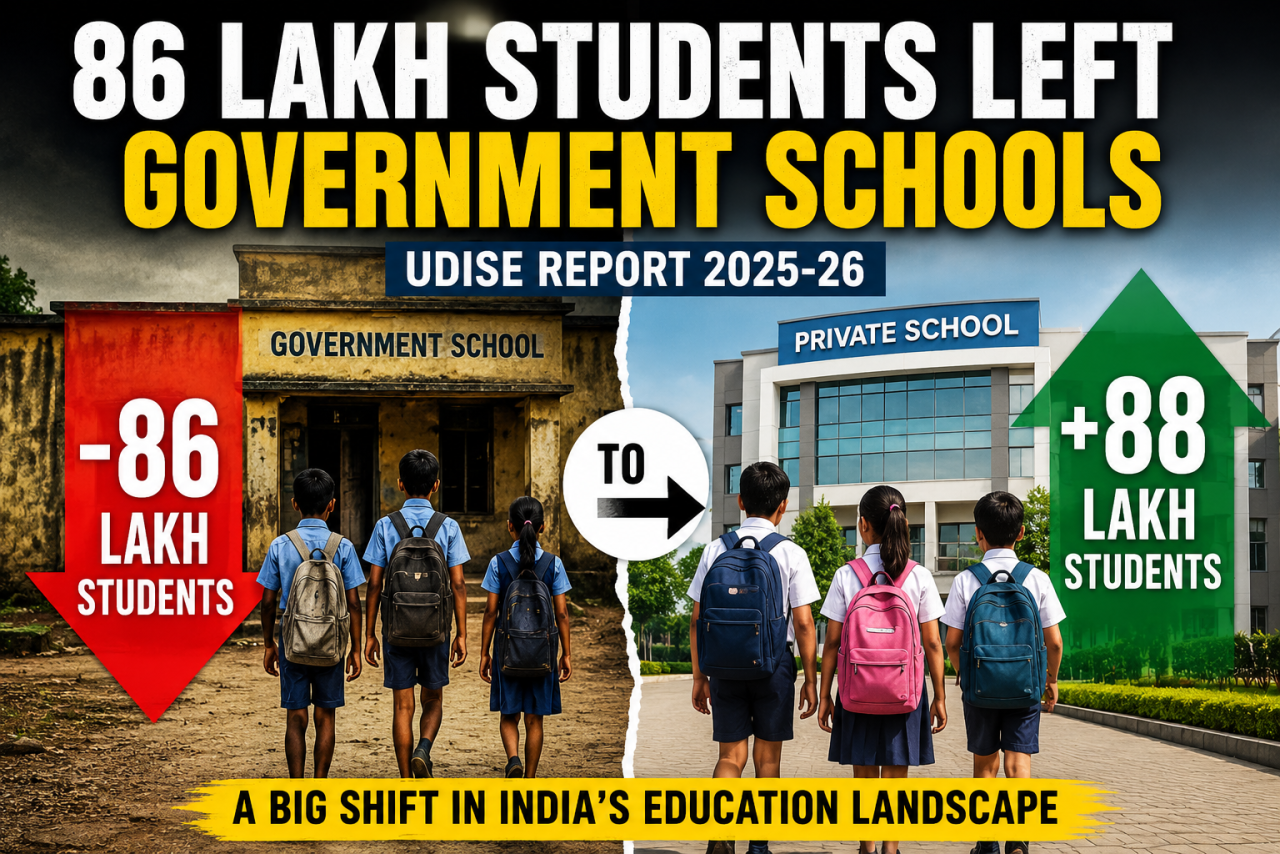
Nearly 86 lakh students have left government schools in just two years. Where are they going, and what does it reveal about India's education system?
India's school education system is witnessing a significant shift in enrolment patterns, with government schools losing nearly 86 lakh students over the past two academic years while private schools continue to attract a growing share of learners. The latest Unified District Information System for Education Plus (UDISE+) 2025-26 report released by the Ministry of Education highlights a changing landscape that raises important questions about parental preferences, the quality of public education and the future of India's school system.
The report shows that enrolment in government schools dropped sharply from 12.75 crore in 2023-24 to 11.89 crore in 2025-26, a decline of nearly 86 lakh students. During the same period, private unaided recognised schools recorded an increase from 9 crore to 9.89 crore students, adding more than 88 lakh new enrolments.
Although the country's overall school enrolment declined only marginally, the movement of students from government institutions to private schools stands out as one of the most notable trends in this year's education data.
A Small Decline in Overall Enrolment
According to the UDISE+ report, total enrolment from the foundational to secondary level stood at 24.72 crore in 2025-26, compared with 24.80 crore in 2023-24. This represents a relatively modest decline of around 8.26 lakh students across the country's school system.
The limited fall in total enrolment indicates that the issue is not simply fewer children attending school. Instead, it reflects a redistribution of students between different types of schools, with private institutions emerging as the biggest beneficiaries.
Education experts have long observed that rising household incomes, greater urbanisation and increasing aspirations among parents have encouraged families to opt for private schools whenever financially possible. Many parents associate private education with better English-language instruction, stronger academic outcomes and greater accountability.
What Is UDISE+?
The Unified District Information System for Education Plus (UDISE+) is the central government's official digital database for the education sector. Maintained by the Ministry of Education, it compiles nationwide information on school infrastructure, student enrolment, teachers and various educational indicators.
The platform enables policymakers to monitor developments across India's vast school network and identify areas requiring intervention. The annual report is regarded as one of the country's most comprehensive sources of school education statistics.
Schools Decline, Teachers Increase
The report also presents a mixed picture regarding educational infrastructure and staffing.
The total number of schools in India declined marginally from 14.72 lakh in 2023-24 to 14.67 lakh in 2025-26. Despite the slight reduction in schools, the number of teachers increased from 98.08 lakh to more than 1.02 crore (1,02,73,020).
This expansion in the teaching workforce has led to an improvement in the pupil-teacher ratio, which improved from 25:1 to 24:1. A lower pupil-teacher ratio generally allows teachers to provide more individual attention and is considered an important indicator of educational quality.
The report also highlights progress in addressing some longstanding structural challenges.
The number of zero-enrolment schools fell dramatically from 12,954 to 5,663, suggesting better rationalisation of school infrastructure or improved utilisation of existing institutions.
Similarly, single-teacher schools, which have often been criticised for limiting educational quality, declined from 1.11 lakh to 1.01 lakh during the reporting period.
Better Student Retention in Higher Grades
One of the more encouraging findings in the report relates to student retention, particularly in middle and secondary education.
The retention rate at the middle level improved from 82.8 percent in 2024-25 to 83.7 percent in 2025-26. At the secondary level, retention rose more substantially from 47.2 percent to 51.9 percent.
Improved retention means that a greater proportion of students are continuing their education instead of dropping out before completing their schooling. This is particularly significant at the secondary level, where dropout rates have traditionally been a major concern in India.
The report, however, notes a marginal decline in retention at the foundational and preparatory stages during 2025-26 after three consecutive years of improvement between 2022-23 and 2024-25. While the decline is small, it suggests that sustained efforts will be necessary to maintain early-stage participation in school.
Why Are Parents Choosing Private Schools?
The data does not identify the reasons behind the enrolment shift, but several factors may be contributing to the trend.
Parents increasingly seek schools that offer English-medium education, digital classrooms, better extracurricular activities and stronger academic performance. Many private schools have expanded rapidly into semi-urban and rural areas, making them more accessible than in previous decades.
At the same time, government schools continue to play a critical role, particularly for economically weaker sections, by providing free education, midday meals, textbooks and scholarships. However, concerns over infrastructure, learning outcomes and teacher accountability continue to influence parental choices in many regions.
The enrolment shift reflected in the UDISE+ data suggests that improving public confidence in government schools may become an increasingly important policy priority.
Final Take
The UDISE+ 2025-26 report presents a complex picture of India's education system. On one hand, improvements in teacher availability, pupil-teacher ratios, retention rates and the reduction of single-teacher schools indicate progress in strengthening educational delivery.
On the other hand, the sharp decline in government school enrolment signals that millions of families are increasingly looking beyond the public education system. This trend carries important implications for education policy, funding priorities and efforts to ensure equitable access to quality education.
As India continues implementing the National Education Policy (NEP) 2020, the challenge will be not only to expand educational access but also to rebuild confidence in government schools so that quality education remains accessible to every child, regardless of economic background.
India's school education system is witnessing a significant shift in enrolment patterns, with government schools losing nearly 86 lakh students over the past two academic years while private schools continue to attract a growing share of learners. The latest Unified District Information System for Education Plus (UDISE+) 2025-26 report released by the Ministry of Education highlights a changing landscape that raises important questions about parental preferences, the quality of public education and the future of India's school system.
The report shows that enrolment in government schools dropped sharply from 12.75 crore in 2023-24 to 11.89 crore in 2025-26, a decline of nearly 86 lakh students. During the same period, private unaided recognised schools recorded an increase from 9 crore to 9.89 crore students, adding more than 88 lakh new enrolments.
Although the country's overall school enrolment declined only marginally, the movement of students from government institutions to private schools stands out as one of the most notable trends in this year's education data.
A Small Decline in Overall Enrolment
According to the UDISE+ report, total enrolment from the foundational to secondary level stood at 24.72 crore in 2025-26, compared with 24.80 crore in 2023-24. This represents a relatively modest decline of around 8.26 lakh students across the country's school system.
The limited fall in total enrolment indicates that the issue is not simply fewer children attending school. Instead, it reflects a redistribution of students between different types of schools, with private institutions emerging as the biggest beneficiaries.
Education experts have long observed that rising household incomes, greater urbanisation and increasing aspirations among parents have encouraged families to opt for private schools whenever financially possible. Many parents associate private education with better English-language instruction, stronger academic outcomes and greater accountability.
What Is UDISE+?
The Unified District Information System for Education Plus (UDISE+) is the central government's official digital database for the education sector. Maintained by the Ministry of Education, it compiles nationwide information on school infrastructure, student enrolment, teachers and various educational indicators.
The platform enables policymakers to monitor developments across India's vast school network and identify areas requiring intervention. The annual report is regarded as one of the country's most comprehensive sources of school education statistics.
Schools Decline, Teachers Increase
The report also presents a mixed picture regarding educational infrastructure and staffing.
The total number of schools in India declined marginally from 14.72 lakh in 2023-24 to 14.67 lakh in 2025-26. Despite the slight reduction in schools, the number of teachers increased from 98.08 lakh to more than 1.02 crore (1,02,73,020).
This expansion in the teaching workforce has led to an improvement in the pupil-teacher ratio, which improved from 25:1 to 24:1. A lower pupil-teacher ratio generally allows teachers to provide more individual attention and is considered an important indicator of educational quality.
The report also highlights progress in addressing some longstanding structural challenges.
The number of zero-enrolment schools fell dramatically from 12,954 to 5,663, suggesting better rationalisation of school infrastructure or improved utilisation of existing institutions.
Similarly, single-teacher schools, which have often been criticised for limiting educational quality, declined from 1.11 lakh to 1.01 lakh during the reporting period.
Better Student Retention in Higher Grades
One of the more encouraging findings in the report relates to student retention, particularly in middle and secondary education.
The retention rate at the middle level improved from 82.8 percent in 2024-25 to 83.7 percent in 2025-26. At the secondary level, retention rose more substantially from 47.2 percent to 51.9 percent.
Improved retention means that a greater proportion of students are continuing their education instead of dropping out before completing their schooling. This is particularly significant at the secondary level, where dropout rates have traditionally been a major concern in India.
The report, however, notes a marginal decline in retention at the foundational and preparatory stages during 2025-26 after three consecutive years of improvement between 2022-23 and 2024-25. While the decline is small, it suggests that sustained efforts will be necessary to maintain early-stage participation in school.
Why Are Parents Choosing Private Schools?
The data does not identify the reasons behind the enrolment shift, but several factors may be contributing to the trend.
Parents increasingly seek schools that offer English-medium education, digital classrooms, better extracurricular activities and stronger academic performance. Many private schools have expanded rapidly into semi-urban and rural areas, making them more accessible than in previous decades.
At the same time, government schools continue to play a critical role, particularly for economically weaker sections, by providing free education, midday meals, textbooks and scholarships. However, concerns over infrastructure, learning outcomes and teacher accountability continue to influence parental choices in many regions.
The enrolment shift reflected in the UDISE+ data suggests that improving public confidence in government schools may become an increasingly important policy priority.
Final Take
The UDISE+ 2025-26 report presents a complex picture of India's education system. On one hand, improvements in teacher availability, pupil-teacher ratios, retention rates and the reduction of single-teacher schools indicate progress in strengthening educational delivery.
On the other hand, the sharp decline in government school enrolment signals that millions of families are increasingly looking beyond the public education system. This trend carries important implications for education policy, funding priorities and efforts to ensure equitable access to quality education.
As India continues implementing the National Education Policy (NEP) 2020, the challenge will be not only to expand educational access but also to rebuild confidence in government schools so that quality education remains accessible to every child, regardless of economic background.























Leave a Comment