
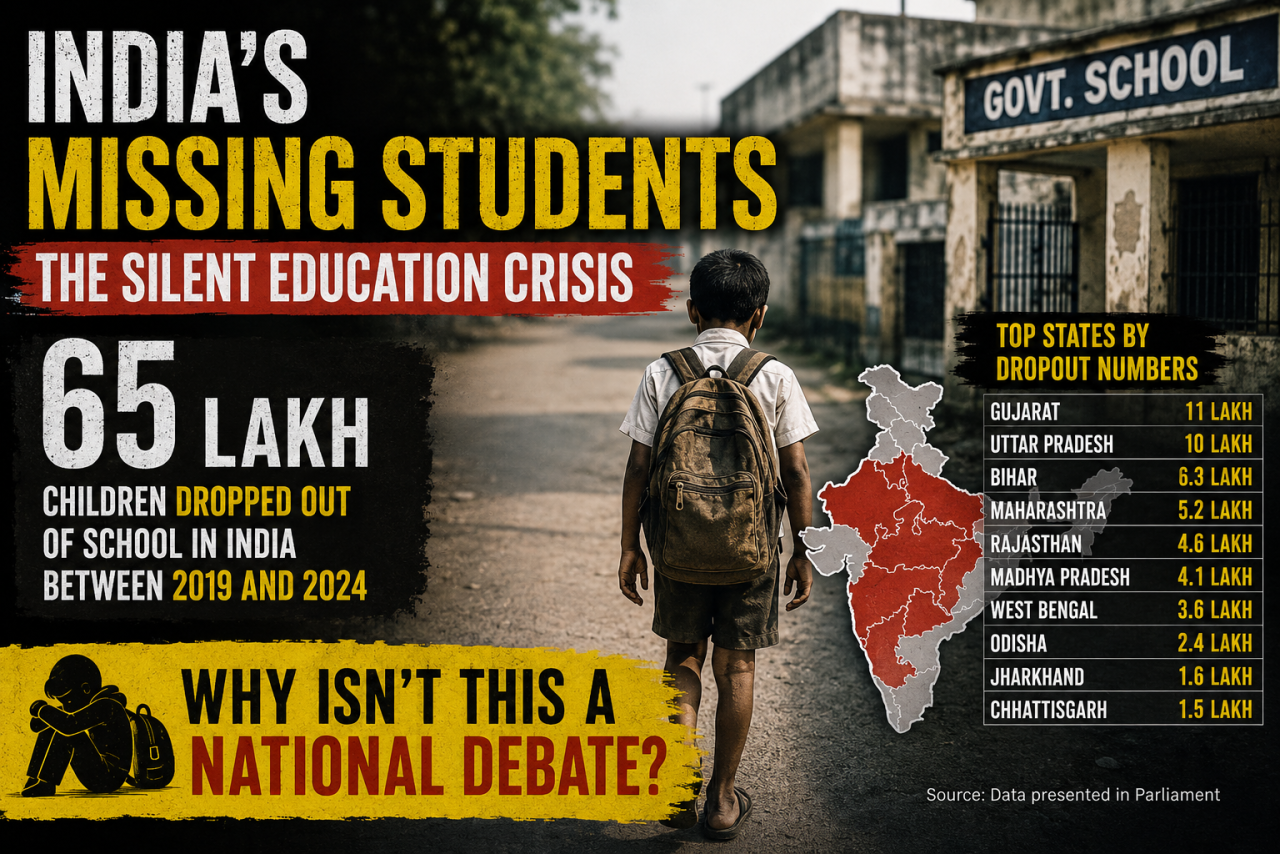
Nearly 65 lakh children left school in India over five years. Why has one of the country's biggest education challenges failed to spark a national conversation despite its far-reaching consequences?
While national debates often revolve around competitive examinations, university admissions, and employment opportunities, a more fundamental challenge confronting India's education system remains largely absent from public discourse: millions of children are leaving school before completing their education.
Data presented in Parliament reveals that nearly 65 lakh children dropped out of school across India between 2019 and 2024, highlighting a crisis that cuts across geography, income groups, and administrative boundaries.
To understand the scale, imagine every school-going child in Delhi suddenly disappearing from classrooms. That is roughly equivalent to the number of students who have exited India's education system over the last five years.
Gujarat Tops the List
Among all states, Gujarat reported approximately 11 lakh school dropouts, the highest in the country during the period under review. The figure has raised eyebrows because Gujarat is frequently cited as one of India's leading economic success stories.
Close behind is Uttar Pradesh, with nearly 10 lakh children reported as out of school. However, Uttar Pradesh is India's most populous state, with a population exceeding 24 crore, while Gujarat's population is estimated at around 7 crore.
This means Gujarat's dropout burden appears significantly larger when viewed relative to its population size, raising important questions about educational retention despite economic growth.
Other states reporting substantial numbers include Bihar, Maharashtra, Madhya Pradesh, Rajasthan, West Bengal, Odisha, Jharkhand, and Chhattisgarh, each facing distinct social and economic challenges that affect school attendance and retention.
Beyond Enrollment Numbers
Over the past two decades, India has expanded access to education through initiatives such as the Right to Education Act, the Mid-Day Meal Scheme, free textbooks, scholarships, and targeted welfare programmes.
As a result, enrollment rates have improved considerably. Yet education experts caution that enrollment figures alone do not capture the full picture.
"The challenge today is not merely getting children into schools. It is ensuring they remain there and continue learning," says a former education policy advisor who has worked on school retention programmes in several states.
A child dropping out is not simply a statistical event. It often reflects a combination of poverty, migration, family circumstances, poor learning outcomes, and inadequate institutional support.
Poverty Remains a Major Factor
For many low-income households, education competes directly with economic survival.
Children are often required to contribute to family income, assist in agriculture, care for younger siblings, or support household work. In such situations, schooling becomes difficult to sustain, especially when families face financial distress.
The problem is particularly acute in economically vulnerable districts where irregular employment and seasonal migration are common.
Migration and Interrupted Education
India's vast migrant workforce creates another challenge.
Families frequently move across districts and states in search of work. Children accompanying them often lose continuity in education due to documentation issues, language barriers, or lack of admission opportunities in destination locations.
Many eventually fail to return to formal schooling.
States with significant migrant populations, including Gujarat, Maharashtra, and parts of northern India, continue to grapple with this issue.
The Pandemic's Lingering Impact
Although schools have reopened following the COVID-19 pandemic, education researchers argue that its effects continue to be felt.
Extended school closures widened learning gaps, particularly among students from disadvantaged backgrounds who lacked access to digital devices and internet connectivity.
For some children, especially those entering the workforce during the pandemic, returning to classrooms proved difficult even after restrictions were lifted.
Several studies conducted after COVID-19 have pointed to increased risks of dropout among economically vulnerable families.
Regional Differences, Common Challenges
Southern states such as Kerala, Tamil Nadu, Karnataka, Telangana, and Andhra Pradesh generally report stronger educational outcomes and lower dropout levels compared with many northern states. Higher literacy rates, better infrastructure, and stronger social indicators have contributed to these results.
However, even these states face challenges related to urban poverty, migrant populations, and learning recovery after the pandemic.
In the northeastern region, including Assam, Meghalaya, Arunachal Pradesh, Nagaland, Manipur, Mizoram, Tripura, and Sikkim, difficult terrain and connectivity issues continue to affect educational access in remote areas.
Meanwhile, tribal districts in Odisha, Jharkhand, Madhya Pradesh, and Chhattisgarh face unique barriers linked to geography, infrastructure, and socio-economic conditions.
Why the Silence?
Perhaps the most troubling aspect of the dropout crisis is the limited public attention it receives.
School dropouts rarely dominate television debates or generate sustained political discussion despite affecting millions of children.
Education specialists argue that the issue remains under-reported because the affected population largely belongs to economically weaker sections of society. Unlike examination controversies or university admissions, dropout statistics often lack immediate political visibility.
Yet the long-term consequences are profound.
Children who leave school prematurely are more likely to face lower earnings, reduced employment opportunities, and limited social mobility. At a national level, large-scale educational exclusion weakens the very human capital that India hopes to leverage as a young and growing economy.
A National Priority Waiting for Attention
India's ambition of becoming a developed economy rests heavily on the quality of its education system.
While discussions on skill development, artificial intelligence, and future jobs continue to gain momentum, policymakers cannot afford to overlook a more basic reality: millions of children are still leaving school before completing their education.
The figure of 65 lakh dropouts is not merely an education statistic. It is a measure of lost opportunities, interrupted aspirations, and unrealised potential.
If India is serious about building a skilled workforce for the future, retaining children in classrooms today must become a national priority.
While national debates often revolve around competitive examinations, university admissions, and employment opportunities, a more fundamental challenge confronting India's education system remains largely absent from public discourse: millions of children are leaving school before completing their education.
Data presented in Parliament reveals that nearly 65 lakh children dropped out of school across India between 2019 and 2024, highlighting a crisis that cuts across geography, income groups, and administrative boundaries.
To understand the scale, imagine every school-going child in Delhi suddenly disappearing from classrooms. That is roughly equivalent to the number of students who have exited India's education system over the last five years.
Gujarat Tops the List
Among all states, Gujarat reported approximately 11 lakh school dropouts, the highest in the country during the period under review. The figure has raised eyebrows because Gujarat is frequently cited as one of India's leading economic success stories.
Close behind is Uttar Pradesh, with nearly 10 lakh children reported as out of school. However, Uttar Pradesh is India's most populous state, with a population exceeding 24 crore, while Gujarat's population is estimated at around 7 crore.
This means Gujarat's dropout burden appears significantly larger when viewed relative to its population size, raising important questions about educational retention despite economic growth.
Other states reporting substantial numbers include Bihar, Maharashtra, Madhya Pradesh, Rajasthan, West Bengal, Odisha, Jharkhand, and Chhattisgarh, each facing distinct social and economic challenges that affect school attendance and retention.
Beyond Enrollment Numbers
Over the past two decades, India has expanded access to education through initiatives such as the Right to Education Act, the Mid-Day Meal Scheme, free textbooks, scholarships, and targeted welfare programmes.
As a result, enrollment rates have improved considerably. Yet education experts caution that enrollment figures alone do not capture the full picture.
"The challenge today is not merely getting children into schools. It is ensuring they remain there and continue learning," says a former education policy advisor who has worked on school retention programmes in several states.
A child dropping out is not simply a statistical event. It often reflects a combination of poverty, migration, family circumstances, poor learning outcomes, and inadequate institutional support.
Poverty Remains a Major Factor
For many low-income households, education competes directly with economic survival.
Children are often required to contribute to family income, assist in agriculture, care for younger siblings, or support household work. In such situations, schooling becomes difficult to sustain, especially when families face financial distress.
The problem is particularly acute in economically vulnerable districts where irregular employment and seasonal migration are common.
Migration and Interrupted Education
India's vast migrant workforce creates another challenge.
Families frequently move across districts and states in search of work. Children accompanying them often lose continuity in education due to documentation issues, language barriers, or lack of admission opportunities in destination locations.
Many eventually fail to return to formal schooling.
States with significant migrant populations, including Gujarat, Maharashtra, and parts of northern India, continue to grapple with this issue.
The Pandemic's Lingering Impact
Although schools have reopened following the COVID-19 pandemic, education researchers argue that its effects continue to be felt.
Extended school closures widened learning gaps, particularly among students from disadvantaged backgrounds who lacked access to digital devices and internet connectivity.
For some children, especially those entering the workforce during the pandemic, returning to classrooms proved difficult even after restrictions were lifted.
Several studies conducted after COVID-19 have pointed to increased risks of dropout among economically vulnerable families.
Regional Differences, Common Challenges
Southern states such as Kerala, Tamil Nadu, Karnataka, Telangana, and Andhra Pradesh generally report stronger educational outcomes and lower dropout levels compared with many northern states. Higher literacy rates, better infrastructure, and stronger social indicators have contributed to these results.
However, even these states face challenges related to urban poverty, migrant populations, and learning recovery after the pandemic.
In the northeastern region, including Assam, Meghalaya, Arunachal Pradesh, Nagaland, Manipur, Mizoram, Tripura, and Sikkim, difficult terrain and connectivity issues continue to affect educational access in remote areas.
Meanwhile, tribal districts in Odisha, Jharkhand, Madhya Pradesh, and Chhattisgarh face unique barriers linked to geography, infrastructure, and socio-economic conditions.
Why the Silence?
Perhaps the most troubling aspect of the dropout crisis is the limited public attention it receives.
School dropouts rarely dominate television debates or generate sustained political discussion despite affecting millions of children.
Education specialists argue that the issue remains under-reported because the affected population largely belongs to economically weaker sections of society. Unlike examination controversies or university admissions, dropout statistics often lack immediate political visibility.
Yet the long-term consequences are profound.
Children who leave school prematurely are more likely to face lower earnings, reduced employment opportunities, and limited social mobility. At a national level, large-scale educational exclusion weakens the very human capital that India hopes to leverage as a young and growing economy.
A National Priority Waiting for Attention
India's ambition of becoming a developed economy rests heavily on the quality of its education system.
While discussions on skill development, artificial intelligence, and future jobs continue to gain momentum, policymakers cannot afford to overlook a more basic reality: millions of children are still leaving school before completing their education.
The figure of 65 lakh dropouts is not merely an education statistic. It is a measure of lost opportunities, interrupted aspirations, and unrealised potential.
If India is serious about building a skilled workforce for the future, retaining children in classrooms today must become a national priority.


















Leave a Comment