
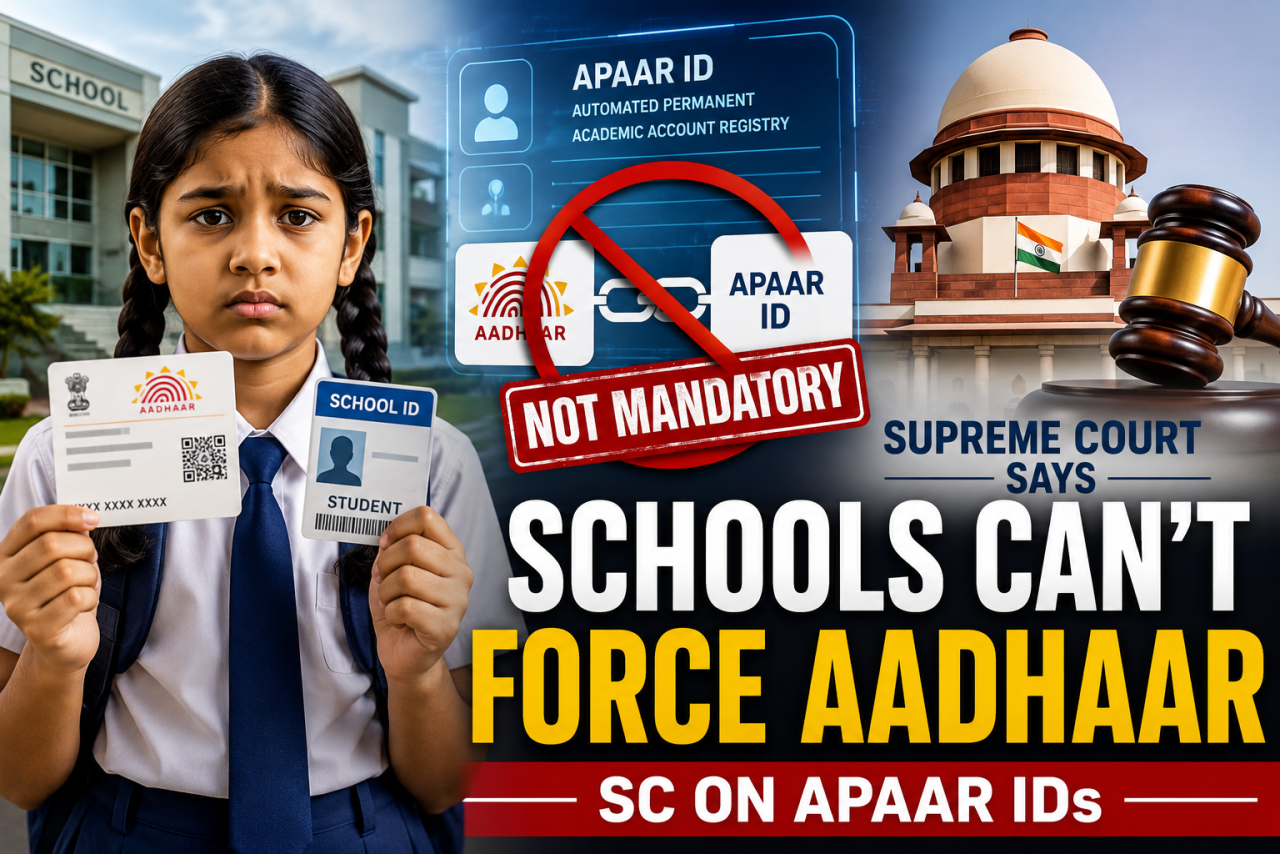
The Supreme Court has drawn a line on Aadhaar-linked APAAR IDs, reinforcing that parents must have a genuine choice before their children's personal data enters India's digital education system.
For lakhs of Indian schoolchildren, getting an Aadhaar card used to be a family errand tied to bank accounts or scholarships. Today, it has quietly become the price of a school ID. The Supreme Court has now stepped in to say that price cannot be compulsory, and the fix it wants may reshape how India collects children's data for years to come.
What the Case Is Actually About
The Automated Permanent Academic Account Registry (APAAR) is a digital student ID launched by the Ministry of Education in July 2023 under the "One Nation, One Student ID" initiative. On paper, the scheme is voluntary. In practice, however, generating an APAAR ID requires an Aadhaar number, and schools across the country have been asking students to provide one before board examination registration, admissions, or even routine administrative work. Parents in several states have reported being informally told that without an APAAR ID, their child's examination forms could be delayed or rejected.
This gap between the official claim of voluntariness and the reality on the ground prompted four families to approach the Supreme Court. Their petition, filed through advocate Paras Nath Singh and argued by senior advocate Indira Jaising, challenges the constitutional validity of APAAR. It argues that the scheme effectively compels children to obtain Aadhaar to access education-related services, violating the Right to Education and failing to meet the standards laid down under the Digital Personal Data Protection Act, 2023, particularly regarding children's personal data.
What the Supreme Court Said
Hearing the matter on July 20, a bench led by Chief Justice of India Surya Kant, along with Justices Joymalya Bagchi and V. Mohana, did not strike down the APAAR scheme. Instead, it agreed with a narrower but significant concern: parents must be given an explicit and informed opportunity to refuse consent before their child is enrolled, rather than merely being allowed to withdraw consent later.
The court's approach builds upon an earlier decision of the Orissa High Court delivered in December 2025, which held that CBSE's consent form contradicted the government's own assertion that APAAR was voluntary. Since that judgment was never challenged by the Union government, the Supreme Court has now directed CBSE to redesign its consent forms nationwide, ensuring that parents across India can decline participation without facing any penalty.
The Chief Justice described the move as a corrective measure rather than a criticism of digital governance, observing that a well-intentioned digital identity system should not automatically invite suspicion. At the same time, the bench asked CBSE to examine the broader privacy and data protection concerns raised in the petition, leaving the constitutional questions open for further consideration.
Why This Matters Beyond a Consent Form
At first glance, the order may appear to be a minor procedural change. In reality, it touches on a much larger issue that has surfaced repeatedly in India's digital governance journey: government schemes described as "voluntary" often become effectively mandatory when no practical alternative exists.
The Supreme Court's landmark privacy ruling in the Aadhaar case in 2018 had already established that access to essential services cannot ordinarily be made conditional upon possessing an Aadhaar number. The APAAR controversy raises the question of whether that principle also protects a child's right to education, examinations and academic records.
Children deserve even stronger safeguards. The Digital Personal Data Protection Act, 2023 recognises that minors cannot provide meaningful consent regarding the collection and use of their personal data. An Aadhaar-linked academic identity that follows a student throughout their educational journey, without an easy and genuine option to opt out, raises important questions about privacy, proportionality and informed consent.
The petitioners have also asked the court to ensure that students who choose not to enrol in APAAR are not denied admissions, board examination registration, mark sheets or certificates. The Supreme Court has yet to rule on this issue. Its eventual decision may prove even more consequential than the revised consent form itself, because the right to refuse is meaningful only if it carries no hidden consequences.
What Happens Next
CBSE must now redesign its consent process across the country, not just in Odisha. Whether the revised process offers parents a genuine and frictionless choice, rather than a symbolic checkbox buried in paperwork, will determine the practical impact of the court's order.
Meanwhile, the constitutional challenge to APAAR remains pending. The Supreme Court is expected to continue examining the larger questions surrounding children's privacy, data protection and the limits of mandatory digital identification in education.
For now, the court has delivered a clear message: administrative convenience cannot replace informed consent, especially when the rights and personal data of children are involved.
For lakhs of Indian schoolchildren, getting an Aadhaar card used to be a family errand tied to bank accounts or scholarships. Today, it has quietly become the price of a school ID. The Supreme Court has now stepped in to say that price cannot be compulsory, and the fix it wants may reshape how India collects children's data for years to come.
What the Case Is Actually About
The Automated Permanent Academic Account Registry (APAAR) is a digital student ID launched by the Ministry of Education in July 2023 under the "One Nation, One Student ID" initiative. On paper, the scheme is voluntary. In practice, however, generating an APAAR ID requires an Aadhaar number, and schools across the country have been asking students to provide one before board examination registration, admissions, or even routine administrative work. Parents in several states have reported being informally told that without an APAAR ID, their child's examination forms could be delayed or rejected.
This gap between the official claim of voluntariness and the reality on the ground prompted four families to approach the Supreme Court. Their petition, filed through advocate Paras Nath Singh and argued by senior advocate Indira Jaising, challenges the constitutional validity of APAAR. It argues that the scheme effectively compels children to obtain Aadhaar to access education-related services, violating the Right to Education and failing to meet the standards laid down under the Digital Personal Data Protection Act, 2023, particularly regarding children's personal data.
What the Supreme Court Said
Hearing the matter on July 20, a bench led by Chief Justice of India Surya Kant, along with Justices Joymalya Bagchi and V. Mohana, did not strike down the APAAR scheme. Instead, it agreed with a narrower but significant concern: parents must be given an explicit and informed opportunity to refuse consent before their child is enrolled, rather than merely being allowed to withdraw consent later.
The court's approach builds upon an earlier decision of the Orissa High Court delivered in December 2025, which held that CBSE's consent form contradicted the government's own assertion that APAAR was voluntary. Since that judgment was never challenged by the Union government, the Supreme Court has now directed CBSE to redesign its consent forms nationwide, ensuring that parents across India can decline participation without facing any penalty.
The Chief Justice described the move as a corrective measure rather than a criticism of digital governance, observing that a well-intentioned digital identity system should not automatically invite suspicion. At the same time, the bench asked CBSE to examine the broader privacy and data protection concerns raised in the petition, leaving the constitutional questions open for further consideration.
Why This Matters Beyond a Consent Form
At first glance, the order may appear to be a minor procedural change. In reality, it touches on a much larger issue that has surfaced repeatedly in India's digital governance journey: government schemes described as "voluntary" often become effectively mandatory when no practical alternative exists.
The Supreme Court's landmark privacy ruling in the Aadhaar case in 2018 had already established that access to essential services cannot ordinarily be made conditional upon possessing an Aadhaar number. The APAAR controversy raises the question of whether that principle also protects a child's right to education, examinations and academic records.
Children deserve even stronger safeguards. The Digital Personal Data Protection Act, 2023 recognises that minors cannot provide meaningful consent regarding the collection and use of their personal data. An Aadhaar-linked academic identity that follows a student throughout their educational journey, without an easy and genuine option to opt out, raises important questions about privacy, proportionality and informed consent.
The petitioners have also asked the court to ensure that students who choose not to enrol in APAAR are not denied admissions, board examination registration, mark sheets or certificates. The Supreme Court has yet to rule on this issue. Its eventual decision may prove even more consequential than the revised consent form itself, because the right to refuse is meaningful only if it carries no hidden consequences.
What Happens Next
CBSE must now redesign its consent process across the country, not just in Odisha. Whether the revised process offers parents a genuine and frictionless choice, rather than a symbolic checkbox buried in paperwork, will determine the practical impact of the court's order.
Meanwhile, the constitutional challenge to APAAR remains pending. The Supreme Court is expected to continue examining the larger questions surrounding children's privacy, data protection and the limits of mandatory digital identification in education.
For now, the court has delivered a clear message: administrative convenience cannot replace informed consent, especially when the rights and personal data of children are involved.





















Leave a Comment