
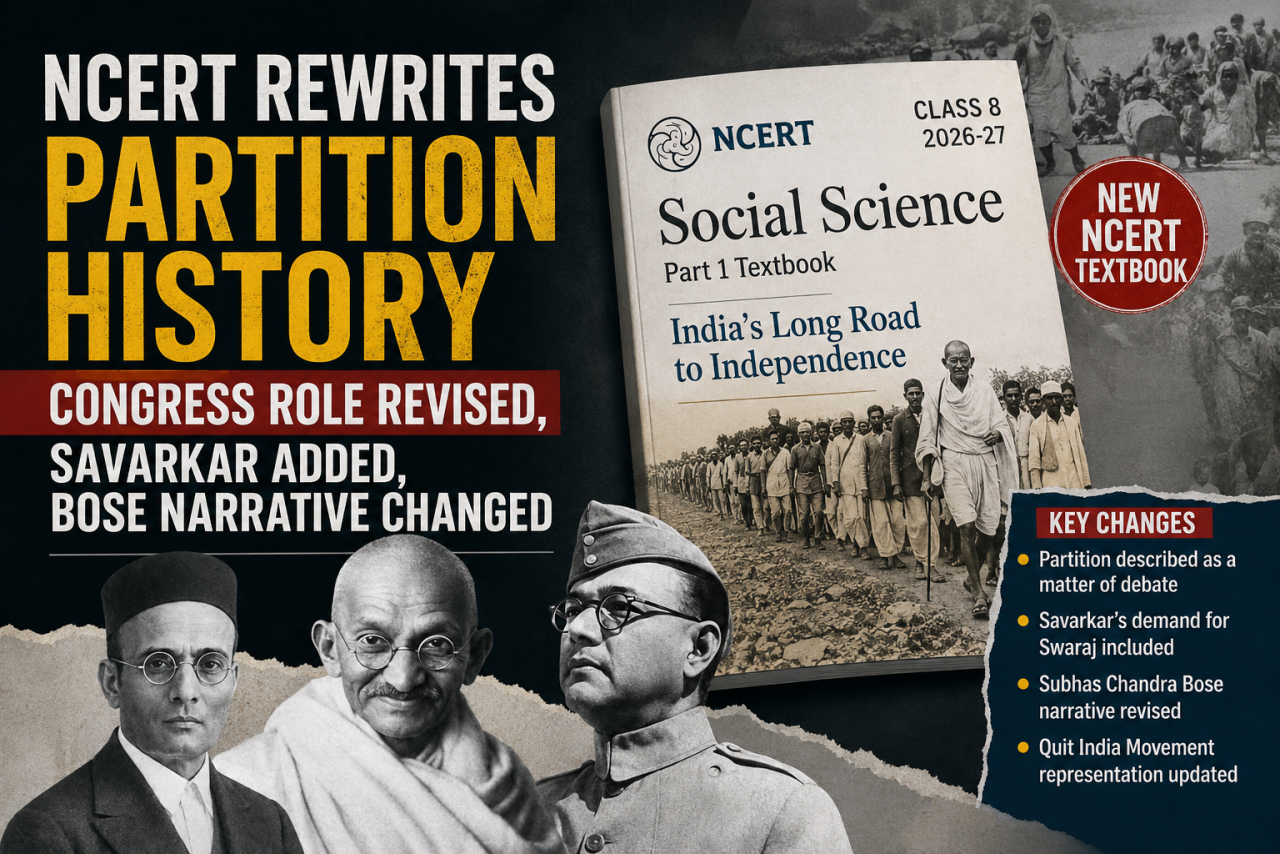
NCERT's revised Class 8 history textbook revisits the story of Partition, recasts the Congress's role, and expands the narrative of India's freedom struggle.
History is not just a record of the past. It also shapes how future generations understand their nation. That is why every revision of school textbooks attracts public attention, especially when it concerns events as significant as India's Independence and Partition.
The National Council of Educational Research and Training (NCERT) has substantially revised the history chapter on India's freedom struggle in the new Class 8 Social Science textbook for the academic session 2026-27. The changes have sparked debate because they revise the description of the Indian National Congress's role in the Partition of India, expand references to Vinayak Damodar Savarkar's demand for Swaraj, and alter the section dealing with Subhas Chandra Bose's stay in Germany during the Second World War.
As historians often remind us, history should neither become a tool for political celebration nor political condemnation. It should remain a careful study of evidence, context and competing viewpoints. The latest textbook changes deserve to be understood in that spirit.
A Different Description of Partition
The most significant revision concerns the chapter titled India's Long Road to Independence.
The earlier version stated that the British took advantage of disagreements between Hindu and Muslim leaders to divide India. It also noted that Mahatma Gandhi and most Congress leaders opposed Partition but eventually accepted it because they believed it was the only practical solution to stop widespread violence. It added that many Indian Muslims also opposed the division.
The revised textbook presents a broader political picture. It states that the British had encouraged Hindu-Muslim differences for decades and that Partition resulted from disagreements between the two communities or sections within them. It also says that the Partition plan was "widely opposed even by the Indian National Congress" and that there was "no national consensus" on accepting it.
Importantly, the new text adds that whether accepting Partition was the only possible course remains a matter of historical debate. This sentence acknowledges that historians continue to disagree over whether different political choices could have prevented Partition or reduced its consequences.
From a historical perspective, this is not an entirely new debate. For decades, scholars have argued over the responsibilities of the British government, the Muslim League, the Congress leadership and other political actors. There is no single interpretation that commands universal agreement.
Greater Attention to Savarkar's Demand for Swaraj
Another noticeable revision concerns the evolution of the demand for complete independence.
Earlier textbooks highlighted leaders such as Bal Gangadhar Tilak, Bipin Chandra Pal, Mahatma Gandhi, Jawaharlal Nehru, Maulana Hasrat Mohani and Subhas Chandra Bose while tracing the development of the idea of Purna Swaraj.
The revised edition adds that Vinayak Damodar Savarkar had also expressed a similar demand for Swaraj in 1925. It further mentions that Aurobindo had raised a comparable demand as early as 1908.
This addition does not replace the contribution of Congress leaders. Instead, it expands the narrative by recognising that the idea of complete self-rule was advocated by several individuals across different political traditions before it became the official goal of the Congress in 1929.
For students, this provides a wider understanding of the intellectual and political currents within India's freedom movement.
Changes in the Subhas Chandra Bose Narrative
The textbook has also revised the description of Netaji Subhas Chandra Bose's efforts during the Second World War.
The earlier version stated that Bose sought Adolf Hitler's support to raise an army and identified Hitler as a dictator whose racist Nazi ideology and expansionist policies triggered the Second World War.
The revised edition shortens this account. It now simply says that Bose sought support from the anti-British forces, removing explicit references to Hitler and Nazi ideology.
This change has generated discussion among historians. While Bose undoubtedly sought assistance from Germany and later Japan to fight British rule, the broader historical context of Nazi Germany also remains an important part of world history. Many scholars believe students should understand both facts together to appreciate the difficult moral and strategic choices made during wartime.
Revisions to the Quit India Movement
The chapter also updates its description of the Quit India Movement.
Earlier editions specifically named Gandhi, Jawaharlal Nehru, Sardar Patel and other Congress leaders as being arrested soon after the movement began in 1942.
The revised textbook states that "virtually the entire leadership of the Congress was arrested." It further highlights the important underground role played by socialist leaders Ram Manohar Lohia and Jayaprakash Narayan after these arrests.
This addition broadens students' understanding by acknowledging that resistance continued through underground networks even after the Congress leadership was imprisoned.
Why These Changes Matter
School textbooks introduce young learners to history for the first time. Therefore, every word carries importance.
History is rarely a story of absolute heroes or absolute villains. India's Independence was achieved through the efforts of numerous leaders, organisations and ordinary citizens with differing ideas and methods. Similarly, the tragedy of Partition cannot be explained by blaming a single individual or political party. It emerged from decades of colonial policies, communal tensions, political disagreements and rapidly changing circumstances in the final years of British rule.
The NCERT revisions reflect one interpretation of these events and attempt to broaden certain aspects of the historical narrative. Whether these revisions improve historical understanding or reflect changing political priorities will continue to be debated by scholars, teachers and citizens.
For students, however, the most valuable lesson remains unchanged. History should encourage critical thinking rather than unquestioning acceptance. Reading multiple sources, comparing different interpretations and understanding historical context are the best ways to appreciate the complexity of India's journey to freedom.
History is not just a record of the past. It also shapes how future generations understand their nation. That is why every revision of school textbooks attracts public attention, especially when it concerns events as significant as India's Independence and Partition.
The National Council of Educational Research and Training (NCERT) has substantially revised the history chapter on India's freedom struggle in the new Class 8 Social Science textbook for the academic session 2026-27. The changes have sparked debate because they revise the description of the Indian National Congress's role in the Partition of India, expand references to Vinayak Damodar Savarkar's demand for Swaraj, and alter the section dealing with Subhas Chandra Bose's stay in Germany during the Second World War.
As historians often remind us, history should neither become a tool for political celebration nor political condemnation. It should remain a careful study of evidence, context and competing viewpoints. The latest textbook changes deserve to be understood in that spirit.
A Different Description of Partition
The most significant revision concerns the chapter titled India's Long Road to Independence.
The earlier version stated that the British took advantage of disagreements between Hindu and Muslim leaders to divide India. It also noted that Mahatma Gandhi and most Congress leaders opposed Partition but eventually accepted it because they believed it was the only practical solution to stop widespread violence. It added that many Indian Muslims also opposed the division.
The revised textbook presents a broader political picture. It states that the British had encouraged Hindu-Muslim differences for decades and that Partition resulted from disagreements between the two communities or sections within them. It also says that the Partition plan was "widely opposed even by the Indian National Congress" and that there was "no national consensus" on accepting it.
Importantly, the new text adds that whether accepting Partition was the only possible course remains a matter of historical debate. This sentence acknowledges that historians continue to disagree over whether different political choices could have prevented Partition or reduced its consequences.
From a historical perspective, this is not an entirely new debate. For decades, scholars have argued over the responsibilities of the British government, the Muslim League, the Congress leadership and other political actors. There is no single interpretation that commands universal agreement.
Greater Attention to Savarkar's Demand for Swaraj
Another noticeable revision concerns the evolution of the demand for complete independence.
Earlier textbooks highlighted leaders such as Bal Gangadhar Tilak, Bipin Chandra Pal, Mahatma Gandhi, Jawaharlal Nehru, Maulana Hasrat Mohani and Subhas Chandra Bose while tracing the development of the idea of Purna Swaraj.
The revised edition adds that Vinayak Damodar Savarkar had also expressed a similar demand for Swaraj in 1925. It further mentions that Aurobindo had raised a comparable demand as early as 1908.
This addition does not replace the contribution of Congress leaders. Instead, it expands the narrative by recognising that the idea of complete self-rule was advocated by several individuals across different political traditions before it became the official goal of the Congress in 1929.
For students, this provides a wider understanding of the intellectual and political currents within India's freedom movement.
Changes in the Subhas Chandra Bose Narrative
The textbook has also revised the description of Netaji Subhas Chandra Bose's efforts during the Second World War.
The earlier version stated that Bose sought Adolf Hitler's support to raise an army and identified Hitler as a dictator whose racist Nazi ideology and expansionist policies triggered the Second World War.
The revised edition shortens this account. It now simply says that Bose sought support from the anti-British forces, removing explicit references to Hitler and Nazi ideology.
This change has generated discussion among historians. While Bose undoubtedly sought assistance from Germany and later Japan to fight British rule, the broader historical context of Nazi Germany also remains an important part of world history. Many scholars believe students should understand both facts together to appreciate the difficult moral and strategic choices made during wartime.
Revisions to the Quit India Movement
The chapter also updates its description of the Quit India Movement.
Earlier editions specifically named Gandhi, Jawaharlal Nehru, Sardar Patel and other Congress leaders as being arrested soon after the movement began in 1942.
The revised textbook states that "virtually the entire leadership of the Congress was arrested." It further highlights the important underground role played by socialist leaders Ram Manohar Lohia and Jayaprakash Narayan after these arrests.
This addition broadens students' understanding by acknowledging that resistance continued through underground networks even after the Congress leadership was imprisoned.
Why These Changes Matter
School textbooks introduce young learners to history for the first time. Therefore, every word carries importance.
History is rarely a story of absolute heroes or absolute villains. India's Independence was achieved through the efforts of numerous leaders, organisations and ordinary citizens with differing ideas and methods. Similarly, the tragedy of Partition cannot be explained by blaming a single individual or political party. It emerged from decades of colonial policies, communal tensions, political disagreements and rapidly changing circumstances in the final years of British rule.
The NCERT revisions reflect one interpretation of these events and attempt to broaden certain aspects of the historical narrative. Whether these revisions improve historical understanding or reflect changing political priorities will continue to be debated by scholars, teachers and citizens.
For students, however, the most valuable lesson remains unchanged. History should encourage critical thinking rather than unquestioning acceptance. Reading multiple sources, comparing different interpretations and understanding historical context are the best ways to appreciate the complexity of India's journey to freedom.





















Leave a Comment