
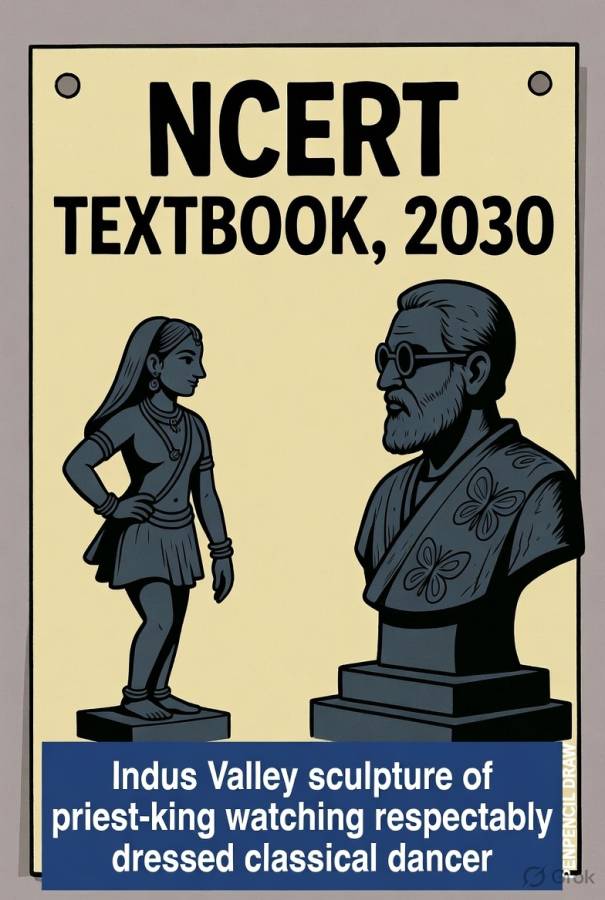
The withdrawal of NCERT's altered Dancing Girl image has reignited a larger debate: should ancient art be preserved as it is, or modified for modern sensibilities?
Why the controversy over NCERT's depiction of an Indus Valley icon became a debate about authenticity, history and cultural confidence
The Dancing Girl of Mohenjo-daro has survived for nearly 4,500 years.
Empires rose and fell. Religions emerged and evolved. Languages transformed. Civilizations disappeared. Yet the tiny bronze figurine endured, carrying with her a glimpse of one of the world's earliest urban societies.
What she did not survive, at least briefly, was a modern attempt at improvement.
Recent criticism erupted after an NCERT publication depicted the iconic Indus Valley artefact with added clothing and embellishments that were not part of the original sculpture. Historians, archaeologists, artists and commentators questioned why an ancient artefact needed to be visually modified at all. The backlash was swift enough that NCERT eventually withdrew the publication, turning what may have appeared to be a minor design decision into a national conversation about historical authenticity.
The controversy was never really about clothing.
It was about whether contemporary institutions have the right to "correct" the past.
The original Dancing Girl is one of the most celebrated discoveries from Mohenjo-daro. Standing just over ten centimetres tall, she is remarkable not because of what she wears, but because of what she represents. Her posture conveys confidence. Her expression suggests individuality. She appears neither submissive nor ceremonial. She simply exists as she was created by an artist more than four millennia ago.
That authenticity is precisely what gives the artefact its value.
Archaeological objects are not illustrations waiting for updates. They are historical records. Every feature—the ornaments, posture, proportions and artistic choices—provides clues about the culture that produced them. Altering those features, even with good intentions, risks replacing evidence with interpretation.
The reaction from historians was therefore unsurprising. If a modern institution can add clothing to an ancient sculpture because it appears more culturally acceptable, where does the process stop? Do we redraw cave paintings? Modify temple sculptures? Retouch murals? Reconstruct ancient figures according to present-day standards of respectability?
History quickly becomes something manufactured rather than something studied.
The episode also reveals an uncomfortable contradiction. India rightly takes pride in its civilizational heritage. From the cities of the Indus Valley to the temples of later centuries, the country's archaeological legacy is celebrated as evidence of a rich and continuous cultural tradition.
Yet genuine confidence in that heritage requires accepting it as it is, not as we wish it had been.
Ancient societies were often different from modern ones. Their artistic conventions, social norms and aesthetic sensibilities cannot always be neatly aligned with contemporary expectations. That is precisely why historical artefacts are valuable. They remind us that the past was not a mirror of the present.
The widespread criticism across newspapers, academic circles and social media reflected a simple principle: preservation should not become beautification.
When museums display artefacts, they do not repaint them to suit modern tastes. When archaeologists document discoveries, they do not alter them to avoid controversy. The responsibility of educational institutions should be no different. Their role is to explain, contextualize and educate—not to improve upon history.
Ironically, the Dancing Girl has captivated generations precisely because she feels so authentic. She does not appear designed to satisfy modern expectations. She appears real.
That authenticity has carried her through 4,500 years.
It deserves to survive a few textbook committees as well.
The withdrawal of the publication may have ended the immediate controversy, but the larger question remains. How should a civilization engage with its past? By preserving it faithfully, or by reshaping it until it feels comfortable?
The answer should be obvious.
History does not need beautification.
It needs understanding.
Why the controversy over NCERT's depiction of an Indus Valley icon became a debate about authenticity, history and cultural confidence
The Dancing Girl of Mohenjo-daro has survived for nearly 4,500 years.
Empires rose and fell. Religions emerged and evolved. Languages transformed. Civilizations disappeared. Yet the tiny bronze figurine endured, carrying with her a glimpse of one of the world's earliest urban societies.
What she did not survive, at least briefly, was a modern attempt at improvement.
Recent criticism erupted after an NCERT publication depicted the iconic Indus Valley artefact with added clothing and embellishments that were not part of the original sculpture. Historians, archaeologists, artists and commentators questioned why an ancient artefact needed to be visually modified at all. The backlash was swift enough that NCERT eventually withdrew the publication, turning what may have appeared to be a minor design decision into a national conversation about historical authenticity.
The controversy was never really about clothing.
It was about whether contemporary institutions have the right to "correct" the past.
The original Dancing Girl is one of the most celebrated discoveries from Mohenjo-daro. Standing just over ten centimetres tall, she is remarkable not because of what she wears, but because of what she represents. Her posture conveys confidence. Her expression suggests individuality. She appears neither submissive nor ceremonial. She simply exists as she was created by an artist more than four millennia ago.
That authenticity is precisely what gives the artefact its value.
Archaeological objects are not illustrations waiting for updates. They are historical records. Every feature—the ornaments, posture, proportions and artistic choices—provides clues about the culture that produced them. Altering those features, even with good intentions, risks replacing evidence with interpretation.
The reaction from historians was therefore unsurprising. If a modern institution can add clothing to an ancient sculpture because it appears more culturally acceptable, where does the process stop? Do we redraw cave paintings? Modify temple sculptures? Retouch murals? Reconstruct ancient figures according to present-day standards of respectability?
History quickly becomes something manufactured rather than something studied.
The episode also reveals an uncomfortable contradiction. India rightly takes pride in its civilizational heritage. From the cities of the Indus Valley to the temples of later centuries, the country's archaeological legacy is celebrated as evidence of a rich and continuous cultural tradition.
Yet genuine confidence in that heritage requires accepting it as it is, not as we wish it had been.
Ancient societies were often different from modern ones. Their artistic conventions, social norms and aesthetic sensibilities cannot always be neatly aligned with contemporary expectations. That is precisely why historical artefacts are valuable. They remind us that the past was not a mirror of the present.
The widespread criticism across newspapers, academic circles and social media reflected a simple principle: preservation should not become beautification.
When museums display artefacts, they do not repaint them to suit modern tastes. When archaeologists document discoveries, they do not alter them to avoid controversy. The responsibility of educational institutions should be no different. Their role is to explain, contextualize and educate—not to improve upon history.
Ironically, the Dancing Girl has captivated generations precisely because she feels so authentic. She does not appear designed to satisfy modern expectations. She appears real.
That authenticity has carried her through 4,500 years.
It deserves to survive a few textbook committees as well.
The withdrawal of the publication may have ended the immediate controversy, but the larger question remains. How should a civilization engage with its past? By preserving it faithfully, or by reshaping it until it feels comfortable?
The answer should be obvious.
History does not need beautification.
It needs understanding.























Leave a Comment