
India's private sector has hit its weakest growth in four years. The numbers tell a story that deserves far more attention than it is getting.
New data released this week by S&P Global should have dominated the front pages of every major Indian newspaper. Instead, it barely registered a ripple in the din of prime-time nationalism and manufactured outrage cycles that pass for news on most channels today.
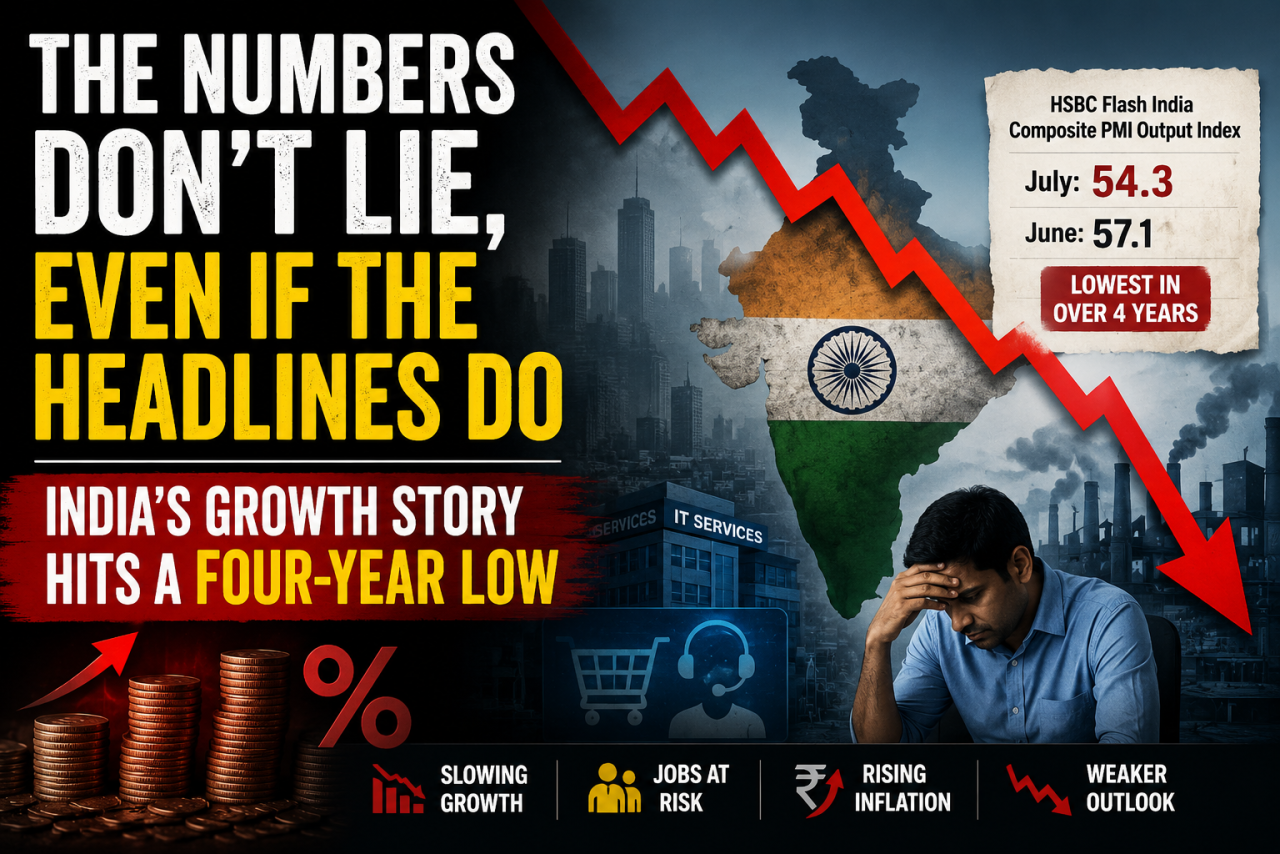
The HSBC Flash India Composite PMI Output Index, a key gauge of private sector activity spanning manufacturing and services, fell to 54.3 in July, down sharply from 57.1 in June. Strip away the jargon and the message is stark. India's private sector is expanding at its slowest pace in more than four years, matching lows last seen in March 2022 during the pandemic-era recovery. This is not a minor statistical wobble. It is a sustained loss of momentum in the engine room of the economy, and it deserves scrutiny, not silence.
Services, the Real Growth Story, Is Cracking
For years now, India's growth narrative has leaned heavily on its services sector, including IT, finance, consulting and retail, as the sector that could carry the economy while manufacturing struggled to find its footing. That crutch is now buckling.
The HSBC Flash India Services PMI Business Activity Index fell from 57.4 in June to just 53.1 in July, marking the weakest pace of expansion in 13 months. New business growth in services slowed to its weakest pace in close to four-and-a-half years.
This matters enormously because services employ a disproportionate share of India's urban middle class, the very constituency the ruling establishment likes to showcase as beneficiaries of its economic management. When the sector that generates white-collar jobs and consumer spending starts sputtering, it is not an abstract data point. It is fewer job offers, slower wage growth and tighter household budgets, the kind of everyday reality that rarely makes it onto a news debate about temple disputes or opposition "conspiracies."
Manufacturing's Modest Gains Don't Offset the Damage
To be fair, manufacturing did show some improvement, with its output index rising to 57.0 from 56.3. But even this needs context. Firms across both sectors cited increasingly difficult market conditions, competitive pressures, order cancellations, weaker client enquiries and raw material shortages as reasons for caution.
The overall Manufacturing PMI itself slipped to 53.9 from 54.2, signalling a below-trend improvement in factory conditions, hardly the robust "Make in India" turnaround that government messaging would have citizens believe.
Inflation Pressures Add to the Squeeze
The report also flags intensifying inflationary pressures, a detail that ought to worry anyone tracking household budgets, especially with festive season spending around the corner.
Rising input costs combined with slowing new business growth is a combination that historically precedes either price hikes passed on to consumers or margin compression that eventually shows up as layoffs and hiring freezes.
Geopolitics as Convenient Cover
Pranjul Bhandari, HSBC's chief India economist, pointed to renewed tensions in the Middle East as a factor pushing firms to build inventory buffers against supply-side uncertainty.
This is a legitimate global factor, but it is also, conveniently, an external scapegoat that domestic economic managers can lean on rather than confront structural weaknesses at home, including sluggish rural demand, uneven job creation and a private investment cycle that has been promised as "around the corner" for years.
Employment Growth: Modest, Not Miraculous
Yes, employment rose for the seventh consecutive month in July, and the pace of job creation did strengthen from June. But the report itself describes this growth as "modest," with services firms hiring faster than manufacturers. This again reinforces that the sector now under the most strain is also the one doing the heavier lifting on jobs.
Meanwhile, outstanding business volumes declined at the composite level for the first time in three months, even as unfinished work piled up for manufacturers, a sign of capacity strain rather than a booming order pipeline.
Why This Deserves the Front Page
None of this is manufactured pessimism. It comes directly from S&P Global's own Flash PMI survey, released through Hindustan Times' reporting on Friday.
It should be examined, debated and explained to citizens who are told daily that India is the world's fastest-growing large economy and an unstoppable growth story. Fastest-growing compared to what baseline, and at what cost to the ordinary wage-earner, are questions that deserve national attention, not relegation to a business-page footnote while television anchors spend prime time manufacturing outrage over irrelevant distractions.
A four-year low in private sector growth is news. Citizens deserve to know it, understand it and ask their elected representatives what they intend to do about it.
New data released this week by S&P Global should have dominated the front pages of every major Indian newspaper. Instead, it barely registered a ripple in the din of prime-time nationalism and manufactured outrage cycles that pass for news on most channels today.
The HSBC Flash India Composite PMI Output Index, a key gauge of private sector activity spanning manufacturing and services, fell to 54.3 in July, down sharply from 57.1 in June. Strip away the jargon and the message is stark. India's private sector is expanding at its slowest pace in more than four years, matching lows last seen in March 2022 during the pandemic-era recovery. This is not a minor statistical wobble. It is a sustained loss of momentum in the engine room of the economy, and it deserves scrutiny, not silence.
Services, the Real Growth Story, Is Cracking
For years now, India's growth narrative has leaned heavily on its services sector, including IT, finance, consulting and retail, as the sector that could carry the economy while manufacturing struggled to find its footing. That crutch is now buckling.
The HSBC Flash India Services PMI Business Activity Index fell from 57.4 in June to just 53.1 in July, marking the weakest pace of expansion in 13 months. New business growth in services slowed to its weakest pace in close to four-and-a-half years.
This matters enormously because services employ a disproportionate share of India's urban middle class, the very constituency the ruling establishment likes to showcase as beneficiaries of its economic management. When the sector that generates white-collar jobs and consumer spending starts sputtering, it is not an abstract data point. It is fewer job offers, slower wage growth and tighter household budgets, the kind of everyday reality that rarely makes it onto a news debate about temple disputes or opposition "conspiracies."
Manufacturing's Modest Gains Don't Offset the Damage
To be fair, manufacturing did show some improvement, with its output index rising to 57.0 from 56.3. But even this needs context. Firms across both sectors cited increasingly difficult market conditions, competitive pressures, order cancellations, weaker client enquiries and raw material shortages as reasons for caution.
The overall Manufacturing PMI itself slipped to 53.9 from 54.2, signalling a below-trend improvement in factory conditions, hardly the robust "Make in India" turnaround that government messaging would have citizens believe.
Inflation Pressures Add to the Squeeze
The report also flags intensifying inflationary pressures, a detail that ought to worry anyone tracking household budgets, especially with festive season spending around the corner.
Rising input costs combined with slowing new business growth is a combination that historically precedes either price hikes passed on to consumers or margin compression that eventually shows up as layoffs and hiring freezes.
Geopolitics as Convenient Cover
Pranjul Bhandari, HSBC's chief India economist, pointed to renewed tensions in the Middle East as a factor pushing firms to build inventory buffers against supply-side uncertainty.
This is a legitimate global factor, but it is also, conveniently, an external scapegoat that domestic economic managers can lean on rather than confront structural weaknesses at home, including sluggish rural demand, uneven job creation and a private investment cycle that has been promised as "around the corner" for years.
Employment Growth: Modest, Not Miraculous
Yes, employment rose for the seventh consecutive month in July, and the pace of job creation did strengthen from June. But the report itself describes this growth as "modest," with services firms hiring faster than manufacturers. This again reinforces that the sector now under the most strain is also the one doing the heavier lifting on jobs.
Meanwhile, outstanding business volumes declined at the composite level for the first time in three months, even as unfinished work piled up for manufacturers, a sign of capacity strain rather than a booming order pipeline.
Why This Deserves the Front Page
None of this is manufactured pessimism. It comes directly from S&P Global's own Flash PMI survey, released through Hindustan Times' reporting on Friday.
It should be examined, debated and explained to citizens who are told daily that India is the world's fastest-growing large economy and an unstoppable growth story. Fastest-growing compared to what baseline, and at what cost to the ordinary wage-earner, are questions that deserve national attention, not relegation to a business-page footnote while television anchors spend prime time manufacturing outrage over irrelevant distractions.
A four-year low in private sector growth is news. Citizens deserve to know it, understand it and ask their elected representatives what they intend to do about it.






















Leave a Comment