
Is India’s idea of progress being shaped more by development and opportunity, or by religion and identity? It debate and asks what a truly developed India should prioritize.
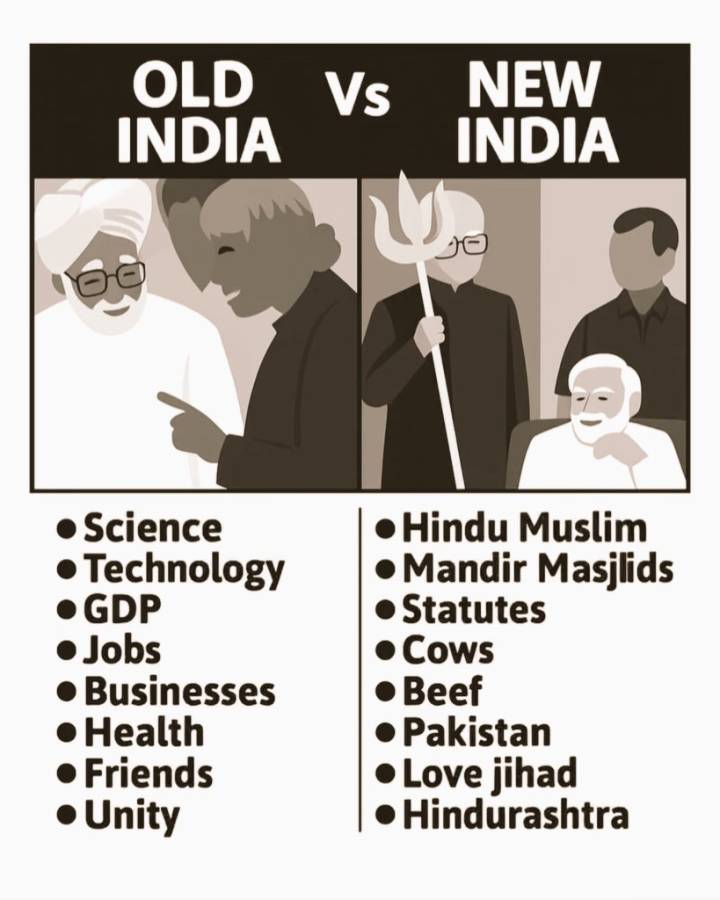
A widely circulated illustration presents a sharp contrast between an “Old India” and a “New India”. On one side, the focus is shown as science, technology, GDP, jobs, businesses, health, friendship and unity. On the other, the image lists Hindu-Muslim issues, temples and mosques, statues, cows, beef, Pakistan, “love jihad” and “Hindurashtra”. The illustration is clearly political and provocative, but its deeper question deserves serious attention. What should be the real priorities of a modern India?
India has changed enormously over the decades. The country has become a major technology centre, built world-class institutions, expanded its infrastructure and developed a strong presence in global affairs. Millions of Indians have benefited from better roads, digital services, greater access to education and new economic opportunities.
Yet development cannot be measured only by impressive projects or economic statistics. It must also be measured by the quality of everyday life. Can young people find stable and meaningful employment? Can a poor family afford good healthcare? Can students receive quality education regardless of their background? Can small businesses survive rising costs and competition? Can farmers earn a secure income?
These questions remain as important as any political slogan.
The illustration also points to another reality of contemporary India. Religion and identity have become central subjects in public debate. Hindu-Muslim relations, temples and mosques, cows, beef, Pakistan and allegations such as “love jihad” often receive enormous political and media attention. These issues cannot simply be wished away. Religious freedom, communal harmony and the protection of citizens' rights are important matters in any democracy.
The problem begins when identity becomes more important than citizenship.
India is a country of extraordinary diversity. Hindus, Muslims, Christians, Sikhs, Buddhists, Jains and people of many other beliefs have lived here for centuries. They speak different languages, follow different traditions and celebrate different festivals. The Constitution does not ask citizens to erase these differences. Instead, it promises equality before the law and freedom of religion.
A healthy democracy should therefore allow debates about faith and culture while ensuring that such debates do not turn citizens against one another.
There is another important point that the illustration misses. India has never been a simple story of “old” versus “new”. The past had serious weaknesses, including poverty, unemployment, social discrimination and inadequate infrastructure. The present has brought major achievements, but it also faces serious challenges. Technology has advanced, yet millions still struggle to obtain secure work. The economy has expanded, yet inequality remains a concern. India has built modern cities, yet many villages continue to face basic problems.
The real debate, therefore, should not be about whether India belongs to the past or the present. It should be about what kind of future India wants.
A country of 1.4 billion people cannot afford to choose between development and social harmony. It needs both. Economic growth without social peace can create frustration and instability. Social harmony without economic opportunity can leave young people without hope.
The same principle applies to politics. Governments must certainly address questions of national security, cultural heritage and religious concerns. But these should not permanently push bread-and-butter issues out of public discussion. Elections may be won through powerful emotional narratives, but nations progress through schools, hospitals, research laboratories, productive businesses, skilled workers and strong institutions.
India's young population makes this especially important. Young Indians need jobs, not just speeches about jobs. They need affordable education, not merely promises of a better future. Entrepreneurs need predictable rules and access to finance. Scientists need freedom to experiment. Citizens need confidence that the law will treat them equally.
Political disagreements are natural in a democracy. What should concern us is when disagreement becomes permanent hostility.
The image may be deliberately one-sided, and it would be unfair to judge an entire country through a single political cartoon. Yet its central warning is worth considering. A nation's attention is also a national resource. What we repeatedly debate, celebrate and fear shapes our political priorities.
India does not have to choose between faith and science, tradition and technology, national pride and economic growth. A confident nation can accommodate all of them.
The real measure of a “New India” should be simple. Are its citizens healthier, better educated, more secure, more prosperous and more united than before?
If the answer is yes, India is moving forward. If political divisions begin to overshadow these goals, then the country must pause and ask itself what progress really means.
A widely circulated illustration presents a sharp contrast between an “Old India” and a “New India”. On one side, the focus is shown as science, technology, GDP, jobs, businesses, health, friendship and unity. On the other, the image lists Hindu-Muslim issues, temples and mosques, statues, cows, beef, Pakistan, “love jihad” and “Hindurashtra”. The illustration is clearly political and provocative, but its deeper question deserves serious attention. What should be the real priorities of a modern India?
India has changed enormously over the decades. The country has become a major technology centre, built world-class institutions, expanded its infrastructure and developed a strong presence in global affairs. Millions of Indians have benefited from better roads, digital services, greater access to education and new economic opportunities.
Yet development cannot be measured only by impressive projects or economic statistics. It must also be measured by the quality of everyday life. Can young people find stable and meaningful employment? Can a poor family afford good healthcare? Can students receive quality education regardless of their background? Can small businesses survive rising costs and competition? Can farmers earn a secure income?
These questions remain as important as any political slogan.
The illustration also points to another reality of contemporary India. Religion and identity have become central subjects in public debate. Hindu-Muslim relations, temples and mosques, cows, beef, Pakistan and allegations such as “love jihad” often receive enormous political and media attention. These issues cannot simply be wished away. Religious freedom, communal harmony and the protection of citizens' rights are important matters in any democracy.
The problem begins when identity becomes more important than citizenship.
India is a country of extraordinary diversity. Hindus, Muslims, Christians, Sikhs, Buddhists, Jains and people of many other beliefs have lived here for centuries. They speak different languages, follow different traditions and celebrate different festivals. The Constitution does not ask citizens to erase these differences. Instead, it promises equality before the law and freedom of religion.
A healthy democracy should therefore allow debates about faith and culture while ensuring that such debates do not turn citizens against one another.
There is another important point that the illustration misses. India has never been a simple story of “old” versus “new”. The past had serious weaknesses, including poverty, unemployment, social discrimination and inadequate infrastructure. The present has brought major achievements, but it also faces serious challenges. Technology has advanced, yet millions still struggle to obtain secure work. The economy has expanded, yet inequality remains a concern. India has built modern cities, yet many villages continue to face basic problems.
The real debate, therefore, should not be about whether India belongs to the past or the present. It should be about what kind of future India wants.
A country of 1.4 billion people cannot afford to choose between development and social harmony. It needs both. Economic growth without social peace can create frustration and instability. Social harmony without economic opportunity can leave young people without hope.
The same principle applies to politics. Governments must certainly address questions of national security, cultural heritage and religious concerns. But these should not permanently push bread-and-butter issues out of public discussion. Elections may be won through powerful emotional narratives, but nations progress through schools, hospitals, research laboratories, productive businesses, skilled workers and strong institutions.
India's young population makes this especially important. Young Indians need jobs, not just speeches about jobs. They need affordable education, not merely promises of a better future. Entrepreneurs need predictable rules and access to finance. Scientists need freedom to experiment. Citizens need confidence that the law will treat them equally.
Political disagreements are natural in a democracy. What should concern us is when disagreement becomes permanent hostility.
The image may be deliberately one-sided, and it would be unfair to judge an entire country through a single political cartoon. Yet its central warning is worth considering. A nation's attention is also a national resource. What we repeatedly debate, celebrate and fear shapes our political priorities.
India does not have to choose between faith and science, tradition and technology, national pride and economic growth. A confident nation can accommodate all of them.
The real measure of a “New India” should be simple. Are its citizens healthier, better educated, more secure, more prosperous and more united than before?
If the answer is yes, India is moving forward. If political divisions begin to overshadow these goals, then the country must pause and ask itself what progress really means.











Leave a Comment