
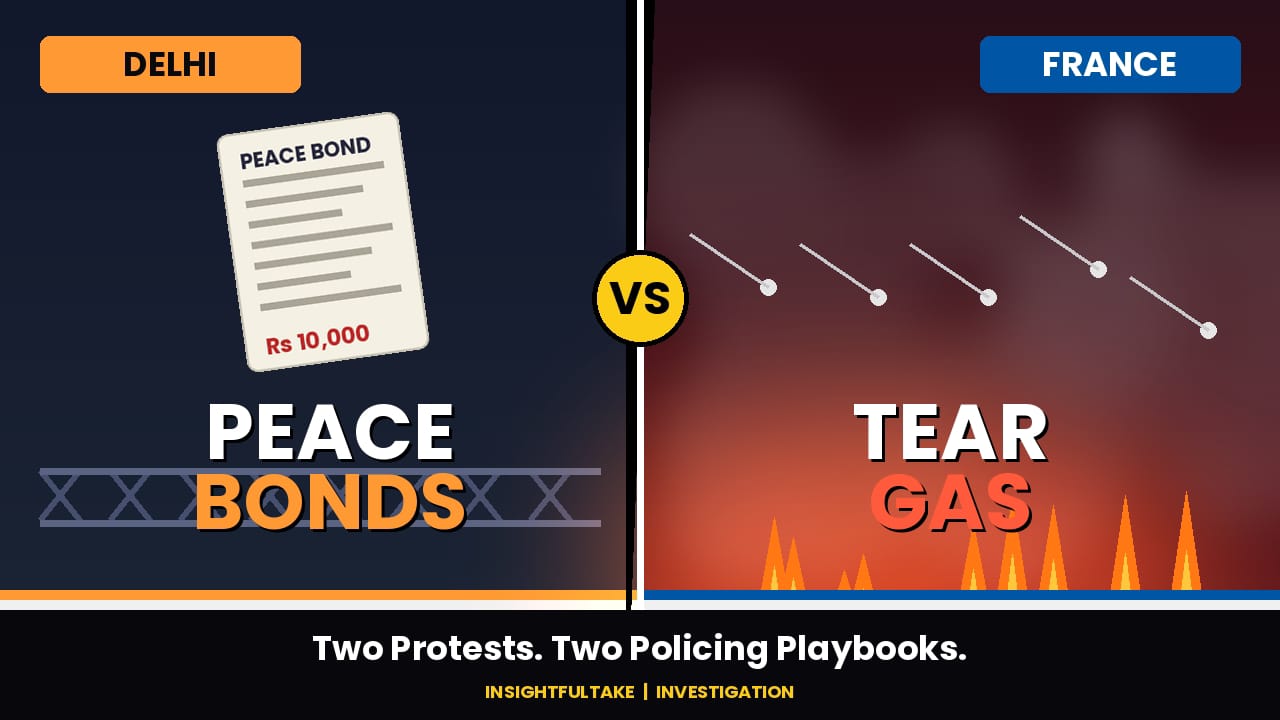
Delhi relied on detentions and peace bonds, while France faced mass unrest and police violence. Both cases raise questions about the right to protest in a democracy.
Within 24 hours of each other, a flag march in Delhi and a nationwide mobilisation in France exposed two sharply different approaches to public dissent. Delhi relied on preventive detentions, legal notices and peace bonds. France faced mass street demonstrations, clashes and an extensive police response after protests escalated into violence.
On the evening of October 16, Delhi Police detained All India Students’ Association (AISA) president Neha Bora at Mandi House as she marched towards Connaught Place. The Cockroach Janta Party (CJP) had called the “Lehra Do Tiranga” rally. Around the same period, hundreds of thousands of people took to the streets across France, where demonstrations linked to student grievances and wider economic discontent escalated into clashes and arson in several cities.
Both episodes placed the police at the centre of a debate about the limits of dissent in a democracy. But the nature of the protests, the methods used by the authorities and the questions of accountability differed considerably.
Two Very Different Grievances
The Delhi protest was rooted in electoral accountability and the right to demonstrate. The CJP has demanded the resignation of Chief Election Commissioner Gyanesh Kumar over alleged irregularities in the Special Intensive Revision (SIR) of electoral rolls. It has also sought the restoration of Jantar Mantar as a designated protest venue.
The “Lehra Do Tiranga” rally was intended as a symbolic demonstration, with participants carrying the national flag. According to reports, police expressed concern about a possible breach of peace.
France's unrest began with school students raising concerns about teacher shortages, overcrowded classrooms, deteriorating school buildings and stress associated with the Parcoursup university admissions platform. The protests subsequently broadened, drawing support from trade unions and groups associated with the Yellow Vests movement, which has long highlighted the pressures of living costs and economic inequality.
French Interior Minister Laurent Nuñez said 110 marches drew approximately 550,000 people on October 17. Organisers put the turnout at around 800,000.
The distinction matters. The Delhi rally was organised around specific political and institutional demands, while the French mobilisation grew from education-related grievances into a wider protest over economic conditions.
Delhi's Playbook: Pre-emption and Paperwork
In Delhi, the police response relied largely on preventive action and administrative restrictions.
Hours before the rally was scheduled to begin at 5 pm, police served CJP founder Abhijeet Dipke with a notice prohibiting the march. The New Delhi Municipal Council also closed Central Park for two days. Dipke and Bora were detained before the planned demonstration could proceed. Reports said more than 100 protesters were detained, with some accounts putting the number at around 150.
The subsequent proceedings brought preventive legal measures into focus.
Dipke was released the following day after executing a peace bond undertaking to maintain peace for a year. Bora was held for approximately 12 hours and released under Section 65 of the Delhi Police Act. A day later, she received a separate notice under the Bharatiya Nagarik Suraksha Sanhita (BNSS), requiring her to furnish a personal bond of ₹10,000 with one surety.
Bora has challenged the notice before the Delhi High Court.
The position of two other CJP convenors, Saurav Das and Ashutosh Ranka, has been more serious. They were remanded to judicial custody after entering Jantar Mantar on October 13, a day after its status as a designated protest venue was withdrawn.
The CJP has alleged that officials repeatedly rejected their surety documents, delaying their release. Police, however, have described the paperwork as defective. These competing accounts remain important to the wider question of how preventive legal procedures are applied to protest organisers.
Police also registered multiple first information reports (FIRs) and acted against at least 17 social media accounts over content they described as misleading or abusive.
Physical confrontation was not the defining feature of the Delhi episode. Reports described minor scuffles and the use of whistles by police to disperse crowds. The pressure instead came through detention, legal notices, bonds, sureties and scrutiny of online activity.
AISA has also alleged that plainclothes personnel followed Bora after her release. That allegation has not been publicly resolved.
France's Playbook: Mass Deployment and Force
France presented a different policing challenge. Rather than preventing the demonstrations from taking place, authorities faced the task of controlling large crowds after parts of the mobilisation escalated into violence.
The unrest brought serious damage and injuries. Reports described a fire at Limoges's historic town hall, burning cars in Paris and incidents of looting. Police unions warned that officers were reaching breaking point.
The scale of arrests and injuries varied across reports and stages of the unrest. Accounts cited more than 6,800 people taken into custody during the wider student protests, many of them minors. The BBC, citing the French Interior Ministry, reported approximately 2,400 arrests and around 1,000 injured officers during a weekend of demonstrations.
In Nantes, an officer died after being struck by a vehicle in an incident in which the motorist was reportedly unconnected to the protests.
The authorities responded with a substantial security deployment. Officials promised a “massive” police presence at subsequent demonstrations, while several cities imposed curfews. Nuñez said officers had been instructed to use the available intermediate weapons to bring the unrest under control.
These measures reflected the state's immediate challenge: protecting people and public property while restoring order. They also raised questions about whether the force used against demonstrators was necessary and proportionate, particularly when children were among those injured.
Who Is Held to Account?
The question of accountability is central to both cases, although it has taken different forms.
In France, allegations of police violence prompted scrutiny by the Inspectorate General of the National Police (IGPN), the body responsible for investigating misconduct within the national police. Reports of injuries to young demonstrators included a 15-year-old in Lens who lost a hand following the use of a police grenade, a 16-year-old in Tours who reportedly lost the use of an eye, and a 14-year-old who suffered a broken jaw.
The incidents triggered demands for independent scrutiny of police tactics and the use of force against minors.
Amnesty International criticised the response as disproportionate, while Human Rights Watch raised concerns about serious injuries to children. The UN Human Rights Office also called for de-escalation. The French government, however, rejected the broader charge of repression and maintained that the police response was proportionate in almost all cases.
These competing positions underline the need to distinguish between the legitimate responsibility to prevent violence and the obligation to investigate alleged misconduct.
In India, the legal test surrounding the Delhi detentions remains significant. Bora's challenge to the bond notice asks the courts to examine the legality of requiring such an undertaking after her release from detention.
AISA has argued that the notice violates Articles 19 and 21 of the Constitution, which protect freedoms including peaceful assembly and personal liberty. These are the petitioner's claims, not established judicial findings.
The treatment of Das and Ranka raises related questions about access to surety procedures and the practical consequences of restrictions on designated protest sites. The CJP's allegations about delays are disputed by the police, making judicial scrutiny particularly important.
Two Models, One Democratic Question
The comparison is not simply between a restrained Indian police force and a forceful French one. The two situations involved different grievances, crowd sizes, levels of violence and immediate security challenges. They cannot be treated as identical events.
Yet they reveal two ways in which the exercise of public dissent can become a test of democratic institutions.
In Delhi, the authorities acted before the planned march could proceed. The consequences for organisers and participants were felt through detentions, restrictions, legal notices and requirements to furnish bonds and sureties. The central question is whether these preventive measures were legally justified and proportionate to the risk posed by a peaceful demonstration.
In France, authorities confronted large-scale unrest that included arson, property damage and injuries. The police had a responsibility to protect the public, but the reported injuries to young people have also made the use of force a matter of urgent scrutiny.
Neither approach should escape examination. A democracy must be able to respond to genuine threats to public safety without treating dissent itself as a threat. It must also ensure that the power to detain, restrict assemblies or use force remains subject to legal safeguards and independent scrutiny.
The French protests placed the consequences of street-level policing in public view. Delhi's episode highlighted a less visible but equally important question: how preventive legal procedures affect the practical ability to organise and participate in peaceful demonstrations.
The ultimate measure of democratic policing is not whether a protest ends quietly or whether a crowd is dispersed. It is whether the state can maintain public order while protecting the constitutional right to dissent, and whether its actions can withstand independent legal scrutiny.
















Leave a Comment