
Gold is more than a family tradition or a wedding essential. For India's policymakers, it is also an economic pressure point. A move by the market regulator highlights how gold investments can become linked to the rupee's stability.
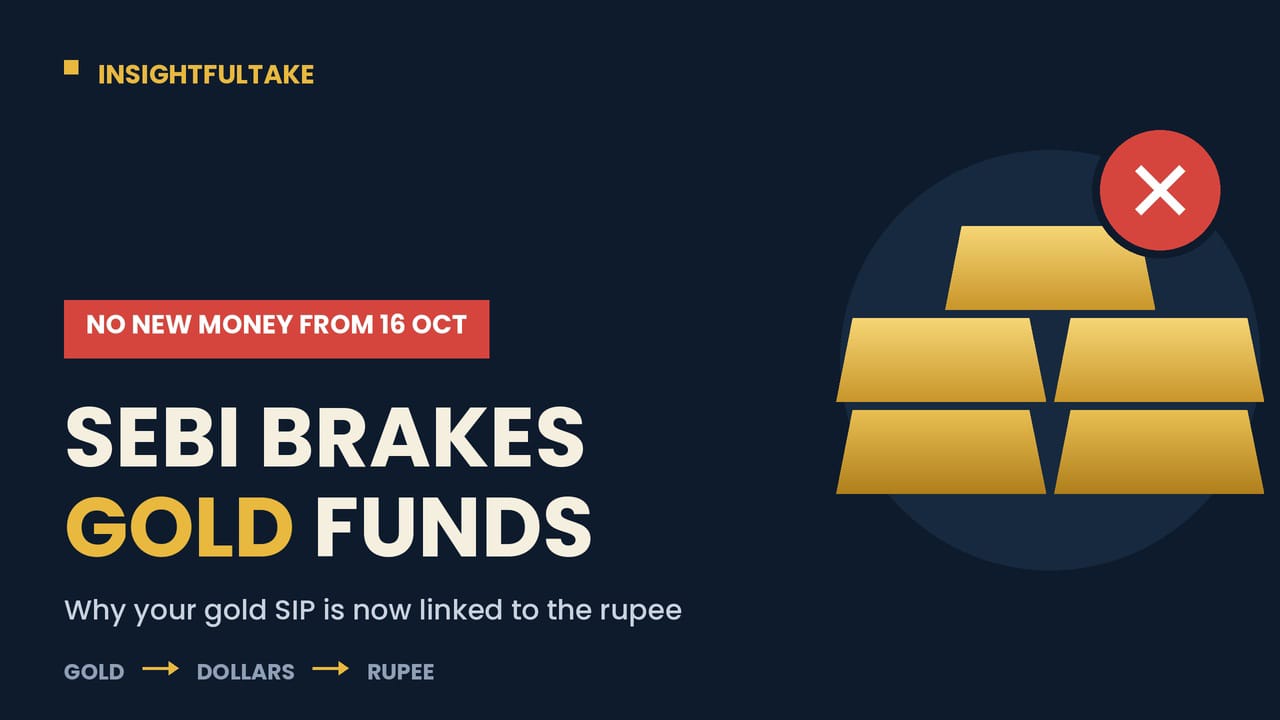
The Securities and Exchange Board of India (Sebi) has reportedly asked mutual funds to stop accepting fresh investments in gold fund-of-funds (FoFs) from 16 October, according to media report citing two industry officials.
The reported restrictions cover lump-sum investments, systematic investment plans (SIPs) and systematic transfer plans (STPs). Existing investments remain unaffected, and the curbs do not apply to gold exchange-traded funds (ETFs) purchased directly on stock exchanges.
The decision may appear to be a technical adjustment, but it raises a larger economic question. Can restricting one route for gold investments help ease pressure on India's currency?
What Exactly Are Gold Fund-of-Funds?
A gold ETF is an investment fund that tracks the price of gold and trades on a stock exchange like a share. Investors generally need a demat account to buy ETF units directly.
A gold FoF invests in gold ETFs on behalf of investors. This makes it more convenient for ordinary savers because they do not need a demat account and can start a small monthly SIP through a mutual fund platform.
The accessibility has helped gold FoFs attract investors who want exposure to gold without purchasing physical jewellery, bars or coins.
However, the reported restrictions would limit fresh investments through this route while leaving direct purchases of gold ETFs available.
Why Would a Regulator Care About Gold Investments?
The answer lies partly in India's dependence on gold imports and the pressure these imports can place on the rupee.
India produces relatively little gold domestically and imports much of the gold it consumes. These purchases require foreign currency, primarily US dollars. When import demand rises, more money flows out of the country to pay overseas suppliers.
Higher imports can widen India's trade deficit and contribute to a larger current account deficit, which measures the country's transactions with the rest of the world, including trade in goods and services and income flows. A widening deficit can put downward pressure on the rupee, particularly when foreign investment inflows are weak.
According to media report, the rupee has faced repeated record lows this year. Restricting fresh investments in gold FoFs could reduce the need for fund houses to purchase additional gold to support new fund units.
The intended economic effect, if this is indeed the motivation, would be to moderate one source of gold demand and potentially ease pressure on imports.
The Numbers Behind the Story
The figures cited in the report highlight the changing trends in India's gold market.
- Gold imports declined: Imports fell 27.3% to $19.27 billion during April-September, compared with $26.51 billion in the corresponding period a year earlier.
- September saw a sharp fall: Gold imports stood at $1.80 billion in September, compared with $9.61 billion in September of the previous year.
- Gold ETFs attracted substantial investment: Net inflows into gold ETFs reached ₹45,951 crore in the year to September. January alone accounted for ₹24,039 crore, the largest monthly contribution.
- FoFs represent a smaller share: According to the report, gold ETFs account for approximately 66% of the industry's gold assets, while gold funds account for the remaining 34%. The reported restrictions affect the latter category.
Gold prices have also experienced considerable volatility. According to the report, spot gold on the Multi Commodity Exchange (MCX) rose by around 20% during the first quarter before retreating. Prices were subsequently about 8% below that peak.
These figures illustrate why gold has become an important investment choice for Indian savers, even as policymakers remain concerned about the economic implications of import demand.
Not the First Attempt to Discourage Gold Buying
The reported restrictions follow earlier efforts to moderate gold investments.
In June, large fund houses reportedly introduced limits on high-value investments in gold ETFs and FoFs, with restrictions generally applying to investments of ₹10 lakh or more. These measures followed Prime Minister Narendra Modi's appeal to Indians to reduce gold purchases and help protect the rupee.
Such appeals reflect a longstanding policy concern. Gold is deeply embedded in Indian household savings, religious customs, weddings and festivals. Reducing demand, therefore, is not simply a financial decision. It also involves habits and traditions that have developed over generations.
The challenge for policymakers is to influence investment behaviour without unnecessarily restricting ordinary savers or disrupting the functioning of financial markets.
Will the Restrictions Work?
The effectiveness of the move remains uncertain.
Investors can still purchase gold ETFs directly through stock exchanges, provided they have the necessary demat arrangements. The restrictions therefore close one convenient investment route rather than eliminate access to financial gold.
Physical gold purchases also remain outside the direct scope of these mutual fund restrictions. Jewellery, bars and coins account for a substantial part of India's gold demand, meaning that a measure focused on FoFs cannot independently control the country's overall gold imports.
The impact may nevertheless be noticeable within the mutual fund industry. Experts said that stopping SIP inflows could affect a substantial portion of the money entering these funds.
There is also a potential market risk. If fresh ETF units cannot be created in sufficient quantities while demand for existing units remains strong, ETF prices could trade at a premium to their underlying net asset value. Investors buying at such a premium could end up paying more than the value of the gold exposure they receive.
The broader question is whether restricting one investment channel can meaningfully reduce import demand when other routes remain open. The answer will depend on investor behaviour, gold prices, physical demand and the wider movement of capital into and out of India.
What Does This Mean for Investors?
For investors who already hold gold FoFs, the reported restrictions do not require any immediate change to their existing holdings.
Those planning to start a gold SIP through a FoF may need to consider other available investment routes. Direct gold ETFs remain an option for investors with demat accounts, subject to the applicable product and market conditions.
Before investing, however, it is important to compare costs, liquidity, tracking differences and the price of ETF units relative to their underlying value. Gold prices can rise sharply, but they can also fall. Recent volatility is a reminder that gold is not a guaranteed or one-way investment.
Investors should also distinguish between owning gold as a portfolio diversifier and buying it in the expectation of short-term gains. The appropriate allocation depends on individual financial goals, risk tolerance and investment horizon.
A Small Investment Decision With Larger Economic Connections
The reported restrictions highlight the connection between household savings, financial markets, international trade and currency stability.
A monthly SIP may seem like a personal financial decision. But when millions of investors make similar choices, their collective demand can influence the flow of money into different assets. In the case of gold, that demand can also intersect with India's import bill and foreign currency requirements.
Whether the curbs will materially strengthen the rupee remains to be seen. Their impact is likely to be limited if physical gold demand and purchases through other financial channels remain strong.
For now, the move serves as a reminder that decisions made by individual investors can have implications beyond their own portfolios. For policymakers, the challenge is to balance investor choice, financial market stability and the country's broader economic interests.
























Leave a Comment