
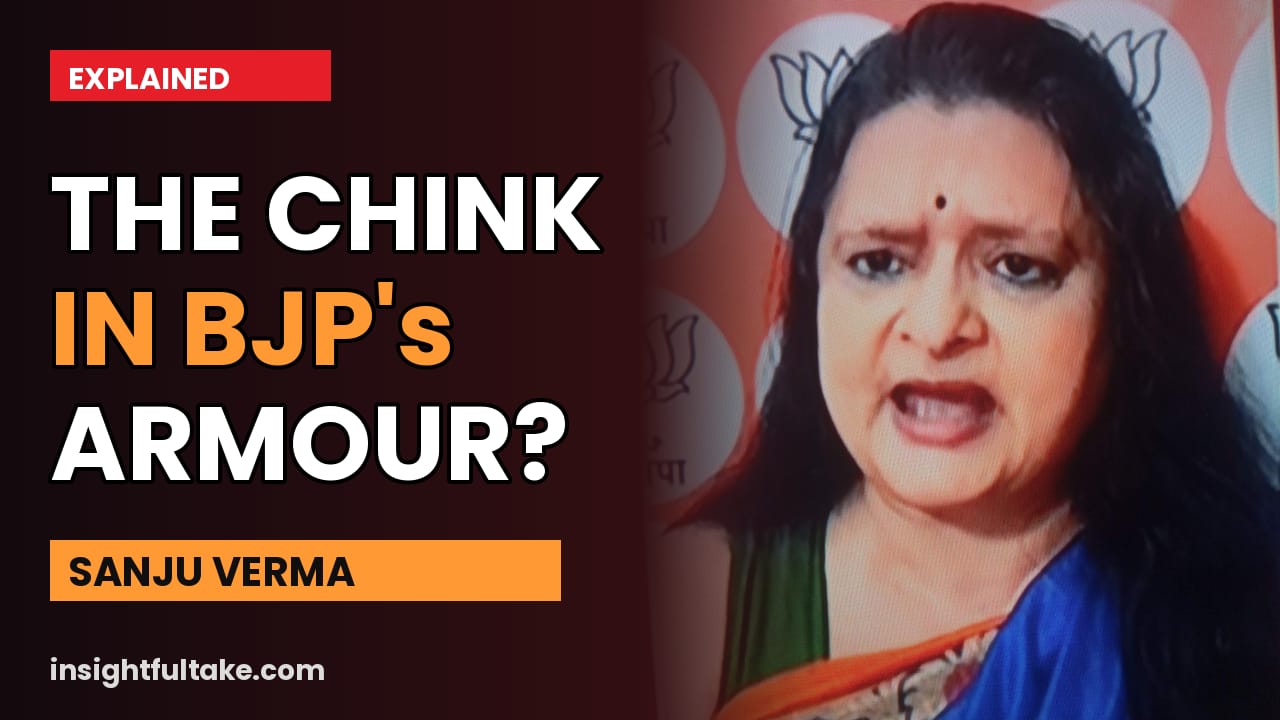
When shouting replaces answers, political debate becomes a spectacle, and public accountability takes a back seat.
There was a time when a television debate meant two people disagreeing, listening to each other, and occasionally conceding a point. That quaint era ended roughly twelve years ago. Indian prime time then discovered a more efficient format: one microphone, several panelists, and a designated person whose job is to make sure nobody else is heard.
Leading this revolution are the BJP’s spokespersons, the party’s most visible foot soldiers on television. They fight tirelessly on the party’s behalf, often appearing determined to win the argument before the question is even finished.
The Bull, the Shop, and the Broken Crockery
Take Sanju Verma, who has turned the phrase “bull in a China shop” from an idiom into a job description. A bull, at least, has the decency to look surprised by the wreckage. Her critics argue that her vocabulary on air has often strayed well beyond the boundaries of parliamentary language, with opposition panelists treated less as debate partners and more as obstacles to be flattened.
Parliament, you will recall, has a list of words it considers unfit for use. Prime time, mercifully for those who prefer the unfiltered version, has no such list.
Then there is Sambit Patra, whose approach to debate seems to suggest that indignation is a renewable resource. Why make a point once when you can make it at full volume six times while the other panelist is still mid-sentence? His critics would say he has mastered the art of looking offended by questions he finds inconvenient, a skill that takes years to develop and seconds to deploy.
And these are only the headliners. The supporting cast is deep, and the production values remain remarkably consistent.
The Playbook
Watch enough television debates and a pattern emerges, as reliable as a railway timetable is not.
Step one: Interrupt within the first ten seconds. Establish dominance early, like a cat claiming a new sofa.
Step two: Never answer the question. Instead, answer a different question from 1975, 1984, or whichever year happens to be most convenient. History is a wonderful thing. It is rarely asked to defend itself.
Step three: When facts appear, raise the volume. Facts are shy creatures and tend to retreat from loud noise.
Step four: If all else fails, reach for the “anti-national” label. It requires no evidence, travels well, and ends conversations far faster than any substantive rebuttal.
Step five: Hope the anchor nods along. A referee who forgets the whistle is a spokesperson’s best friend.
Of course, this is not a problem confined to one party. Opposition spokespersons can be equally combative, and some television anchors seem as invested in confrontation as the politicians sitting across from them. The format itself rewards interruptions, dramatic accusations, and viral sound bites. A calm, reasoned answer rarely competes with a spectacular shouting match for attention.
But understanding the incentives does not absolve those who exploit them. If political representatives repeatedly turn public debate into a contest of decibels, they help sustain a format that leaves viewers with more heat than light.
The Bill Comes Due
The curious thing is that this strategy is supposed to project strength. A party with a historic mandate, a formidable organisation, and a formidable electoral record should not need to shout to establish its authority.
Confidence can afford to be quiet. Shouting, by contrast, can create the impression that an argument cannot stand on its own.
Meanwhile, the viewer at home, the same voter the party courts so carefully at rallies, watches a spokesperson talk over a woman or a man struggling to finish a sentence. Many viewers come from households where interrupting elders earns a stern look. A party that frequently invokes culture and sanskaar risks sending a contradictory message when its most visible representatives demonstrate the opposite on television.
Twelve years of this spectacle have a cumulative effect. Each loud, abusive, whatabout-laden appearance may generate a clip for WhatsApp forwards, but it can also erode something harder to rebuild: the impression that a political party can face an uncomfortable question without taking offence.
There is a difference between defending a government and defending every government decision, between challenging an opponent and refusing to let one speak. A spokesperson who treats every question as an attack may energise loyal supporters, but the same performance can alienate viewers who expect answers rather than accusations.
The ultimate cost is not merely a decline in television civility. It is the weakening of public debate itself. When political representatives spend more time drowning out questions than answering them, citizens lose an opportunity to understand the policies, decisions, and failures that affect their lives.
A Modest Proposal
Perhaps it is time for a radical experiment: a debate in which a BJP spokesperson listens to the entire question, answers it directly, and allows the other person to respond.
The ratings might dip, but dignity might rise. The party might even discover that its policies can win an argument without a megaphone.
The same standard should apply to every party spokesperson and every television anchor. Political accountability cannot depend on who is shouting or whose side happens to be winning the argument.
Until then, the bulls will keep charging, the crockery will keep breaking, and the audience will keep wondering who is going to pay for the damage.
There was a time when a television debate meant two people disagreeing, listening to each other, and occasionally conceding a point. That quaint era ended roughly twelve years ago. Indian prime time then discovered a more efficient format: one microphone, several panelists, and a designated person whose job is to make sure nobody else is heard.
Leading this revolution are the BJP’s spokespersons, the party’s most visible foot soldiers on television. They fight tirelessly on the party’s behalf, often appearing determined to win the argument before the question is even finished.
The Bull, the Shop, and the Broken Crockery
Take Sanju Verma, who has turned the phrase “bull in a China shop” from an idiom into a job description. A bull, at least, has the decency to look surprised by the wreckage. Her critics argue that her vocabulary on air has often strayed well beyond the boundaries of parliamentary language, with opposition panelists treated less as debate partners and more as obstacles to be flattened.
Parliament, you will recall, has a list of words it considers unfit for use. Prime time, mercifully for those who prefer the unfiltered version, has no such list.
Then there is Sambit Patra, whose approach to debate seems to suggest that indignation is a renewable resource. Why make a point once when you can make it at full volume six times while the other panelist is still mid-sentence? His critics would say he has mastered the art of looking offended by questions he finds inconvenient, a skill that takes years to develop and seconds to deploy.
And these are only the headliners. The supporting cast is deep, and the production values remain remarkably consistent.
The Playbook
Watch enough television debates and a pattern emerges, as reliable as a railway timetable is not.
Step one: Interrupt within the first ten seconds. Establish dominance early, like a cat claiming a new sofa.
Step two: Never answer the question. Instead, answer a different question from 1975, 1984, or whichever year happens to be most convenient. History is a wonderful thing. It is rarely asked to defend itself.
Step three: When facts appear, raise the volume. Facts are shy creatures and tend to retreat from loud noise.
Step four: If all else fails, reach for the “anti-national” label. It requires no evidence, travels well, and ends conversations far faster than any substantive rebuttal.
Step five: Hope the anchor nods along. A referee who forgets the whistle is a spokesperson’s best friend.
Of course, this is not a problem confined to one party. Opposition spokespersons can be equally combative, and some television anchors seem as invested in confrontation as the politicians sitting across from them. The format itself rewards interruptions, dramatic accusations, and viral sound bites. A calm, reasoned answer rarely competes with a spectacular shouting match for attention.
But understanding the incentives does not absolve those who exploit them. If political representatives repeatedly turn public debate into a contest of decibels, they help sustain a format that leaves viewers with more heat than light.
The Bill Comes Due
The curious thing is that this strategy is supposed to project strength. A party with a historic mandate, a formidable organisation, and a formidable electoral record should not need to shout to establish its authority.
Confidence can afford to be quiet. Shouting, by contrast, can create the impression that an argument cannot stand on its own.
Meanwhile, the viewer at home, the same voter the party courts so carefully at rallies, watches a spokesperson talk over a woman or a man struggling to finish a sentence. Many viewers come from households where interrupting elders earns a stern look. A party that frequently invokes culture and sanskaar risks sending a contradictory message when its most visible representatives demonstrate the opposite on television.
Twelve years of this spectacle have a cumulative effect. Each loud, abusive, whatabout-laden appearance may generate a clip for WhatsApp forwards, but it can also erode something harder to rebuild: the impression that a political party can face an uncomfortable question without taking offence.
There is a difference between defending a government and defending every government decision, between challenging an opponent and refusing to let one speak. A spokesperson who treats every question as an attack may energise loyal supporters, but the same performance can alienate viewers who expect answers rather than accusations.
The ultimate cost is not merely a decline in television civility. It is the weakening of public debate itself. When political representatives spend more time drowning out questions than answering them, citizens lose an opportunity to understand the policies, decisions, and failures that affect their lives.
A Modest Proposal
Perhaps it is time for a radical experiment: a debate in which a BJP spokesperson listens to the entire question, answers it directly, and allows the other person to respond.
The ratings might dip, but dignity might rise. The party might even discover that its policies can win an argument without a megaphone.
The same standard should apply to every party spokesperson and every television anchor. Political accountability cannot depend on who is shouting or whose side happens to be winning the argument.
Until then, the bulls will keep charging, the crockery will keep breaking, and the audience will keep wondering who is going to pay for the damage.













Leave a Comment