
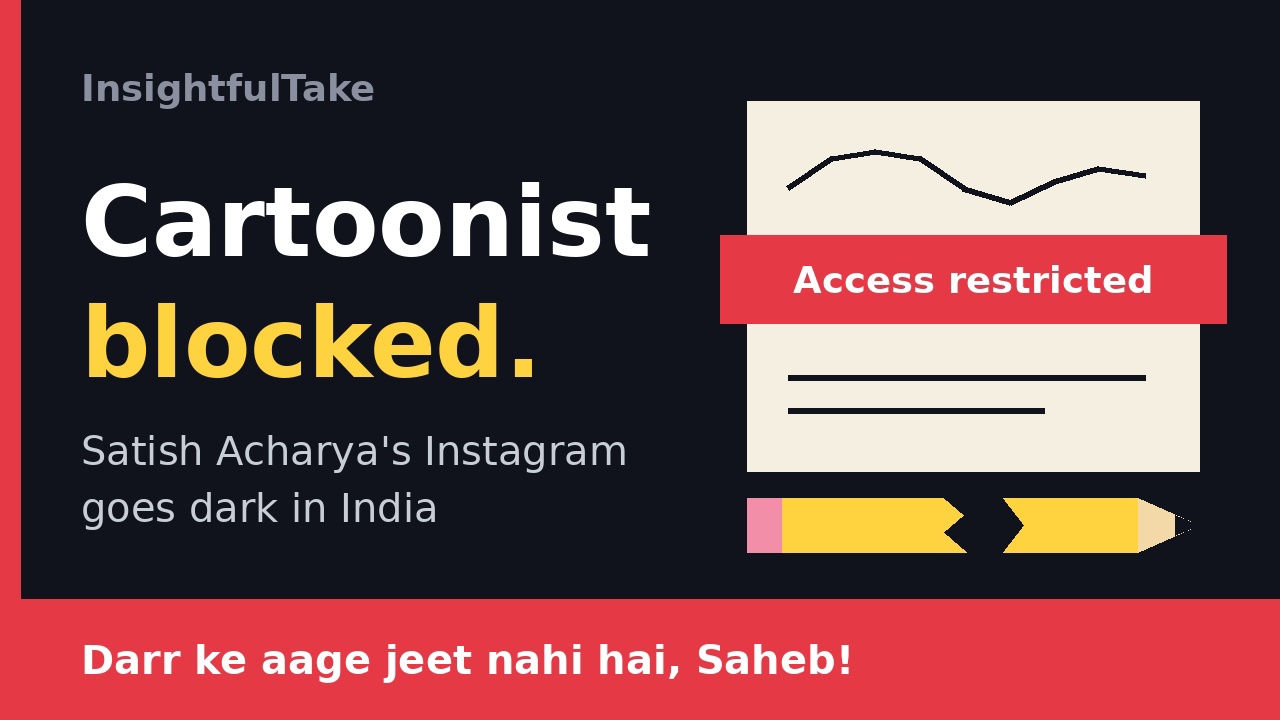
When a cartoonist’s account disappears without a clear public explanation, the bigger question is not just what was blocked, but why.
Satish Acharya’s Instagram account has been blocked in India since Monday, September 28. The lack of a clear explanation raises questions about transparency, free expression and the use of IT rules.
Satish Acharya’s Instagram account has been inaccessible in India since Monday, September 28.
Visitors to his page see a brief message saying access has been “temporarily restricted” under the legal requirements of the Information Technology (Intermediary Guidelines and Digital Media Ethics Code) Rules.
That is all.
No specific cartoon is identified. No rule is explained. No reason is provided that an ordinary citizen can read, question or challenge.
The cartoon that came under scrutiny
Before the account was blocked, some of Acharya’s cartoons had already faced restrictions.
One of them, published for South First, was critical of Prime Minister Narendra Modi and followed an Indian Express report concerning the Election Commission of India.
The sequence deserves public scrutiny.
A newspaper publishes a report concerning the country’s election body. A cartoonist responds with satire. The cartoon is restricted. Soon after, the cartoonist’s entire Instagram account becomes inaccessible in India.
The authorities may say these events are unrelated. But the timing naturally raises questions, and those questions deserve a clear answer.
Why are older cartoons being blocked now?
Another issue is the reported restriction of some cartoons from 2023.
That raises a straightforward question. If a particular cartoon violated a rule, why was action taken years later?
And if it was not considered objectionable then, what has changed now?
The answer should come from the authorities rather than from speculation. A restriction affecting an artist’s work needs a specific explanation, particularly when the material is old and the action is being taken today.
The problem with a “temporary” restriction
The word “temporarily” may sound limited. For a working cartoonist, however, losing access to an Instagram account can have an immediate impact.
An artist’s social-media account can function as a gallery, archive, publishing platform and direct connection with readers.
Whether the restriction lasts for days or weeks, the consequence is already felt.
There is also a broader concern. When the state restricts the work of a political cartoonist without publicly identifying the specific material and legal basis, other artists may reasonably wonder whether certain subjects are becoming riskier to address.
That is how censorship can operate without an outright ban. There may be no dramatic prohibition. There may simply be a notice, a legal reference and the disappearance of a voice.
Satire is meant to provoke
A cartoon is not a government document or a conventional news report. It uses exaggeration, irony and ridicule to comment on public life.
That is precisely why political cartooning has long occupied an important place in democratic societies.
A government can disagree with a cartoon. A politician can criticise it. A citizen can find it offensive or unfair.
But if a cartoon violates a specific law, the public should be told what law applies, which cartoon is at issue and why the restriction was considered necessary.
That transparency matters because legal restrictions on speech should be capable of public and judicial scrutiny.
Blocking first and explaining later leaves citizens with little basis on which to understand or challenge the decision.
Acharya’s response
Acharya responded on X with a pointed line:
“Darr ke aage jeet nahi hai, Saheb!”
The phrase plays on the familiar advertising slogan about overcoming fear.
His larger point is about the effect such restrictions can have beyond one artist.
If artists begin avoiding subjects because they fear account restrictions, editors become more cautious and young cartoonists choose safer themes, the impact extends beyond one Instagram page.
The government does not benefit from a public sphere in which criticism disappears without explanation. Nor does the public.
A democracy does not become stronger by making disagreement harder to see.
What should happen now?
Three things would provide greater clarity.
First, the authorities should identify the specific material considered objectionable and the legal provision under which action was taken.
Second, the restrictions should be reviewed transparently, including the reported action involving older cartoons.
Third, Meta should explain how it handles such government orders and whether it challenged, reviewed or otherwise assessed the restriction.
Until those questions are answered, the public is left with an account that has disappeared, a legal reference without a detailed explanation and a controversy that is larger than a single cartoon.
An artist’s page can be blocked.
The questions raised by the cartoon cannot be blocked so easily.
The real issue is not whether a government can silence a cartoonist. It is whether, in a democracy, it is willing to explain why it did so.
Satish Acharya’s Instagram account has been blocked in India since Monday, September 28. The lack of a clear explanation raises questions about transparency, free expression and the use of IT rules.
Satish Acharya’s Instagram account has been inaccessible in India since Monday, September 28.
Visitors to his page see a brief message saying access has been “temporarily restricted” under the legal requirements of the Information Technology (Intermediary Guidelines and Digital Media Ethics Code) Rules.
That is all.
No specific cartoon is identified. No rule is explained. No reason is provided that an ordinary citizen can read, question or challenge.
The cartoon that came under scrutiny
Before the account was blocked, some of Acharya’s cartoons had already faced restrictions.
One of them, published for South First, was critical of Prime Minister Narendra Modi and followed an Indian Express report concerning the Election Commission of India.
The sequence deserves public scrutiny.
A newspaper publishes a report concerning the country’s election body. A cartoonist responds with satire. The cartoon is restricted. Soon after, the cartoonist’s entire Instagram account becomes inaccessible in India.
The authorities may say these events are unrelated. But the timing naturally raises questions, and those questions deserve a clear answer.
Why are older cartoons being blocked now?
Another issue is the reported restriction of some cartoons from 2023.
That raises a straightforward question. If a particular cartoon violated a rule, why was action taken years later?
And if it was not considered objectionable then, what has changed now?
The answer should come from the authorities rather than from speculation. A restriction affecting an artist’s work needs a specific explanation, particularly when the material is old and the action is being taken today.
The problem with a “temporary” restriction
The word “temporarily” may sound limited. For a working cartoonist, however, losing access to an Instagram account can have an immediate impact.
An artist’s social-media account can function as a gallery, archive, publishing platform and direct connection with readers.
Whether the restriction lasts for days or weeks, the consequence is already felt.
There is also a broader concern. When the state restricts the work of a political cartoonist without publicly identifying the specific material and legal basis, other artists may reasonably wonder whether certain subjects are becoming riskier to address.
That is how censorship can operate without an outright ban. There may be no dramatic prohibition. There may simply be a notice, a legal reference and the disappearance of a voice.
Satire is meant to provoke
A cartoon is not a government document or a conventional news report. It uses exaggeration, irony and ridicule to comment on public life.
That is precisely why political cartooning has long occupied an important place in democratic societies.
A government can disagree with a cartoon. A politician can criticise it. A citizen can find it offensive or unfair.
But if a cartoon violates a specific law, the public should be told what law applies, which cartoon is at issue and why the restriction was considered necessary.
That transparency matters because legal restrictions on speech should be capable of public and judicial scrutiny.
Blocking first and explaining later leaves citizens with little basis on which to understand or challenge the decision.
Acharya’s response
Acharya responded on X with a pointed line:
“Darr ke aage jeet nahi hai, Saheb!”
The phrase plays on the familiar advertising slogan about overcoming fear.
His larger point is about the effect such restrictions can have beyond one artist.
If artists begin avoiding subjects because they fear account restrictions, editors become more cautious and young cartoonists choose safer themes, the impact extends beyond one Instagram page.
The government does not benefit from a public sphere in which criticism disappears without explanation. Nor does the public.
A democracy does not become stronger by making disagreement harder to see.
What should happen now?
Three things would provide greater clarity.
First, the authorities should identify the specific material considered objectionable and the legal provision under which action was taken.
Second, the restrictions should be reviewed transparently, including the reported action involving older cartoons.
Third, Meta should explain how it handles such government orders and whether it challenged, reviewed or otherwise assessed the restriction.
Until those questions are answered, the public is left with an account that has disappeared, a legal reference without a detailed explanation and a controversy that is larger than a single cartoon.
An artist’s page can be blocked.
The questions raised by the cartoon cannot be blocked so easily.
The real issue is not whether a government can silence a cartoonist. It is whether, in a democracy, it is willing to explain why it did so.








Leave a Comment