
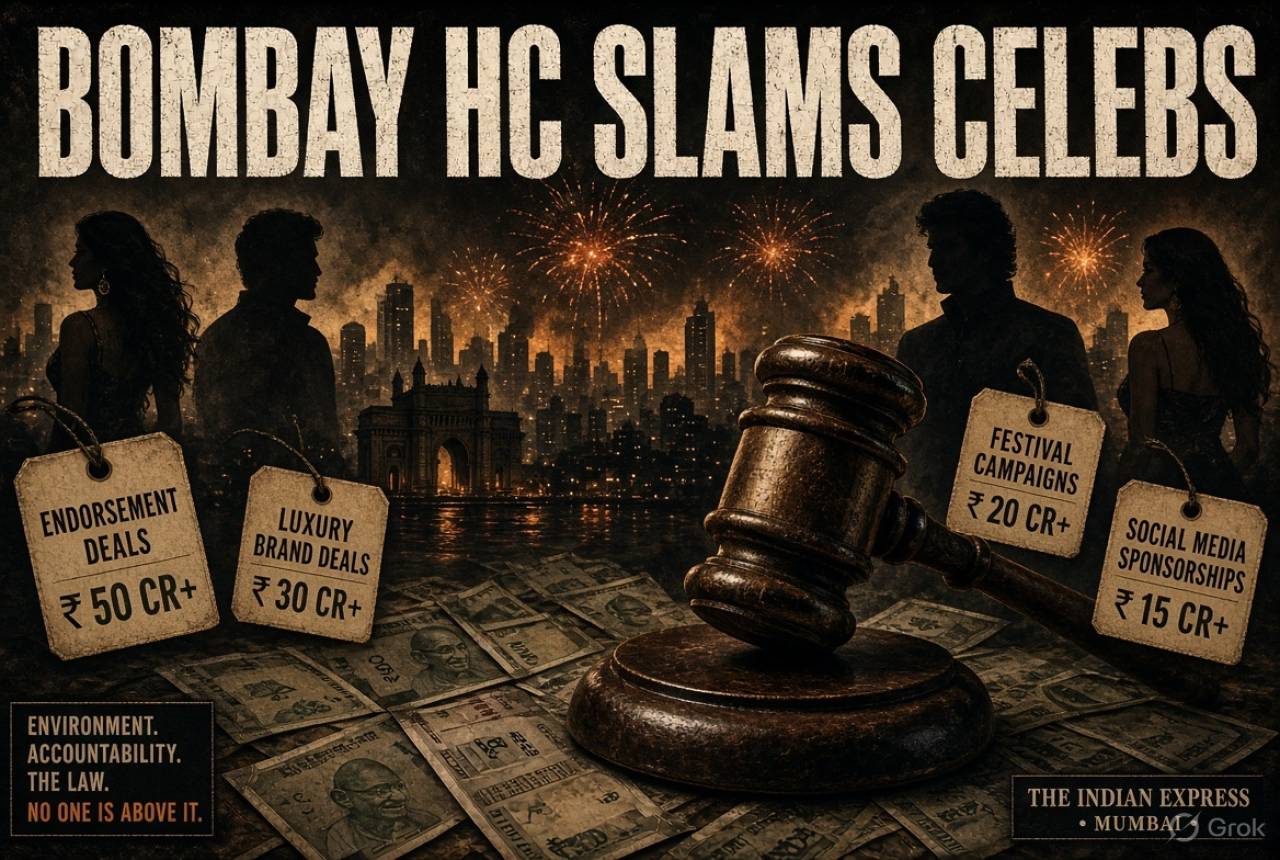
The Bombay High Court’s criticism of fee-based celebrity endorsements for an anti-firecracker campaign raises uncomfortable questions about civic responsibility, public trust and the commercialisation of social causes.
The Bombay High Court’s recent expression of displeasure over Bollywood’s reluctance to endorse the Maharashtra government’s anti-firecracker campaign free of charge has laid bare an uncomfortable truth about celebrity culture in India. At a hearing focused on curbing noise and air pollution during festive processions, Justice G.S. Kulkarni’s remarks were unusually direct: do not approach those who demand fees for supporting a cause that concerns their own city. If public figures are conscious only when compensated, the court made clear, society has little reason to seek their endorsement. The observation, delivered amid deteriorating air quality in Mumbai—where the Air Quality Index recently touched 322, placing the city in the “very poor” category—cuts to the heart of a larger question. What does it mean when those who command vast public attention treat civic responsibility as a commercial transaction?
Every Diwali, Indian cities grapple with spikes in particulate matter and noise levels that affect the most vulnerable—children, the elderly, patients with respiratory ailments, and animals. Governments periodically float awareness campaigns. This year, Maharashtra’s proposal sought celebrity participation to amplify the message against firecrackers. Additional Government Pleader Jyoti Chavan informed the court that most celebrities operate on fixed rates and do not work for free. The judicial response was pointed. Consciousness about one’s city, the bench suggested, cannot be outsourced to a rate card.
When Public Causes Become Commercial Opportunities
This is not merely about one campaign or one set of remarks. It reflects a structural shift in how public causes are mediated in contemporary India. Celebrities occupy a unique position in the national imagination. Their faces sell products, shape fashion, and influence voting behaviour. When they speak on environmental degradation, gender justice or public health, the reach is immediate. Yet the same platform is frequently monetised. Brand endorsements for fairness creams or soft drinks coexist, often without visible contradiction, with selective statements on pollution or climate. The anti-firecracker episode simply made the commercial logic explicit. Support is available—at a price.
The implications for public trust are significant. When advocacy is perceived as paid labour rather than voluntary civic engagement, its moral force weakens. Citizens already sceptical of institutional messaging may conclude that even the glamorous ambassadors of social causes operate within the same transactional framework that governs much of public life. The court’s caution against approaching fee-charging celebrities is, in this sense, an institutional recognition that authenticity matters. A campaign that relies on paid endorsements risks being dismissed as another marketing exercise rather than a genuine call for behavioural change.
Not Every Celebrity Activist Deserves the Same Criticism
There is, of course, a counter-narrative. Actor Dia Mirza Rekhi has maintained that many celebrities remain willing to support environmental causes, pointing to her own sustained focus on air quality spanning more than a decade. Her position deserves acknowledgement. Not every public figure treats every request as a commercial opportunity. Some have consistently spoken on ecological issues, often at personal cost.
The media report accompanying the court proceedings also noted the backlash faced by those who appeal against firecrackers: criticism, social media hostility, and in some cases the deletion of videos followed by apologies. Speaking out is not cost-free. The fear of organised trolling or professional isolation can deter even well-intentioned voices.
Yet the larger pattern remains difficult to ignore. The willingness to lend one’s name and face to a cause often correlates with the presence or absence of financial incentive or brand alignment. Causes that align with corporate social responsibility budgets or enhance personal branding find ready takers. Those that demand confrontation with popular festival practices or challenge entrenched consumer habits encounter greater resistance. The result is a selective activism that prioritises visibility over consistency.
Influence Should Not Be Mistaken for Integrity
For ordinary Indians, the episode offers a useful corrective. Celebrity culture thrives on the projection of glamour, accessibility and moral authority. The court’s observation strips away some of that carefully curated aura. It suggests that the same individuals who urge the public towards better civic behaviour may themselves calibrate that behaviour against commercial returns.
This does not render every celebrity statement worthless. It does, however, invite citizens to evaluate such statements with greater scrutiny. Influence should not be mistaken for integrity, nor reach for commitment.
The deeper challenge lies in the relationship between public institutions and private celebrity. Governments increasingly rely on star power to popularise policies because traditional communication channels struggle to cut through noise. When that reliance meets a marketplace logic, the campaign itself becomes vulnerable.
The Bombay High Court’s reluctance to endorse such a route is instructive. It privileges institutional responsibility and citizen awareness over the borrowed credibility of paid influencers.
India's Pollution Crisis Needs Commitment, Not Celebrity Invoices
India’s air quality crisis, particularly in the winter months, is too severe to be left to the calculus of celebrity fees. Sustainable change will require consistent regulation, public education, alternative livelihood support for those dependent on the firecracker industry, and a cultural shift that does not treat every festival as an occasion for excess.
Celebrities can contribute to that shift. Whether they choose to do so without an invoice will remain a test of the values they claim to represent.
The court’s remarks have simply made the terms of that test public.

















Leave a Comment