
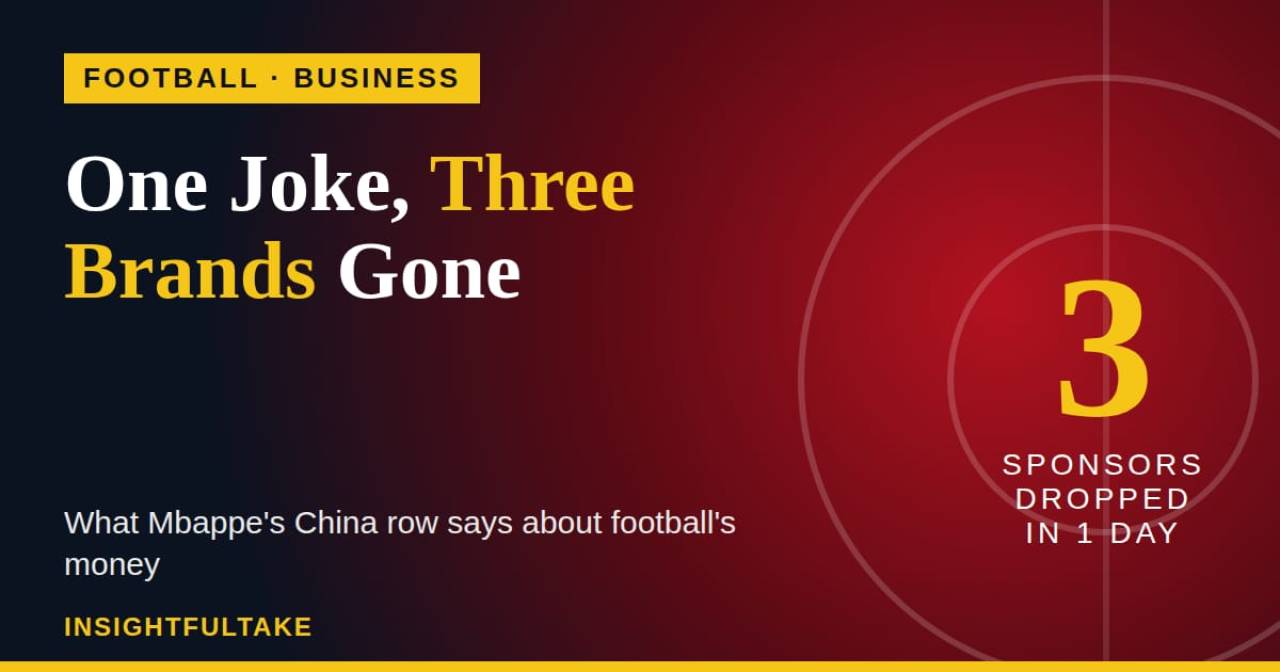
One alleged joke cost Kylian Mbappe three Chinese sponsors. The controversy reveals how quickly global football fame can turn into a commercial liability when reputation collides with politics.
Kylian Mbappe lost three Chinese sponsors in a single day after a video appeared to show him joking about Mao Zedong. Beverage maker Dongpeng, dairy giant Mengniu and cheesemaker Milkground all announced on October 27, 2026 that they were cutting ties with the France captain. Chinese state-run media also reported that public television was suspending broadcasts of La Liga matches, the league in which Mbappe plays for Real Madrid.
According to reports, the clip shows Mbappe calling the funniest internet meme he had seen one in which his face was edited onto that of "some guy", whom he described as a Chinese dictator. This looks like a reference to an image of Mao carrying the footballer's face. Memes casting Mbappe as a dictator have circulated online for a couple of years, and he had himself criticised such edits during the World Cup as a sign of poor political awareness. That makes the alleged remark harder to explain.
China's foreign ministry said it was aware of the reports and that words and actions hurting the feelings of the Chinese people would meet rejection from all sections of society. Later the same day Mbappe apologised, calling his comment "ill-judged" and saying he understood it had hurt many people in China and in Chinese communities abroad.
Why Three Sponsors Walked Away Within Hours
For a sports lover, the sponsorship losses are the less interesting part. The speed is what stands out. All three companies moved within hours, and that tells us how brand deals really work. A sponsor does not buy a footballer's talent. It buys his goodwill with a specific audience. When that goodwill is damaged, every day of silence becomes a risk, because customers can read silence as approval.
The size of that audience explains the haste. China did not even qualify for this year's World Cup, yet Chinese companies were among the loudest advertisers at the tournament. Mengniu was a FIFA sponsor and put Mbappe on its milk cartons alongside Lionel Messi and Lamine Yamal. Dongpeng had signed him in April as the face of its electrolyte drink and ran AI-generated images of him during the tournament.
These brands were not buying fandom of a national team. They were buying a global star to sell products at home, and a star who offends the home market is no use to them.
When One Remark Threatens an Entire Football League
The reported La Liga broadcast suspension shows how far the damage can travel. Players are only one link in a chain that includes clubs, leagues and broadcasters, and each earns from international audiences. When a single remark disturbs one link, the others feel the pressure.
It has happened before. In 2019, Chinese broadcasters pulled an Arsenal match after Mesut Ozil criticised China's treatment of Uighurs, and an NBA executive's tweet that year took games off Chinese television.
Different sports, same lesson: access to China's viewers can be withdrawn in a day.
The Double-Edged Sword of Memes and AI Marketing
There is also a modern twist here. Meme culture and AI-made content are now part of how athletes are sold. Dongpeng's own World Cup advertising relied on AI-generated images of Mbappe.
The same online culture that turns a player into a marketing asset also turns him into a meme, and he controls neither. Every casual answer can be copied, translated and judged by millions within hours. A player who speaks on camera now speaks to every market at once.
Can Mbappe Rebuild Trust in China?
The facts are still emerging. The report calls the remark "alleged" and says he was "apparently" joking, and the full context has not been laid out. What is clear is that Mbappe accepted the comment was a mistake.
Whether the damage is lasting depends on what follows. Sponsors that left publicly will not return quietly, and Chinese viewers will judge whether the apology is followed by action. Real Madrid, La Liga and Mbappe's advisers now face a practical question: how to rebuild trust in a commercially vital market.
A Lesson for India's Celebrity-Driven Sports Market
For fans in India, where cricketers and footballers endorse dozens of brands and every comment travels instantly across platforms, the episode is a useful reminder.
Modern stardom is built on two things, performance and reputation. The first wins matches. The second pays for almost everything else, and as this week showed, it can be lost much faster.




Leave a Comment