
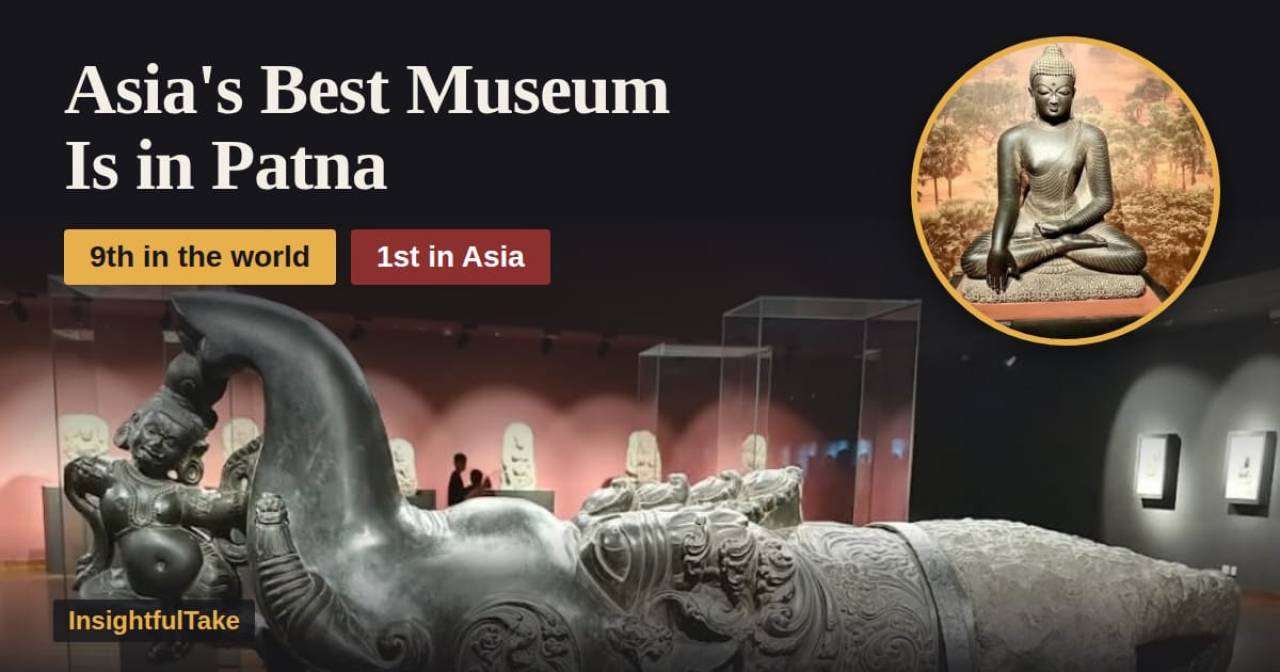
Patna's Bihar Museum has secured ninth place in a 2026 global ranking of 100 museums, putting Bihar's cultural heritage in the international spotlight.
The Bihar Museum in Patna has been ranked ninth among the world's 100 best museums in a 2026 list compiled by Worth a Journey, placing it first among Asian museums in the ranking. The recognition, reported by Indian media on October 25 and 26, comes just 11 years after the museum first opened to visitors in 2015.
For Bihar, a state whose historical importance is rarely matched by its representation on India's modern tourism map, the recognition offers an opportunity to attract greater attention to its cultural institutions.
From a ₹500-Crore Project to Global Recognition
The Bihar Museum project began in 2013, when Chief Minister Nitish Kumar laid its foundation stone. Construction started in October that year on Bailey Road in Patna, with an estimated budget of approximately ₹498 crore.
The first phase opened to the public in 2015, introducing a modern cultural institution designed to present Bihar's history through architecture, technology and carefully curated exhibitions.
Bihar's historical legacy stretches across several major periods of Indian civilisation. The region was central to the Mauryan and Gupta empires, witnessed the rise of Buddhism and Jainism, and was home to Nalanda, one of the ancient world's most celebrated centres of learning.
The museum was conceived to bring this history together under one roof, with international expertise contributing to its architecture and exhibition planning.
Unlike conventional museums that primarily display artefacts in glass cases, Bihar Museum was designed to encourage visitors to explore history through visual storytelling, multimedia installations and interactive experiences.
What Makes Bihar Museum Different?
The museum houses collections covering Bihar's history, archaeology, art and cultural traditions. Its galleries combine ancient sculptures, bronzes and historical artefacts with contemporary exhibition techniques.
Carefully planned lighting, digital presentations and thematic displays help visitors understand the historical significance of the objects on display.
The institution also offers dedicated spaces for children, educational activities and visitor amenities, including dining facilities serving regional cuisine.
Its cultural calendar extends beyond permanent exhibitions. The Bihar Museum Biennale, organised every two years, brings together museums, artists and cultural institutions from India and abroad.
The museum also celebrates its foundation day every August, with programmes highlighting Bihar's artistic and historical heritage.
Reported admission charges are ₹100 for Indian adults, ₹50 for children and ₹500 for foreign visitors, although visitors should confirm the latest rates before planning a trip.
These facilities have helped position the museum as an educational destination for schoolchildren, families, researchers and tourists.
A 1.5-Km Underground Tunnel to Connect Two Museums
The international recognition comes as Patna prepares another major addition to its cultural infrastructure.
The Bihar government is developing an underground heritage tunnel connecting Bihar Museum with the historic Patna Museum, which was established in 1917.
Patna Museum holds important collections of Buddhist sculptures, terracotta objects and artefacts associated with the Mauryan and Gupta periods.
The proposed tunnel, approximately 1.5 kilometres long, is intended to allow visitors to travel between the two institutions without navigating the city's busy roads.
In August 2023, the Bihar cabinet approved a revised project cost of ₹542 crore. The Delhi Metro Rail Corporation was appointed as consultant for the project.
Chief Minister Nitish Kumar formally launched construction in March 2026. A tunnel boring machine brought from Singapore has reportedly reached Patna for the work.
Earlier project estimates indicated 2027 as a possible completion year, although the actual schedule will depend on construction progress.
Once completed, the tunnel could create a connected heritage corridor linking two of Bihar's most important museums.
The government has also discussed improvements to parking, accessibility and visitor facilities around the institutions.
Such a corridor could encourage tourists to spend more time exploring Patna rather than treating the city merely as a transit point on their way to Bodh Gaya, Nalanda or Rajgir.
The Controversy Over Patna Museum's Artefacts
The development of Bihar Museum has also raised questions about the preservation and distribution of the state's historical collections.
During the establishment of the new institution, several artefacts were transferred from the older Patna Museum.
The transfers attracted criticism, particularly because Patna Museum was approaching its centenary in 2017. Concerns were raised that moving important collections could diminish the older institution's historical identity.
The state government has since undertaken a separate modernisation programme for Patna Museum, involving an investment of approximately ₹158 crore.
The upgrade includes plans for improved galleries, exhibition spaces and visitor facilities.
Maintaining the distinct identities of both museums will be important as the government moves towards integrating them through the proposed underground corridor.
Why the Ranking Matters for Bihar Tourism
Bihar possesses some of India's most significant archaeological and religious destinations, including Bodh Gaya, Nalanda and Rajgir.
However, the state has struggled to convert its historical wealth into a tourism economy comparable with those of several other Indian states.
The Bihar Museum ranking could help change perceptions, particularly among international travellers interested in archaeology, Buddhism and South Asian history.
A globally recognised museum gives Patna an additional attraction that can be promoted alongside the state's established heritage destinations.
The potential economic benefits extend beyond museum ticket sales. Increased tourist arrivals could support hotels, restaurants, transport operators, local markets and traditional craftspeople.
However, international recognition alone cannot guarantee sustained tourism growth.
Better transport connectivity, clean public spaces, reliable visitor information, professional guides and well-maintained heritage sites will be essential to translating publicity into economic benefits.
Global Recognition Brings Greater Responsibility
A place among the world's top ten museums is an achievement worth celebrating, but it also raises expectations.
The Bihar Museum will need to maintain high standards of conservation, exhibition management, accessibility and visitor services.
The government must also ensure that the underground tunnel project progresses efficiently and that the older Patna Museum receives the attention it deserves.
The ranking is a recognition from a particular international list, rather than a universal assessment of all museums. Its long-term significance will depend on how effectively Bihar builds on the publicity.
For a state frequently associated with economic and administrative challenges, the recognition provides a welcome opportunity to present another aspect of its identity.
Bihar's contribution to Indian civilisation has never been in doubt. The challenge has been to preserve that heritage, present it effectively and make it accessible to the wider world.
The Bihar Museum's international ranking gives Patna a reason to celebrate. Turning that recognition into lasting cultural and economic progress will be the more important achievement.
Editorial verification note (not for publication): The ninth-place ranking, the claim of being first in Asia, and the ranking organisation's methodology should be independently verified against the original 2026 list before publication. The tunnel's construction status, projected completion date and museum admission charges also warrant confirmation.

























Leave a Comment