
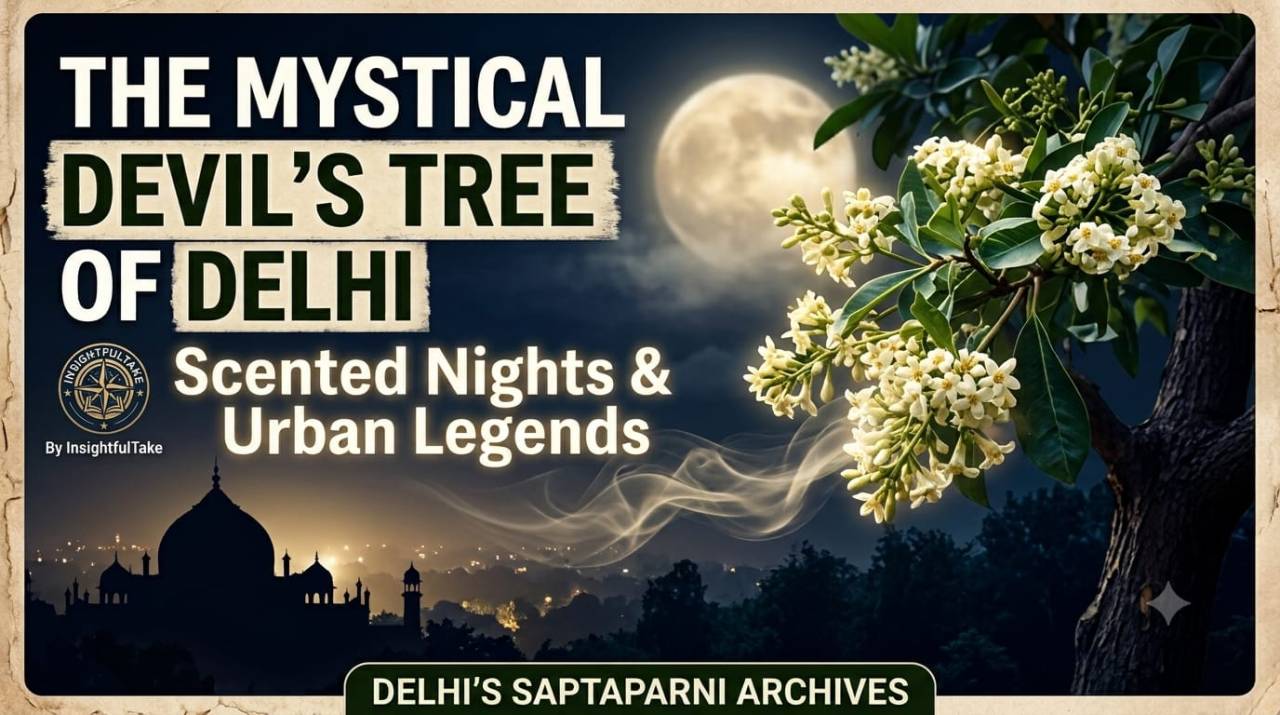
Every October, a powerful fragrance fills Delhi's streets. Behind it stands the Saptaparni tree, whose history connects ancient folklore, traditional medicine and urban memories.
Delhi's autumn has a fragrance of its own. As October arrives and the monsoon retreats, a strong, sweet scent begins to spread through the Capital's tree-lined avenues, residential colonies and public parks. Some residents welcome it as a familiar sign of the changing season. Others find it overpowering, particularly during evening walks.
The fragrance comes from the Saptaparni tree (Alstonia scholaris), also known as the Devil's Tree. Its small, greenish-white flowers release a distinctive scent that becomes especially noticeable after sunset.
For many Delhi residents, the flowering of Saptaparni is as much a part of October as the arrival of cooler evenings. However, the tree's importance extends beyond its seasonal fragrance. Its presence in Delhi reflects the city's landscaping history, while its medicinal associations and place in folklore reveal a cultural identity that has developed over centuries.
From Forest Landscapes to Delhi's Avenues
Saptaparni is native to a broad region of South and Southeast Asia, including parts of the Indian subcontinent. It grows naturally in tropical and subtropical environments and is recognised for its straight trunk, evergreen foliage and clusters of leaves arranged around the stem.
Its Sanskrit-derived name, Saptaparni, refers to the characteristic arrangement of leaves, often appearing in groups of seven.
The tree became a familiar feature of New Delhi's planned neighbourhoods during the twentieth century. It is particularly associated with the leafy avenues of Lutyens' Delhi and residential areas such as Golf Links.
Its popularity in urban landscaping is understandable. Saptaparni provides shade, retains its foliage throughout much of the year and can tolerate a range of growing conditions. These qualities make it useful in a city that experiences intense summer heat, monsoon humidity and considerable environmental stress.
Its widespread presence also reflects an important chapter in Delhi's development. Trees were planted not simply to beautify streets but to make the expanding city more comfortable and liveable.
Today, mature Saptaparni trees form part of the green character of several older neighbourhoods.
A Tree Associated With Traditional Medicine
Long before Saptaparni became a familiar roadside tree, it occupied an important place in traditional systems of medicine.
Its bark, leaves and other parts have been used in Ayurvedic and regional medicinal practices. The bitter bark has traditionally been associated with treatments for fever, digestive disorders and other ailments.
Historical accounts also describe its use in preparations intended to treat malaria.
However, traditional use should not be confused with established medical effectiveness. Saptaparni contains biologically active compounds, and its medicinal properties require careful scientific evaluation. Its preparations should not replace proven treatment for malaria or other illnesses.
The tree also appears in local customs surrounding the harvesting of medicinal plants. In some traditional communities, gathering bark and leaves is accompanied by practices expressing respect for nature.
Such customs reflect an older understanding of the relationship between people and plants, where trees were valued for their practical uses as well as their cultural and spiritual significance.
Why Saptaparni Is Called the Devil's Tree
Few trees carry names as contrasting as Saptaparni.
Its English name, Devil's Tree, suggests something mysterious or threatening. The precise origin of the common name is uncertain, although the tree's strong fragrance and associations with traditional beliefs may have contributed to its reputation.
Its scientific name tells a different story.
The genus Alstonia honours the Scottish botanist Charles Alston, while the species name scholaris refers to the historical use of its lightweight wood in making school slates and related educational materials.
The connection with education also appears in an important Indian cultural tradition.
At Santiniketan, founded by Rabindranath Tagore, Saptaparni leaves hold symbolic significance in the convocation tradition of Visva-Bharati. The leaves are associated with learning, achievement and the relationship between education and nature.
A tree known in one context as the Devil's Tree thus becomes a symbol of knowledge and intellectual growth in another.
These contrasting identities show how the meaning of a plant can change across societies and traditions.
The Yakshi and the Folklore of Fragrance
Saptaparni also finds a place in the wider world of South Asian folklore, where trees and forests are often associated with supernatural beings.
Among the most intriguing figures in these traditions is the Yakshi, a female nature spirit whose character varies across regional stories.
In some accounts, Yakshis are benevolent beings associated with fertility, prosperity and the natural world. In others, they appear as mysterious women capable of enchanting unsuspecting travellers.
Certain regional legends connect such spirits with fragrant trees and secluded forest landscapes.
The association between Saptaparni and the Yakshi belongs to this broader tradition of storytelling rather than to a single universally accepted legend.
These narratives reveal how people once interpreted the unfamiliar sounds, smells and experiences of forests. A powerful fragrance drifting through the darkness could inspire admiration, curiosity or fear.
The Saptaparni's night-time scent makes it particularly suited to such stories.
Even today, its fragrance can seem mysterious when it reaches a passerby long before the flowering tree becomes visible.
The Fragrance That Divides Delhi
Saptaparni usually flowers during the post-monsoon months, often between September and November, depending on local conditions.
Its small flowers grow in clusters and release a fragrance that can travel considerable distances.
Some people describe the scent as sweet, spicy or similar to cardamom. Others find it heavy and unpleasant.
This difference in perception is not unusual. Human sensitivity to floral scents varies considerably, and the same fragrance may produce very different reactions.
For some Delhi residents, Saptaparni brings back memories of school journeys, evening walks, neighbourhood parks and the first signs of winter.
For others, its flowering season is associated with discomfort.
The tree's pollen and fragrance are sometimes blamed for seasonal allergies. However, a strong smell does not necessarily establish that a plant is responsible for allergic symptoms. Delhi's autumn air also contains dust, pollutants and other airborne particles that may contribute to respiratory irritation.
The distinction matters because the flowering season overlaps with a period when air quality frequently begins to deteriorate.
Delhi's Seasonal Memory Lives in Its Trees
Cities are usually remembered through their monuments, markets, roads and buildings. Yet smell also plays an important role in how people recognise places and recall experiences.
The scent of wet earth after the first monsoon rain, flowers near a temple or food being prepared in a neighbourhood market can remain associated with a place for years.
Saptaparni performs a similar function in Delhi.
Its fragrance returns at roughly the same time each year, creating a recurring sensory marker of the changing season.
Unlike a monument, the tree does not require anyone to stop and observe it. Its presence is announced through the air.
This gives Saptaparni an unusual place in the Capital's collective memory.
Residents may not know its botanical name or recognise its flowers, but many can identify the fragrance immediately.
Such everyday encounters with nature contribute to a city's identity in ways that conventional histories often overlook.
A Fragrant Season Before Winter Pollution
The timing of Saptaparni's flowering adds another dimension to its place in Delhi's seasonal life.
October marks the transition from the monsoon to winter. Temperatures begin to fall, evenings become more comfortable and outdoor activity often increases.
It is also the period when Delhi faces growing concerns over air pollution.
Changing weather conditions, vehicle emissions, dust, industrial pollution, agricultural residue burning and other sources contribute to the deterioration of air quality during the colder months.
Against this background, the flowering of Saptaparni creates a striking contrast.
Its sweet fragrance becomes noticeable at a time when residents are increasingly concerned about the quality of the air they breathe.
The scent should not be mistaken for evidence of clean air. Pleasant-smelling air can still contain harmful pollutants.
Nevertheless, the annual flowering provides a reminder that Delhi's urban environment contains living ecological systems alongside roads, buildings and infrastructure.
The Urban Yakshi and Delhi's Contradictions
The folklore surrounding the Yakshi offers an interesting way to understand Delhi's relationship with Saptaparni.
Like the mysterious figure of traditional stories, the city can be attractive and overwhelming at the same time.
Its historic neighbourhoods, cultural diversity and tree-lined avenues exist alongside traffic congestion, shrinking green spaces and severe environmental pressures.
Saptaparni reflects some of these contradictions.
It is admired for its shade and greenery but disliked by some for its powerful fragrance. It is associated with healing traditions, yet its medicinal use requires scientific caution. It is rooted in ancient cultural practices while remaining a familiar part of modern urban landscaping.
These different meanings are not necessarily in conflict. They demonstrate how a single tree can occupy several places in public life.
The comparison with the Yakshi also gives the tree a literary significance. Both represent a relationship with nature shaped by attraction, uncertainty and respect.
Preserving the Living Heritage of Delhi
Delhi's green heritage is often discussed in terms of forest cover, parks and large-scale plantation drives. These are important, but the value of individual mature trees deserves equal attention.
An established tree provides shade, supports urban biodiversity and contributes to the character of a neighbourhood. Its environmental value cannot always be replaced quickly by planting a young sapling elsewhere.
Saptaparni is one example of how urban trees become part of local history.
Protecting such trees requires informed planning, suitable species selection, adequate space for roots and careful maintenance. Urban greening must also consider ecological suitability, biodiversity and the needs of residents.
As Delhi continues to expand, its familiar trees should be recognised not merely as decorative features but as part of the city's living heritage.
Every October, Saptaparni flowers return to the Capital's streets. Their fragrance passes through residential lanes, public gardens and busy roads, reaching people who may never notice the trees themselves.
Some welcome the scent. Others wait for it to fade.
But the annual flowering carries something more enduring than fragrance. It connects the present-day city with older landscapes, cultural traditions and personal memories.
Delhi's buildings record how the city has changed. Its trees preserve something of how the city has been experienced.


























Leave a Comment