
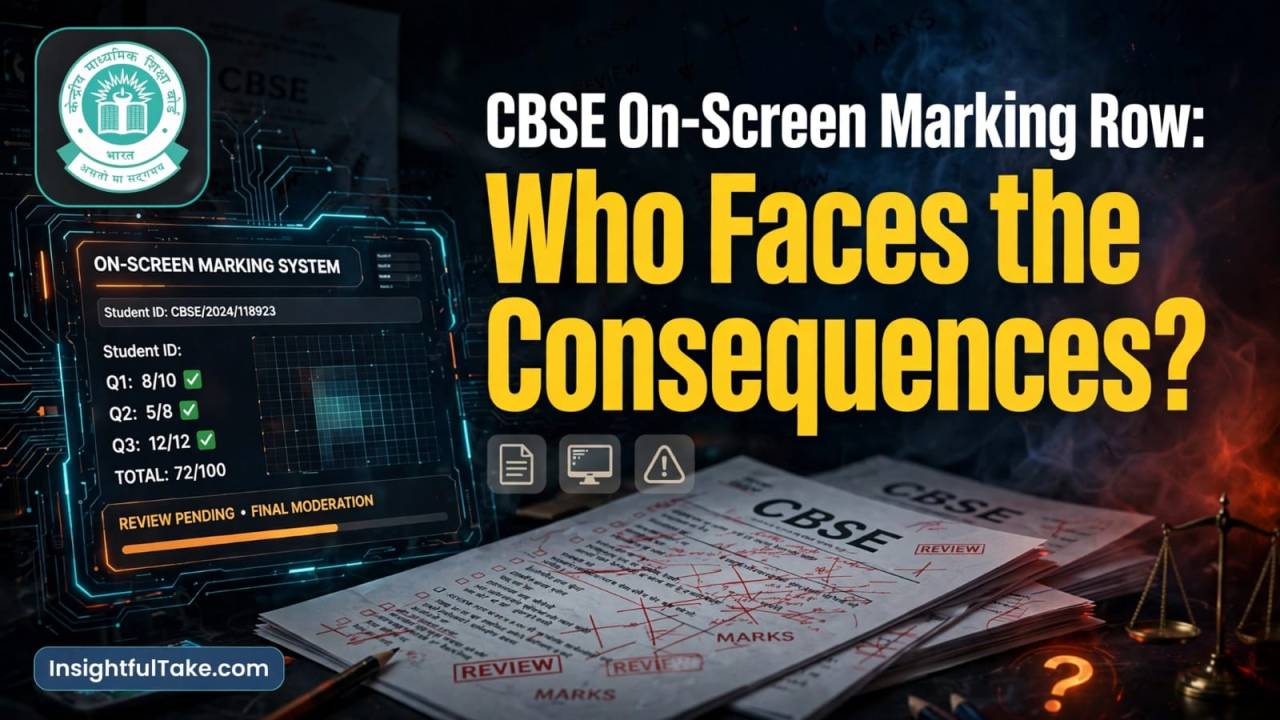
Five months after glitches disrupted Class 12 evaluation, RTI replies reveal no penalty imposed on the vendor and no payment sanction order on record. What does this accountability gap mean for students and parents?
When the CBSE Class 12 results were announced on May 13, most families had one immediate concern of their children’s marks. Behind those numbers, however, was a major change in how answer sheets were evaluated. For the first time, the Central Board of Secondary Education (CBSE) used an on-screen marking (OSM) system, under which answer books are scanned and examiners evaluate them on computers rather than on paper.
Five months later, questions remain over the rollout. A Hindustan Times report by Sanjay Maurya, based on replies obtained under the Right to Information (RTI) Act, found that CBSE had not issued a sanction order for payment to Coempt Edu Teck, the vendor responsible for the system. The replies also indicated that no penalty had been imposed on the company.
For students and parents who raised concerns about the evaluation process, these findings raise a basic question: if a system affecting lakhs of students encounters serious problems, who is held accountable?
What Went Wrong With On-Screen Marking?
According to the report, the introduction of OSM was marred by technical glitches before and after the results were declared. Students and parents complained about unexpectedly low marks, blurred scanned answer sheets and answers that appeared to have gone unchecked. Re-evaluation also reportedly revealed discrepancies in some cases.
The rollout faced criticism over inadequate preparation and training. These concerns put the spotlight on whether the new system had been tested thoroughly before being used for an examination as important as the CBSE Class 12 board exams.
The stakes were considerable. The examinations were held from February 17 to April 10, while the overall pass percentage fell to 85.20%, compared with 88.39% in the previous year.
The decline does not, by itself, establish that the digital evaluation system was responsible. Pass percentages can change for several reasons, including the difficulty of question papers and differences in student performance. However, when students are already questioning their marks, unexplained discrepancies can deepen doubts about the fairness and reliability of the evaluation process.
For a student seeking admission to a preferred college or applying for a scholarship, even a small difference in marks can matter. That is why accuracy, transparency and an effective grievance-redressal system are essential when new evaluation technology is introduced.
The Money Trail: Penalties Announced, but What Happened Next?
The financial arrangements surrounding the contract raise another set of questions.
The tender, issued in August 2025, linked payment to the actual number of answer books scanned and uploaded. Payment was to be released after the completion of examination-related formalities, including the declaration of results and re-evaluation.
The contract also reportedly included financial penalties for service failures. One provision specified a penalty of ₹1 lakh for every 15-minute delay in resolving an issue flagged by CBSE.
In June, CBSE officials had told the newspaper that the company would be penalised for its shortcomings. However, the subsequent RTI replies did not establish that any penalty had actually been imposed.
When asked whether a penalty had been levied, the board's finance section replied that no such information was available. In a separate response, CBSE said its Finance Division had no payment sanction order for the vendor on record.
These replies do not necessarily establish that no action was taken by any other division or that no payment was ever made through another process. They do, however, leave important questions unanswered about the financial consequences of the reported shortcomings.
The company did not respond to the newspaper's repeated requests for comment.
The report also drew attention to a corrigendum dated September 20, 2025, issued before the contract was awarded on December 5. The corrigendum reportedly removed key references to blacklisting a vendor for such failures.
That detail deserves scrutiny. Contractual penalties are meaningful only when the terms are clear, enforceable and applied consistently. If a public body promises action but cannot provide a clear account of what followed, confidence in its procurement and oversight processes can suffer.
Why This Matters Beyond One Contract
The controversy is not simply about a technology vendor or an administrative dispute. It concerns the credibility of a public examination system on which millions of students depend.
First, accountability must go beyond official assurances.
When a controversy emerges, authorities may promise an inquiry or strict action. But an announcement is not the same as an outcome. Students, parents and taxpayers deserve to know whether the findings were established, whether contractual provisions were enforced and what corrective steps followed.
If a penalty was warranted under the contract, the board should explain whether it was imposed. If it was not imposed, the reasons should be made public. If the matter remains under examination, the board should communicate the status and expected next steps.
Second, students should not bear the cost of administrative failures.
Class 12 marks influence college admissions, scholarships and eligibility for several competitive opportunities. Students have little control over the technology or procedures used to evaluate their answer books, yet they bear the consequences when something goes wrong.
A reliable system must therefore provide more than a fast results process. It must ensure that answer sheets are scanned legibly, every answer is assessed, discrepancies can be identified and students have access to a fair and timely review.
Third, transparency must continue after a controversy fades.
The RTI Act allows citizens to seek information about decisions and actions taken by public authorities. In this case, the replies helped bring specific questions about payment and penalties into the public domain.
Citizens should not have to depend solely on official statements to understand whether promised action has taken place. Records, reasoned responses and public disclosures are essential to meaningful accountability.
What Parents and Students Can Do
The controversy also offers practical lessons for families dealing with evaluation concerns.
Use the official review process. If marks appear inconsistent with a student's performance, check the applicable CBSE procedures for verification of marks, obtaining answer-book copies and re-evaluation. Follow the published deadlines and eligibility conditions.
Examine available answer-book copies carefully. Where copies are available, check whether the scanned pages are legible, all pages are present and the answers appear to have been evaluated. Raise specific discrepancies through the prescribed channels.
Keep records of complaints. Save application receipts, payment confirmations, screenshots, correspondence and acknowledgements. A clear record can help when following up on an unresolved grievance.
Use RTI for specific questions. Students and parents can seek information about administrative decisions, subject to the law and applicable exemptions. Questions such as whether a penalty was imposed, whether a payment sanction order was issued or what action followed an inquiry are more useful than broad requests for explanations.
Seek collective clarification. Schools, parent associations and student groups can raise common concerns with the board. A coordinated request for clear procedures and public reporting may help secure answers that individual complaints cannot.
These steps cannot correct every systemic problem, but they can help families protect their interests and seek documented responses.
Digital Evaluation Is Not the Problem in Itself
Moving from paper-based marking to digital evaluation can offer genuine benefits. It can reduce the physical movement and storage of answer books, simplify monitoring, support faster processing and make certain administrative checks easier.
But technology does not automatically guarantee accuracy. Its success depends on adequate testing, trained personnel, reliable scanning, clear procedures for handling technical failures and effective supervision of the vendor.
A system that works well in a demonstration may still encounter problems when deployed at scale. That is why a major change in board examination procedures needs careful preparation, contingency plans and a dependable mechanism for resolving complaints.
It is also important to distinguish allegations and reported glitches from a final finding of responsibility. Changes in CBSE leadership followed the controversy, and a probe into the OSM procurement was ordered. The findings of that examination should be considered before drawing final conclusions about individual responsibility or contractual violations.
The board must be given the opportunity to establish the facts. At the same time, an ongoing inquiry should not become a reason to withhold basic information about its progress or the steps taken to protect students.
The Question That Remains
The introduction of on-screen marking was intended to modernise the evaluation process. Whether it can deliver on that promise depends not only on the technology but also on the institutions responsible for implementing it.
Students followed examination schedules, prepared for months and placed their future in the marks awarded to them. When the evaluation process faced reported glitches, they and their families were entitled to expect a transparent explanation and an effective remedy.
The RTI findings have brought the questions of vendor penalties and payment approval into focus, but they do not settle every aspect of the controversy. CBSE needs to clarify what action was taken, what the inquiry found and what safeguards will prevent similar problems in future examinations.
The real test of digital reform is not whether a new system can be introduced. It is whether it can be trusted, whether failures are addressed fairly and whether those responsible are held accountable under clearly established rules.
Students faced the uncertainty of the rollout. They should not also be left waiting indefinitely for answers.
























Leave a Comment