
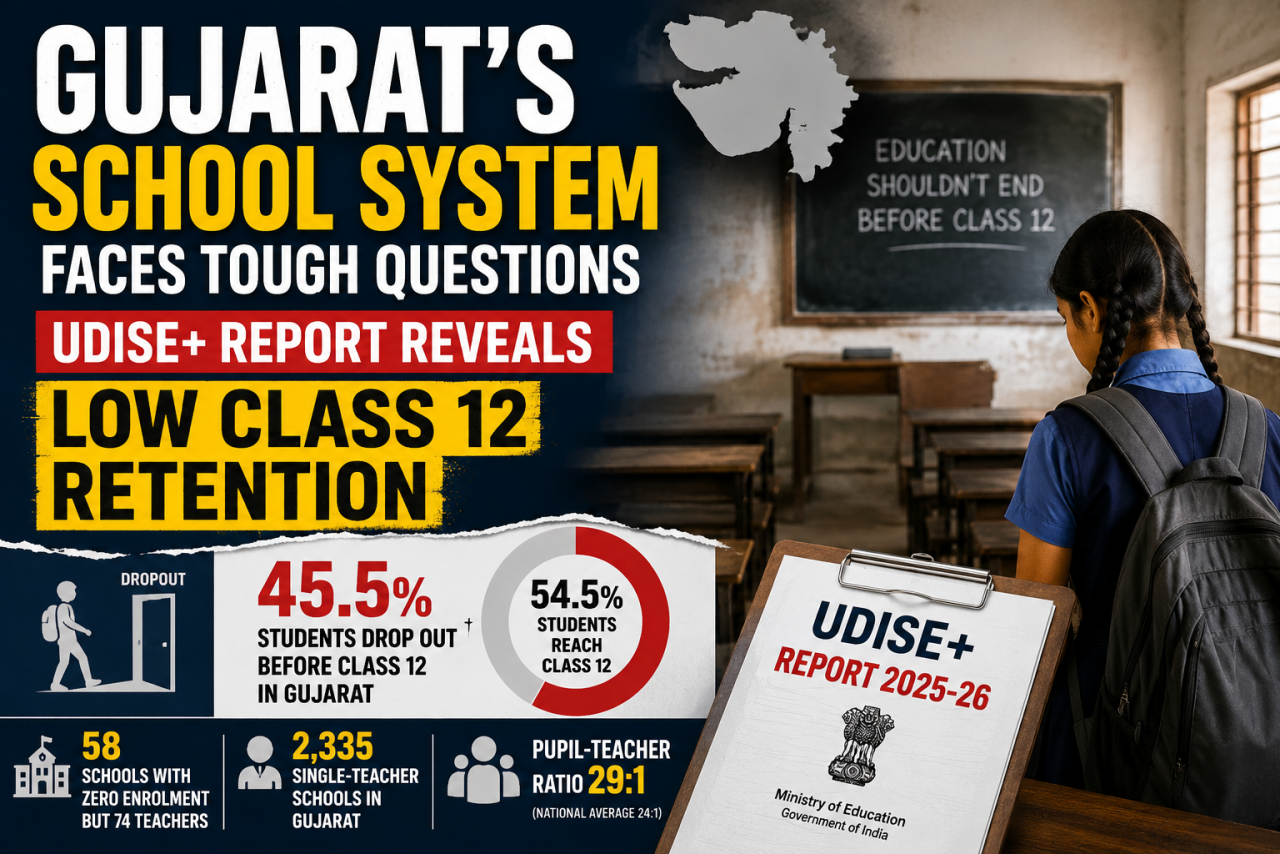
Nearly half of Gujarat's students never reach Class 12, raising serious questions about dropout rates, teacher deployment and education planning.
Gujarat enrolled 1.15 crore students across 53,425 schools in the academic year 2025–26, but only 54.5 percent remained in the education system until Class 12. In other words, nearly one in every two students who begins schooling in the state does not complete secondary education. These findings come from the Unified District Information System for Education Plus (UDISE+) 2025–26 report released by the Union Ministry of Education.
Girls recorded a slightly better retention rate than boys. While 56.2 percent of girls stayed in school until Class 12, the corresponding figure for boys stood at 53 percent. Although girls performed better, both numbers raise concerns for a state that is often projected as a model of economic growth and governance.
The report shows that Gujarat performs well in the early years of schooling. Retention at the foundational and preparatory stages is 100 percent, indicating that almost every child who enters school continues through the primary years. The decline begins at the middle stage, where retention falls to 90.4 percent. It drops sharply at the secondary stage, with retention reaching just 51.9 percent, matching the national average at that level. Independent analyses of the same UDISE+ dataset also place Gujarat among the states and union territories with the highest secondary-level dropout rates, alongside Ladakh, Chhattisgarh and Karnataka.
The dropout figures reinforce this trend. Gujarat's secondary-stage dropout rate stands at 12.5 percent, almost double the national average of 7 percent. This means students in Gujarat are significantly more likely to leave school between Classes 9 and 12 than students across the country as a whole.
The report also highlights concerns over school infrastructure and teacher deployment. Gujarat has 58 schools with zero student enrolment despite employing 74 teachers. Although these schools represent only a small share of the 5,663 zero-enrolment schools reported nationwide, they point to administrative inefficiencies in the allocation of teaching staff.
An even bigger challenge is the number of single-teacher schools. Gujarat has 2,335 schools functioning with only one teacher, collectively serving 80,053 students. On average, each teacher is responsible for more than 34 students, often across multiple grades in the same classroom. Across India, there are 1,00,843 single-teacher schools educating over 29 lakh students, but Gujarat's share remains significant for a state that positions itself as an administrative and industrial leader.
Teacher availability presents another contradiction. Gujarat has an average of seven teachers per school, equal to the national average. Yet the state's pupil-teacher ratio is 29, compared with the national average of 24. This suggests that while teacher numbers appear adequate overall, they are unevenly distributed. Some schools have more teachers than required, while others remain severely understaffed.
These findings raise uncomfortable questions about Gujarat's education system. A state known for its industrial development and governance achievements is struggling to ensure that half of its students complete school education. The presence of schools with no students but salaried teachers reflects administrative lapses, while the large number of single-teacher schools points to gaps in planning and teacher deployment, particularly in rural and remote areas.
Compiled from data submitted by schools with active UDISE+ codes, the UDISE+ report remains India's most comprehensive database on school education. For Gujarat, the latest findings present a detailed picture that goes beyond development narratives, revealing persistent challenges in student retention, teacher distribution and access to quality secondary education.
Gujarat enrolled 1.15 crore students across 53,425 schools in the academic year 2025–26, but only 54.5 percent remained in the education system until Class 12. In other words, nearly one in every two students who begins schooling in the state does not complete secondary education. These findings come from the Unified District Information System for Education Plus (UDISE+) 2025–26 report released by the Union Ministry of Education.
Girls recorded a slightly better retention rate than boys. While 56.2 percent of girls stayed in school until Class 12, the corresponding figure for boys stood at 53 percent. Although girls performed better, both numbers raise concerns for a state that is often projected as a model of economic growth and governance.
The report shows that Gujarat performs well in the early years of schooling. Retention at the foundational and preparatory stages is 100 percent, indicating that almost every child who enters school continues through the primary years. The decline begins at the middle stage, where retention falls to 90.4 percent. It drops sharply at the secondary stage, with retention reaching just 51.9 percent, matching the national average at that level. Independent analyses of the same UDISE+ dataset also place Gujarat among the states and union territories with the highest secondary-level dropout rates, alongside Ladakh, Chhattisgarh and Karnataka.
The dropout figures reinforce this trend. Gujarat's secondary-stage dropout rate stands at 12.5 percent, almost double the national average of 7 percent. This means students in Gujarat are significantly more likely to leave school between Classes 9 and 12 than students across the country as a whole.
The report also highlights concerns over school infrastructure and teacher deployment. Gujarat has 58 schools with zero student enrolment despite employing 74 teachers. Although these schools represent only a small share of the 5,663 zero-enrolment schools reported nationwide, they point to administrative inefficiencies in the allocation of teaching staff.
An even bigger challenge is the number of single-teacher schools. Gujarat has 2,335 schools functioning with only one teacher, collectively serving 80,053 students. On average, each teacher is responsible for more than 34 students, often across multiple grades in the same classroom. Across India, there are 1,00,843 single-teacher schools educating over 29 lakh students, but Gujarat's share remains significant for a state that positions itself as an administrative and industrial leader.
Teacher availability presents another contradiction. Gujarat has an average of seven teachers per school, equal to the national average. Yet the state's pupil-teacher ratio is 29, compared with the national average of 24. This suggests that while teacher numbers appear adequate overall, they are unevenly distributed. Some schools have more teachers than required, while others remain severely understaffed.
These findings raise uncomfortable questions about Gujarat's education system. A state known for its industrial development and governance achievements is struggling to ensure that half of its students complete school education. The presence of schools with no students but salaried teachers reflects administrative lapses, while the large number of single-teacher schools points to gaps in planning and teacher deployment, particularly in rural and remote areas.
Compiled from data submitted by schools with active UDISE+ codes, the UDISE+ report remains India's most comprehensive database on school education. For Gujarat, the latest findings present a detailed picture that goes beyond development narratives, revealing persistent challenges in student retention, teacher distribution and access to quality secondary education.























Leave a Comment