
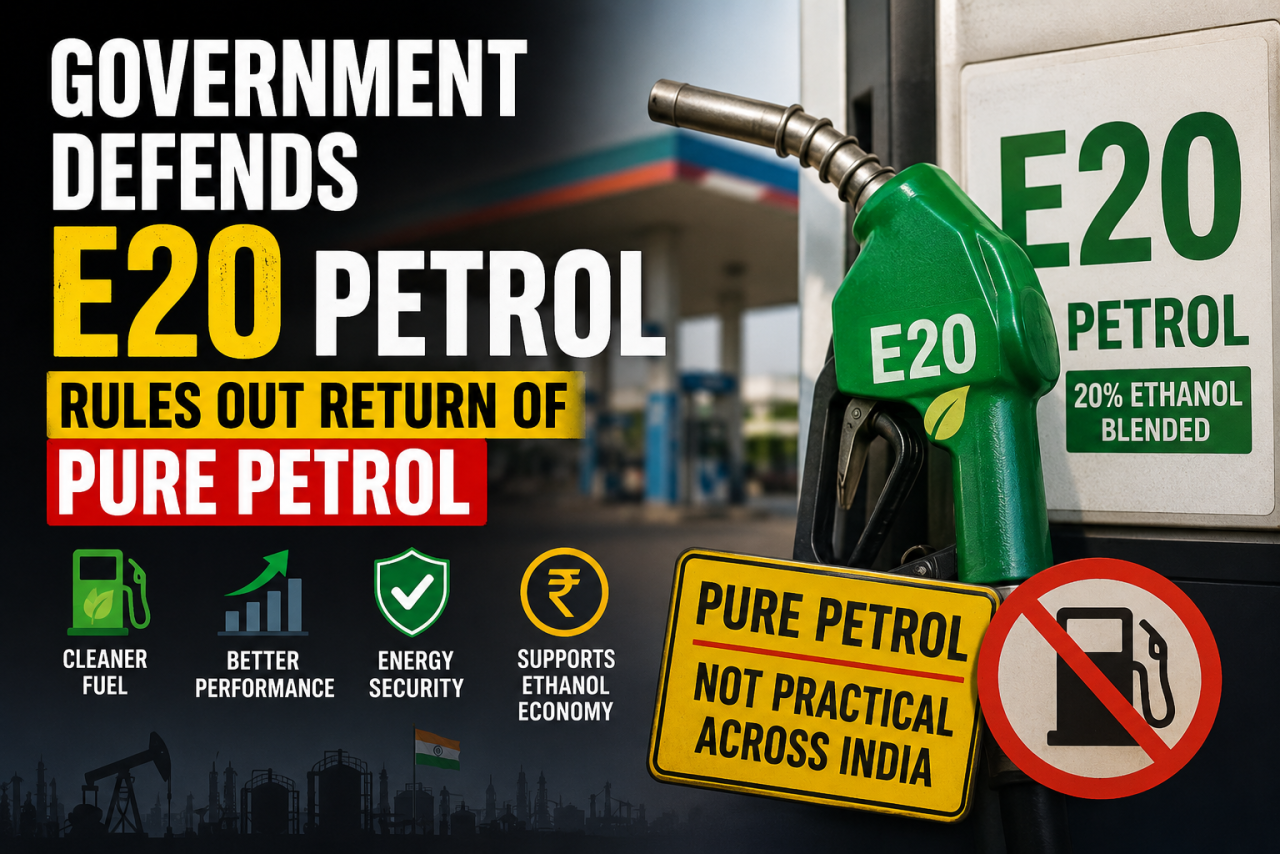
The government has acknowledged that E20 petrol may reduce mileage by up to 5%, but says the fuel delivers better performance and that bringing back pure petrol across India is not practically possible
The government of India pushed back against growing criticism of E20 petrol, insisting that the ethanol-blended fuel offers real performance benefits even as it admitted the blend causes a drop in mileage for some vehicles.
The petroleum ministry's clarification came in the form of a detailed FAQ statement, released amid rising anger on social media over E20's effect on car engines. Owners across the country have complained about reduced fuel efficiency since the 20% ethanol blend became the default option at most pumps, replacing pure petrol in large parts of the retail network.
The ministry did not dodge the mileage question. It accepted that some vehicles may see a 3-5% drop in fuel economy when running on E20 compared to pure petrol. But it argued that mileage is "only one parameter" to judge a fuel by, and that E20 makes up for it elsewhere. According to the ministry, the blend offers a significantly higher octane rating, better anti-knock properties, faster combustion, stronger pickup, smoother acceleration, and cleaner engine operation than pure petrol.
Why the Government Won't Bring Back Pure Petrol at Every Pump
The FAQ also addressed a demand that has gained traction online that every petrol pump in the country should stock three separate options: pure petrol, E10, and E20, allowing consumers to choose. The government rejected this outright, calling it a suggestion that ignores the practical realities of how fuel actually reaches Indian consumers.
India runs on a vast and layered fuel distribution system, with over one lakh retail outlets supported by a network of terminals, depots, and pipelines. Maintaining multiple grades of base petrol across this entire chain, the ministry said, would create serious logistical problems, including higher handling costs, more complicated inventory management, and reduced efficiency at every stage of the supply chain.
The ministry also pushed back against comparisons with premium petrol, which many critics have cited as proof that multiple fuel options are feasible. Officials described the comparison as misleading, pointing out that premium petrol is a niche product sold in limited quantities at a significant price premium. It is not designed to meet the nationwide demand for a mass-market fuel like regular petrol.
Why the Government Believes E20 Is a Long-Term Policy
Running through the ministry's response is a broader argument that E20 is not just about individual vehicle mileage, but about India's long-term energy security and ethanol ecosystem. Public sector banks have financed ethanol infrastructure and logistics over several years, while the blended fuel policy has driven investment in ethanol distilleries, storage facilities, and distribution networks across the country. Rolling back the programme, the government argues, would undermine years of investment.
The ministry's position is that consumers should look beyond the immediate impact on mileage and consider larger national objectives, including reducing dependence on imported crude oil and supporting domestic ethanol production, much of which is linked to India's sugarcane and grain sectors.
What This Means for Vehicle Owners
For now, the government's message is clear. E20 will remain the default petrol available across India, and pure petrol will not return as a standard option at fuel stations. Vehicle owners experiencing lower mileage are being told that this is an expected trade-off rather than a defect in the fuel or their vehicles.
Whether this explanation will calm public concerns remains uncertain. The debate over E20 has gathered momentum on social media in recent months, with many motorists arguing that they were not adequately informed about the possible impact on fuel efficiency before the transition became widespread. While the ministry's FAQ answers several technical questions, it may not fully bridge the trust gap that has emerged between policymakers and consumers.
The government of India pushed back against growing criticism of E20 petrol, insisting that the ethanol-blended fuel offers real performance benefits even as it admitted the blend causes a drop in mileage for some vehicles.
The petroleum ministry's clarification came in the form of a detailed FAQ statement, released amid rising anger on social media over E20's effect on car engines. Owners across the country have complained about reduced fuel efficiency since the 20% ethanol blend became the default option at most pumps, replacing pure petrol in large parts of the retail network.
The ministry did not dodge the mileage question. It accepted that some vehicles may see a 3-5% drop in fuel economy when running on E20 compared to pure petrol. But it argued that mileage is "only one parameter" to judge a fuel by, and that E20 makes up for it elsewhere. According to the ministry, the blend offers a significantly higher octane rating, better anti-knock properties, faster combustion, stronger pickup, smoother acceleration, and cleaner engine operation than pure petrol.
Why the Government Won't Bring Back Pure Petrol at Every Pump
The FAQ also addressed a demand that has gained traction online that every petrol pump in the country should stock three separate options: pure petrol, E10, and E20, allowing consumers to choose. The government rejected this outright, calling it a suggestion that ignores the practical realities of how fuel actually reaches Indian consumers.
India runs on a vast and layered fuel distribution system, with over one lakh retail outlets supported by a network of terminals, depots, and pipelines. Maintaining multiple grades of base petrol across this entire chain, the ministry said, would create serious logistical problems, including higher handling costs, more complicated inventory management, and reduced efficiency at every stage of the supply chain.
The ministry also pushed back against comparisons with premium petrol, which many critics have cited as proof that multiple fuel options are feasible. Officials described the comparison as misleading, pointing out that premium petrol is a niche product sold in limited quantities at a significant price premium. It is not designed to meet the nationwide demand for a mass-market fuel like regular petrol.
Why the Government Believes E20 Is a Long-Term Policy
Running through the ministry's response is a broader argument that E20 is not just about individual vehicle mileage, but about India's long-term energy security and ethanol ecosystem. Public sector banks have financed ethanol infrastructure and logistics over several years, while the blended fuel policy has driven investment in ethanol distilleries, storage facilities, and distribution networks across the country. Rolling back the programme, the government argues, would undermine years of investment.
The ministry's position is that consumers should look beyond the immediate impact on mileage and consider larger national objectives, including reducing dependence on imported crude oil and supporting domestic ethanol production, much of which is linked to India's sugarcane and grain sectors.
What This Means for Vehicle Owners
For now, the government's message is clear. E20 will remain the default petrol available across India, and pure petrol will not return as a standard option at fuel stations. Vehicle owners experiencing lower mileage are being told that this is an expected trade-off rather than a defect in the fuel or their vehicles.
Whether this explanation will calm public concerns remains uncertain. The debate over E20 has gathered momentum on social media in recent months, with many motorists arguing that they were not adequately informed about the possible impact on fuel efficiency before the transition became widespread. While the ministry's FAQ answers several technical questions, it may not fully bridge the trust gap that has emerged between policymakers and consumers.















Leave a Comment