
London's classrooms are changing faster than many realize. New census figures reveal that White British children are now a minority in 31 of the capital's 32 boroughs—a demographic shift that is reshaping education, identity, and the future...
London's classrooms are offering perhaps the clearest glimpse into the city's rapidly changing demographic landscape.
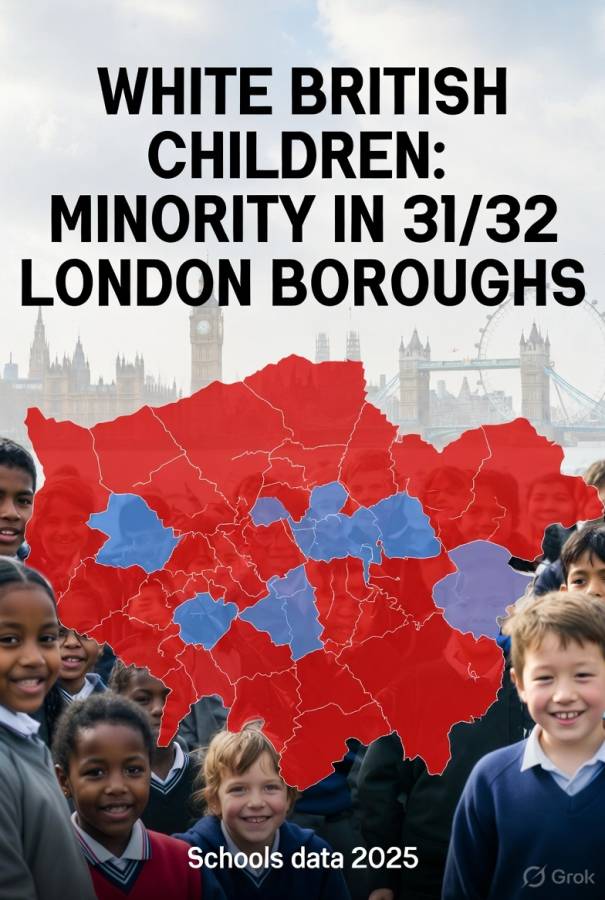
New figures from the Department for Education's latest school census show that White British pupils are now a minority in 31 of London's 32 boroughs. Only Bromley retains a narrow White British majority among schoolchildren, with the group accounting for just over half of pupils. In some boroughs, the numbers are dramatically lower. White British children make up roughly 5% of pupils in Newham and around 7% in Harrow.
The data reflects a transformation that has been unfolding over several decades but is now becoming increasingly visible through the capital's education system. Schools, by their nature, often reveal demographic shifts earlier than the wider population because they represent the newest generation of residents.
Across England as a whole, White British pupils still form the largest ethnic group in state-funded schools, accounting for around 60% of the student population. Yet that share has steadily declined from approximately 70% a decade ago. The trend is significantly more pronounced in London, where diversity has become a defining feature of everyday life.
The numbers are striking. In dozens of schools across England, there are no White British pupils enrolled at all, while hundreds more report White British pupils making up only a tiny fraction of their student body.
A City Transformed
The shift mirrors broader demographic changes across the capital.
According to the 2021 Census, White British residents account for 36.8% of London's population, down from 44.9% in 2011. The city remains majority White when other White ethnic groups are included, but London's population today is far more diverse than it was even a generation ago.
Several factors have contributed to this transformation.
Immigration has played a major role. London has long served as one of the world's leading destination cities, attracting workers, students, entrepreneurs, and families from across Europe, Asia, Africa, and the Middle East. Successive waves of migration, coupled with the city's economic opportunities, have steadily reshaped its population profile.
Demographers also point to differences in age structure and birth rates. Many migrant communities tend to have younger populations and, at least initially, higher fertility rates than the White British population. While these differences often narrow over time, they can have a significant impact on school-age demographics.
Housing costs have added another dimension. Over recent decades, many White British families have moved from inner London to outer suburbs, commuter towns, or other parts of England in search of more affordable housing and greater living space. This pattern, sometimes described as "internal migration," has further accelerated demographic change within the capital itself.
Diversity in the Classroom
Supporters of multiculturalism view London's schools as one of the city's greatest strengths.
Students routinely grow up alongside classmates from dozens of different cultural, linguistic, and religious backgrounds. Advocates argue that such environments help young people develop cultural awareness, adaptability, and the skills needed to thrive in an increasingly interconnected world.
Many London schools have also delivered strong academic results despite serving highly diverse populations. Educational researchers often point to a combination of ambitious school leadership, parental aspiration, targeted reforms, and the determination of many immigrant families to succeed through education.
Yet diversity also brings challenges.
Schools in some areas face growing demand for English-language support, particularly for pupils who speak English as an additional language. Teachers must navigate a wide range of cultural and educational backgrounds while ensuring that all students have equal opportunities to succeed.
Questions of integration and social cohesion remain central to the debate. While many communities interact successfully and build shared identities, critics argue that rapid demographic change can sometimes lead to social fragmentation if integration policies fail to keep pace.
Political commentators and academics continue to disagree over the long-term implications. Some see diversity as a source of economic dynamism and cultural vitality. Others worry about the potential erosion of shared national identity and social trust, particularly in areas where communities live largely parallel lives.
Research has produced mixed findings. Studies suggest that diverse communities can foster greater understanding and cross-cultural relationships, while some evidence indicates that rapid demographic change may temporarily reduce levels of social trust, especially in economically deprived areas.
Looking Beyond London
Importantly, London's experience is not representative of the entire country.
Large parts of rural England and many suburban communities remain overwhelmingly White British. Nevertheless, demographic trends observed in the capital are increasingly attracting national attention because London often serves as a preview of broader social changes.
Population projections suggest that, if current migration and birth-rate patterns continue, the ethnic composition of Britain will continue to evolve in the coming decades. Exactly how quickly that change occurs remains the subject of considerable debate among demographers and policymakers.
For government, the challenge is not simply managing population change but ensuring successful integration. Policymakers across the political spectrum have proposed various approaches, ranging from immigration reform and housing policies to investment in language education, community-building initiatives, and support for families.
What is beyond dispute is that London's classrooms now reflect a city unlike any previous generation has known. They are increasingly multilingual, multicultural, and globally connected. For supporters, that diversity represents one of London's greatest assets. For critics, it raises important questions about identity, cohesion, and the pace of change.
As Britain continues to grapple with those questions, the nation's schools remain at the forefront of a demographic transformation that is reshaping the country one generation at a time.
London's classrooms are offering perhaps the clearest glimpse into the city's rapidly changing demographic landscape.
New figures from the Department for Education's latest school census show that White British pupils are now a minority in 31 of London's 32 boroughs. Only Bromley retains a narrow White British majority among schoolchildren, with the group accounting for just over half of pupils. In some boroughs, the numbers are dramatically lower. White British children make up roughly 5% of pupils in Newham and around 7% in Harrow.
The data reflects a transformation that has been unfolding over several decades but is now becoming increasingly visible through the capital's education system. Schools, by their nature, often reveal demographic shifts earlier than the wider population because they represent the newest generation of residents.
Across England as a whole, White British pupils still form the largest ethnic group in state-funded schools, accounting for around 60% of the student population. Yet that share has steadily declined from approximately 70% a decade ago. The trend is significantly more pronounced in London, where diversity has become a defining feature of everyday life.
The numbers are striking. In dozens of schools across England, there are no White British pupils enrolled at all, while hundreds more report White British pupils making up only a tiny fraction of their student body.
A City Transformed
The shift mirrors broader demographic changes across the capital.
According to the 2021 Census, White British residents account for 36.8% of London's population, down from 44.9% in 2011. The city remains majority White when other White ethnic groups are included, but London's population today is far more diverse than it was even a generation ago.
Several factors have contributed to this transformation.
Immigration has played a major role. London has long served as one of the world's leading destination cities, attracting workers, students, entrepreneurs, and families from across Europe, Asia, Africa, and the Middle East. Successive waves of migration, coupled with the city's economic opportunities, have steadily reshaped its population profile.
Demographers also point to differences in age structure and birth rates. Many migrant communities tend to have younger populations and, at least initially, higher fertility rates than the White British population. While these differences often narrow over time, they can have a significant impact on school-age demographics.
Housing costs have added another dimension. Over recent decades, many White British families have moved from inner London to outer suburbs, commuter towns, or other parts of England in search of more affordable housing and greater living space. This pattern, sometimes described as "internal migration," has further accelerated demographic change within the capital itself.
Diversity in the Classroom
Supporters of multiculturalism view London's schools as one of the city's greatest strengths.
Students routinely grow up alongside classmates from dozens of different cultural, linguistic, and religious backgrounds. Advocates argue that such environments help young people develop cultural awareness, adaptability, and the skills needed to thrive in an increasingly interconnected world.
Many London schools have also delivered strong academic results despite serving highly diverse populations. Educational researchers often point to a combination of ambitious school leadership, parental aspiration, targeted reforms, and the determination of many immigrant families to succeed through education.
Yet diversity also brings challenges.
Schools in some areas face growing demand for English-language support, particularly for pupils who speak English as an additional language. Teachers must navigate a wide range of cultural and educational backgrounds while ensuring that all students have equal opportunities to succeed.
Questions of integration and social cohesion remain central to the debate. While many communities interact successfully and build shared identities, critics argue that rapid demographic change can sometimes lead to social fragmentation if integration policies fail to keep pace.
Political commentators and academics continue to disagree over the long-term implications. Some see diversity as a source of economic dynamism and cultural vitality. Others worry about the potential erosion of shared national identity and social trust, particularly in areas where communities live largely parallel lives.
Research has produced mixed findings. Studies suggest that diverse communities can foster greater understanding and cross-cultural relationships, while some evidence indicates that rapid demographic change may temporarily reduce levels of social trust, especially in economically deprived areas.
Looking Beyond London
Importantly, London's experience is not representative of the entire country.
Large parts of rural England and many suburban communities remain overwhelmingly White British. Nevertheless, demographic trends observed in the capital are increasingly attracting national attention because London often serves as a preview of broader social changes.
Population projections suggest that, if current migration and birth-rate patterns continue, the ethnic composition of Britain will continue to evolve in the coming decades. Exactly how quickly that change occurs remains the subject of considerable debate among demographers and policymakers.
For government, the challenge is not simply managing population change but ensuring successful integration. Policymakers across the political spectrum have proposed various approaches, ranging from immigration reform and housing policies to investment in language education, community-building initiatives, and support for families.
What is beyond dispute is that London's classrooms now reflect a city unlike any previous generation has known. They are increasingly multilingual, multicultural, and globally connected. For supporters, that diversity represents one of London's greatest assets. For critics, it raises important questions about identity, cohesion, and the pace of change.
As Britain continues to grapple with those questions, the nation's schools remain at the forefront of a demographic transformation that is reshaping the country one generation at a time.





























Leave a Comment