
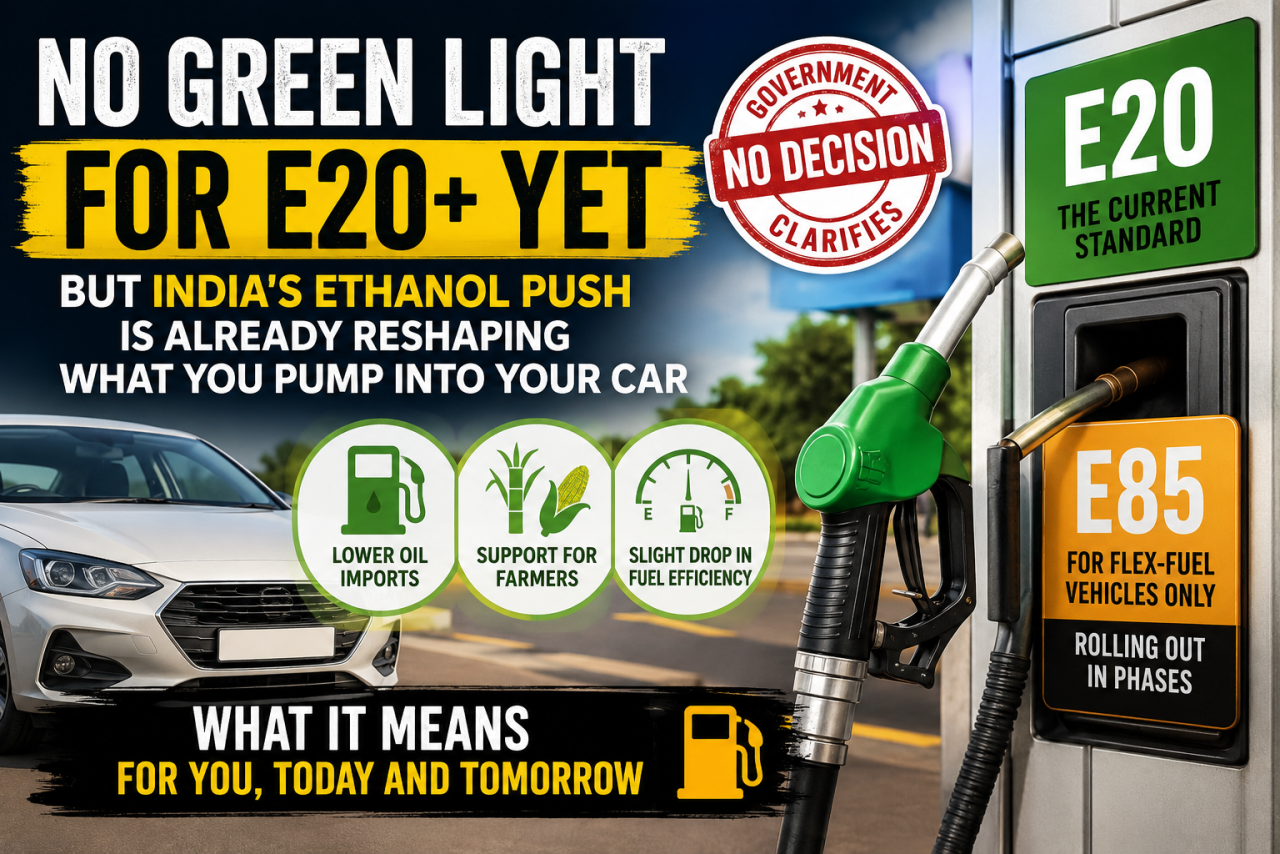
No, India is not moving beyond E20 yet. Here's what the government's clarification means for your car, your fuel bill, and the future of ethanol-blended petrol.
The Union government has clarified that it has not taken any decision to raise the mandatory ethanol blending level in petrol beyond the current 20 percent limit.
Replying in the Rajya Sabha, Minister of State for Petroleum and Natural Gas Suresh Gopi said any move towards higher ethanol blends would be based on detailed scientific studies and extensive consultations with automobile manufacturers, oil marketing companies, and research institutions.
The clarification follows the petroleum ministry's June 5 announcement of a phased rollout of E85 fuel, which had led to speculation that India was preparing to move beyond E20 for regular petrol.
The government has now made it clear that these are two separate initiatives. E20 remains the standard ethanol blend for petrol sold across the country, while E85 is an optional fuel intended exclusively for flex-fuel vehicles (FFVs), which are designed to operate on ethanol blends ranging from E20 to E100.
According to government officials, the distinction between the two programmes was widely misunderstood. The Rajya Sabha clarification applies only to conventional petrol sold to the general public and does not affect the rollout of E85 for flex-fuel vehicles.
What E20 Already Means for Consumers
India's Ethanol Blended Petrol Programme has been evolving for more than two decades. Introduced as a pilot project in 2001, it has steadily expanded and achieved the 20 percent blending target well ahead of the government's original 2030 timeline.
Today, millions of motorists are already using E20 petrol, often without noticing, since it is dispensed through the same fuel stations as conventional petrol and carries no separate pricing category.
The primary benefits are economic and strategic rather than immediately visible to consumers. Ethanol is produced domestically from sugarcane, maize, and surplus food grains. Higher blending helps reduce India's dependence on imported crude oil, improves energy security, and can soften the long-term impact of volatile global oil prices. It also creates a stable market for agricultural produce, providing additional income opportunities for farmers.
Consumers, however, may notice certain trade-offs.
Because ethanol contains roughly 30 percent less energy than pure petrol, fuel economy can decline slightly. Owners of older vehicles, particularly those manufactured before 2023, have reported mileage reductions ranging from around 1 to 6 percent, although actual performance varies depending on vehicle type and driving conditions.
Automobile manufacturers have also cautioned that older engines and fuel system components, especially rubber and plastic parts not designed for higher ethanol content, may experience increased wear or corrosion over time. In a country where two-wheelers and budget cars account for a large share of daily transport, even a modest reduction in fuel efficiency can have a noticeable impact on annual running costs.
Why E85 Is Different
The government's E85 initiative has been designed specifically to avoid these concerns.
Launched by Union Petroleum Minister Hardeep Singh Puri on World Environment Day, E85 fuel is intended only for flex-fuel vehicles that are engineered to safely operate on ethanol blends ranging from E20 to E100.
Owners of conventional petrol vehicles will not be required to use E85, eliminating concerns about engine compatibility or accidental damage.
The rollout will begin cautiously. Initially, E85 will be available at 48 public sector fuel outlets before expanding to around 500 outlets by December 2026 and nearly 5,000 outlets by December 2027.
The petroleum ministry estimates that, together with the existing E20 programme, this expansion could help raise India's overall ethanol blending level to nearly 26 percent by 2030-31.
For consumers considering a new vehicle purchase, the rollout is worth monitoring. Flex-fuel vehicles remain a niche segment in India, and buyers should weigh the relatively limited availability of E85 stations in the coming years. They should also remember that higher ethanol blends generally require greater fuel consumption to travel the same distance, even when the fuel is priced lower per litre.
What Consumers Should Know
For now, the government's latest clarification is more reassuring than transformative.
There is no proposal to require existing petrol vehicles to operate on ethanol blends higher than E20. Any future increase, the government has said, will only be considered after comprehensive scientific evaluation and consultations with vehicle manufacturers, reducing the risk of compatibility issues or unexpected warranty concerns.
For most motorists, daily life remains unchanged. E20 petrol will continue to be the standard fuel available at regular pumps, with only a modest impact on fuel efficiency for most users. The broader benefits of the ethanol programme are expected to be felt through lower crude oil imports, improved energy security, and stronger support for India's agricultural economy rather than through dramatic changes at the fuel station.
The rollout of E85 offers a glimpse into the future of India's transport fuel strategy, but for the foreseeable future it will remain an optional choice for owners of flex-fuel vehicles rather than a mandatory shift for the country's millions of conventional petrol vehicle users.
The Union government has clarified that it has not taken any decision to raise the mandatory ethanol blending level in petrol beyond the current 20 percent limit.
Replying in the Rajya Sabha, Minister of State for Petroleum and Natural Gas Suresh Gopi said any move towards higher ethanol blends would be based on detailed scientific studies and extensive consultations with automobile manufacturers, oil marketing companies, and research institutions.
The clarification follows the petroleum ministry's June 5 announcement of a phased rollout of E85 fuel, which had led to speculation that India was preparing to move beyond E20 for regular petrol.
The government has now made it clear that these are two separate initiatives. E20 remains the standard ethanol blend for petrol sold across the country, while E85 is an optional fuel intended exclusively for flex-fuel vehicles (FFVs), which are designed to operate on ethanol blends ranging from E20 to E100.
According to government officials, the distinction between the two programmes was widely misunderstood. The Rajya Sabha clarification applies only to conventional petrol sold to the general public and does not affect the rollout of E85 for flex-fuel vehicles.
What E20 Already Means for Consumers
India's Ethanol Blended Petrol Programme has been evolving for more than two decades. Introduced as a pilot project in 2001, it has steadily expanded and achieved the 20 percent blending target well ahead of the government's original 2030 timeline.
Today, millions of motorists are already using E20 petrol, often without noticing, since it is dispensed through the same fuel stations as conventional petrol and carries no separate pricing category.
The primary benefits are economic and strategic rather than immediately visible to consumers. Ethanol is produced domestically from sugarcane, maize, and surplus food grains. Higher blending helps reduce India's dependence on imported crude oil, improves energy security, and can soften the long-term impact of volatile global oil prices. It also creates a stable market for agricultural produce, providing additional income opportunities for farmers.
Consumers, however, may notice certain trade-offs.
Because ethanol contains roughly 30 percent less energy than pure petrol, fuel economy can decline slightly. Owners of older vehicles, particularly those manufactured before 2023, have reported mileage reductions ranging from around 1 to 6 percent, although actual performance varies depending on vehicle type and driving conditions.
Automobile manufacturers have also cautioned that older engines and fuel system components, especially rubber and plastic parts not designed for higher ethanol content, may experience increased wear or corrosion over time. In a country where two-wheelers and budget cars account for a large share of daily transport, even a modest reduction in fuel efficiency can have a noticeable impact on annual running costs.
Why E85 Is Different
The government's E85 initiative has been designed specifically to avoid these concerns.
Launched by Union Petroleum Minister Hardeep Singh Puri on World Environment Day, E85 fuel is intended only for flex-fuel vehicles that are engineered to safely operate on ethanol blends ranging from E20 to E100.
Owners of conventional petrol vehicles will not be required to use E85, eliminating concerns about engine compatibility or accidental damage.
The rollout will begin cautiously. Initially, E85 will be available at 48 public sector fuel outlets before expanding to around 500 outlets by December 2026 and nearly 5,000 outlets by December 2027.
The petroleum ministry estimates that, together with the existing E20 programme, this expansion could help raise India's overall ethanol blending level to nearly 26 percent by 2030-31.
For consumers considering a new vehicle purchase, the rollout is worth monitoring. Flex-fuel vehicles remain a niche segment in India, and buyers should weigh the relatively limited availability of E85 stations in the coming years. They should also remember that higher ethanol blends generally require greater fuel consumption to travel the same distance, even when the fuel is priced lower per litre.
What Consumers Should Know
For now, the government's latest clarification is more reassuring than transformative.
There is no proposal to require existing petrol vehicles to operate on ethanol blends higher than E20. Any future increase, the government has said, will only be considered after comprehensive scientific evaluation and consultations with vehicle manufacturers, reducing the risk of compatibility issues or unexpected warranty concerns.
For most motorists, daily life remains unchanged. E20 petrol will continue to be the standard fuel available at regular pumps, with only a modest impact on fuel efficiency for most users. The broader benefits of the ethanol programme are expected to be felt through lower crude oil imports, improved energy security, and stronger support for India's agricultural economy rather than through dramatic changes at the fuel station.
The rollout of E85 offers a glimpse into the future of India's transport fuel strategy, but for the foreseeable future it will remain an optional choice for owners of flex-fuel vehicles rather than a mandatory shift for the country's millions of conventional petrol vehicle users.
























Leave a Comment