
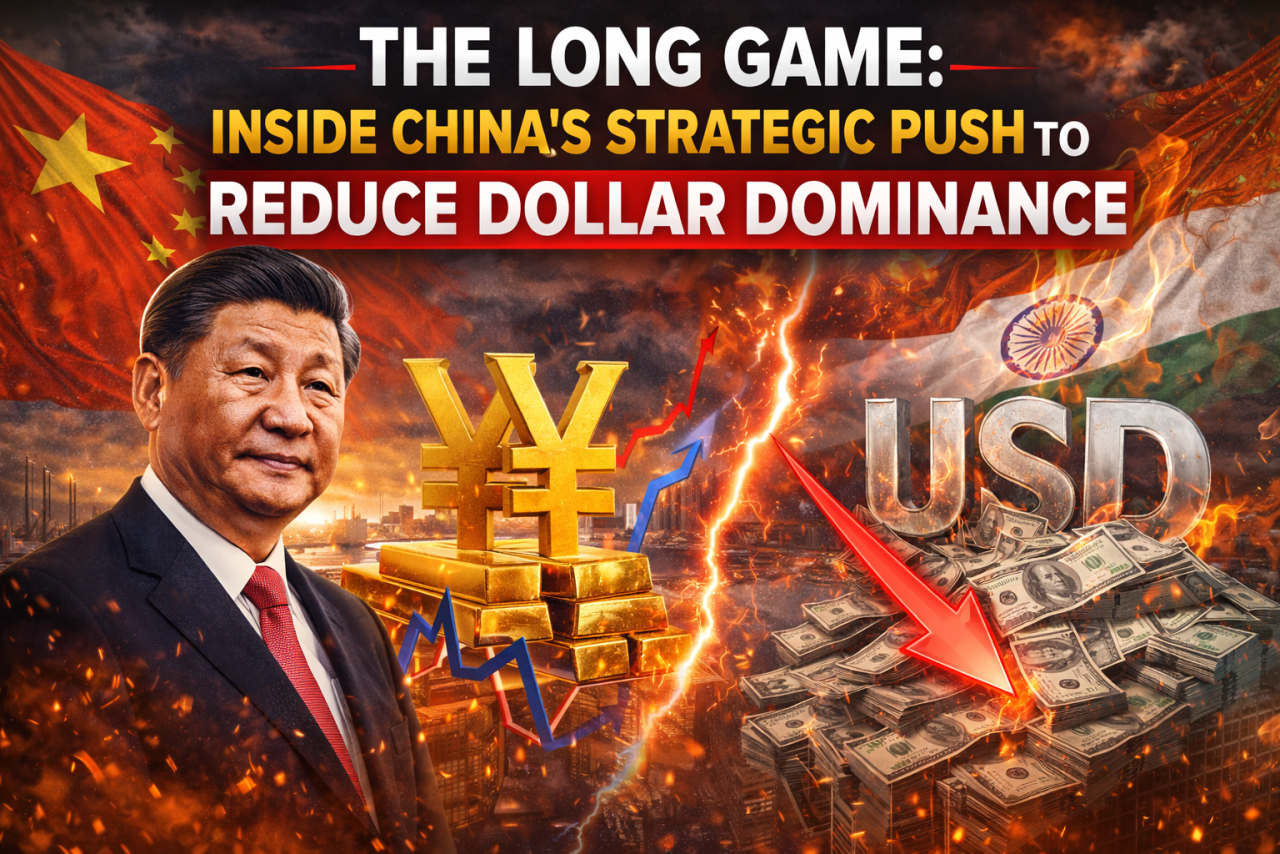
While the world watches markets and wars, China is playing a longer game by redesigning the plumbing of global finance.
China is steadily working to reduce the global dominance of the US dollar by building its own financial systems and alternatives. From currency swap agreements to gold accumulation and the development of a digital yuan, Beijing is laying the groundwork for a parallel financial architecture aimed at reducing its exposure to US monetary policy and economic sanctions.
For decades, the global financial system has rested on one central reality. The US dollar is the world’s primary currency for trade, reserves, and financial transactions. This position gives Washington enormous economic influence and allows it to use financial tools as part of its foreign policy. However, a slow and deliberate challenge to this dominance is now taking shape in East Asia. China, the world’s second-largest economy, is not attempting a sudden or dramatic replacement of the dollar. Economists widely agree such a shift would be unrealistic. Instead, Beijing is pursuing a long-term strategy that gradually weakens the dollar’s central role while strengthening alternatives that serve China’s interests.
The motivation behind this strategy is largely practical rather than ideological. China’s heavy reliance on the dollar system exposes it to several risks. US sanctions, enforced through dollar-based clearing systems, could be used against Chinese companies and institutions. Changes in US Federal Reserve policy also have direct consequences for China, as higher interest rates in the US can trigger capital outflows and financial instability. In addition, China holds more than 770 billion dollars in US Treasury securities, tying a large part of its financial security to American fiscal conditions. As geopolitical analysts often note, China’s objective is to increase resilience rather than replace the dollar outright.
One of the key pillars of this effort is the gradual internationalisation of the renminbi. Although the Chinese currency accounts for only about 2.5 percent of global payments, its use is increasing. The People’s Bank of China has signed bilateral currency swap agreements with more than 40 central banks, creating a network worth over 4 trillion yuan. These arrangements allow partner countries to settle trade directly in renminbi instead of converting through the dollar. China has also used its position as the world’s largest commodities importer to encourage renminbi-based trade, particularly in energy and raw materials sourced from countries such as Russia, Saudi Arabia, and Brazil.
Supporting this push is China’s investment in its own financial infrastructure. The Cross-Border Interbank Payment System, launched in 2015, provides an alternative channel for international renminbi transactions. While its transaction volume remains much smaller than that of the SWIFT network, its strategic value is significant. CIPS allows China and its trading partners to move funds through a system that is not controlled by Western institutions, reducing exposure to potential restrictions or sanctions.
China is also adjusting the composition of its foreign exchange reserves. With total reserves exceeding 3.2 trillion dollars, Beijing has been steadily increasing its gold holdings. Official data shows that China has added gold to its reserves for more than a year and a half without interruption. This move lowers dependence on dollar-denominated assets and strengthens confidence in the long-term stability of the renminbi.
Another important element of this strategy is the digital yuan. While it is primarily used within China at present, authorities are exploring its potential for cross-border payments. A fully functional central bank digital currency could enable faster and more direct international settlements without relying on traditional banking channels. Over time, this could reduce the role of dollar-based systems in global transactions.
China’s broader goal is not to create a world dominated by the yuan, but to encourage a more multipolar currency system. Efforts by China, along with initiatives such as expanded BRICS cooperation on local-currency trade, are gradually pushing global finance in this direction. The dollar is likely to remain the world’s leading currency for years to come, supported by deep US capital markets and long-standing trust. Still, its share of global reserves has fallen from over 70 percent in 2000 to around 58 percent today.
What China ultimately wants is choice. By developing alternatives such as renminbi trade settlement, payment systems, and reserve diversification, Beijing is working toward a world where dependence on the dollar is no longer absolute. This transformation is happening slowly and largely out of the spotlight, but it is reshaping the foundations of global economic power. By the middle of the century, the structure of the international financial system may reflect decisions being made in Beijing today rather than reliance on a single dominant currency.





























Leave a Comment