
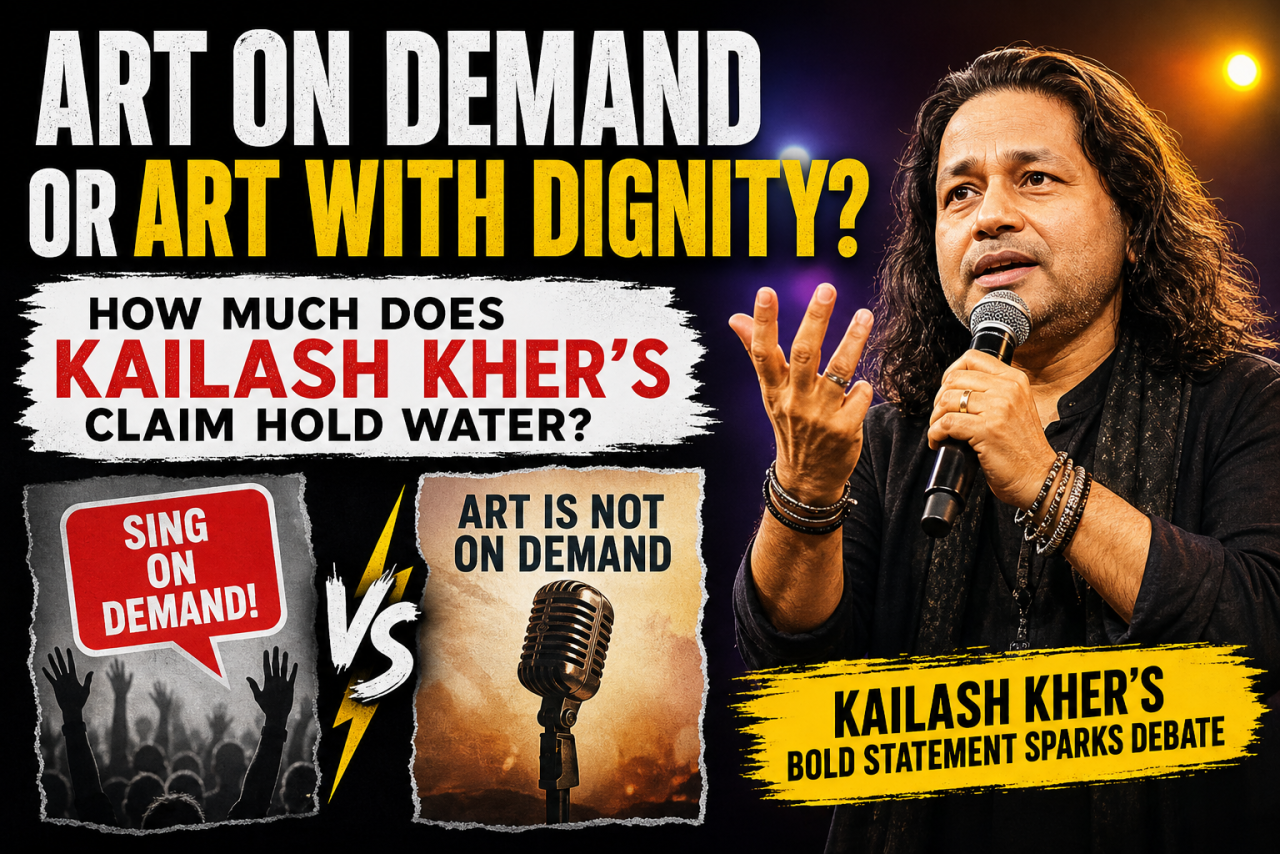
Can creativity be commanded, or does true art refuse to perform on cue?
When singer Kailash Kher recently remarked that he does not sing “on demand,” it sparked a familiar debate: should artists be expected to perform whenever the audience asks, or does art require space, mood, and respect to exist meaningfully?
At first glance, the expectation seems harmless. After all, audiences admire artists deeply. When people request a song, it often comes from love, nostalgia, or excitement. In everyday settings—family gatherings, small events, or even social media—asking someone to sing or perform feels natural. But Kher’s claim challenges this casual culture by placing art in a more professional and thoughtful framework.
His argument rests on a simple idea that an art is not a vending machine. You cannot insert a request and expect a performance instantly. Singing, like any serious craft, involves preparation, emotional alignment, and context. A stage performance is not just about vocal delivery—it includes rehearsals, sound checks, and a mental connection with the audience. When stripped of these elements, the performance risks becoming mechanical rather than expressive.
This perspective finds support among many artists. Singer-composer Salim Merchant has pointed out that such casual demands can sometimes feel demeaning, especially when they ignore the effort behind the art. Similarly, Raghu Dixit emphasizes that music is a profession, not a hobby to be accessed on demand. From this viewpoint, Kher’s stance holds considerable weight.
However, the issue is not entirely one-sided.
Art, unlike many other professions, thrives on connection. A spontaneous song at a gathering, a poet reciting a verse among friends, or a musician responding to a crowd’s energy—these moments often create magic. They humanize artists and bring them closer to their audience. For many fans, such unscripted performances are the most memorable experiences.
Critics of Kher’s view argue that refusing such requests may come across as aloof or disconnected. They believe that artists, especially public figures, carry a certain responsibility to engage with their audience beyond formal settings. In cultures like India, where music and poetry are deeply woven into everyday life, spontaneity is part of the tradition. Saying “no” too often may risk losing that warmth.
So, where does the truth lie?
The answer likely sits somewhere in between. Kher’s claim is valid when seen through the lens of professionalism and artistic integrity. Art deserves respect, and artists should have the autonomy to decide when and how they perform. Reducing art to a casual demand can dilute its value and ignore the years of practice behind it.
At the same time, completely distancing art from spontaneity may not be ideal either. Some of the most beautiful artistic moments emerge unexpectedly. The key difference lies in consent and context. When an artist chooses to perform spontaneously, it is an act of generosity. When they are pressured into it, it becomes an obligation—and that is where the problem begins.
Ultimately, Kher’s statement is less about refusal and more about redefining boundaries. It reminds audiences that appreciation should come with respect. Admiring art also means understanding the artist’s space, mood, and process.
In a world where content is constantly demanded and instantly consumed, this message feels increasingly relevant. Art is not just output—it is expression. And expression, by its very nature, cannot always be summoned on command.
When singer Kailash Kher recently remarked that he does not sing “on demand,” it sparked a familiar debate: should artists be expected to perform whenever the audience asks, or does art require space, mood, and respect to exist meaningfully?
At first glance, the expectation seems harmless. After all, audiences admire artists deeply. When people request a song, it often comes from love, nostalgia, or excitement. In everyday settings—family gatherings, small events, or even social media—asking someone to sing or perform feels natural. But Kher’s claim challenges this casual culture by placing art in a more professional and thoughtful framework.
His argument rests on a simple idea that an art is not a vending machine. You cannot insert a request and expect a performance instantly. Singing, like any serious craft, involves preparation, emotional alignment, and context. A stage performance is not just about vocal delivery—it includes rehearsals, sound checks, and a mental connection with the audience. When stripped of these elements, the performance risks becoming mechanical rather than expressive.
This perspective finds support among many artists. Singer-composer Salim Merchant has pointed out that such casual demands can sometimes feel demeaning, especially when they ignore the effort behind the art. Similarly, Raghu Dixit emphasizes that music is a profession, not a hobby to be accessed on demand. From this viewpoint, Kher’s stance holds considerable weight.
However, the issue is not entirely one-sided.
Art, unlike many other professions, thrives on connection. A spontaneous song at a gathering, a poet reciting a verse among friends, or a musician responding to a crowd’s energy—these moments often create magic. They humanize artists and bring them closer to their audience. For many fans, such unscripted performances are the most memorable experiences.
Critics of Kher’s view argue that refusing such requests may come across as aloof or disconnected. They believe that artists, especially public figures, carry a certain responsibility to engage with their audience beyond formal settings. In cultures like India, where music and poetry are deeply woven into everyday life, spontaneity is part of the tradition. Saying “no” too often may risk losing that warmth.
So, where does the truth lie?
The answer likely sits somewhere in between. Kher’s claim is valid when seen through the lens of professionalism and artistic integrity. Art deserves respect, and artists should have the autonomy to decide when and how they perform. Reducing art to a casual demand can dilute its value and ignore the years of practice behind it.
At the same time, completely distancing art from spontaneity may not be ideal either. Some of the most beautiful artistic moments emerge unexpectedly. The key difference lies in consent and context. When an artist chooses to perform spontaneously, it is an act of generosity. When they are pressured into it, it becomes an obligation—and that is where the problem begins.
Ultimately, Kher’s statement is less about refusal and more about redefining boundaries. It reminds audiences that appreciation should come with respect. Admiring art also means understanding the artist’s space, mood, and process.
In a world where content is constantly demanded and instantly consumed, this message feels increasingly relevant. Art is not just output—it is expression. And expression, by its very nature, cannot always be summoned on command.









Leave a Comment