
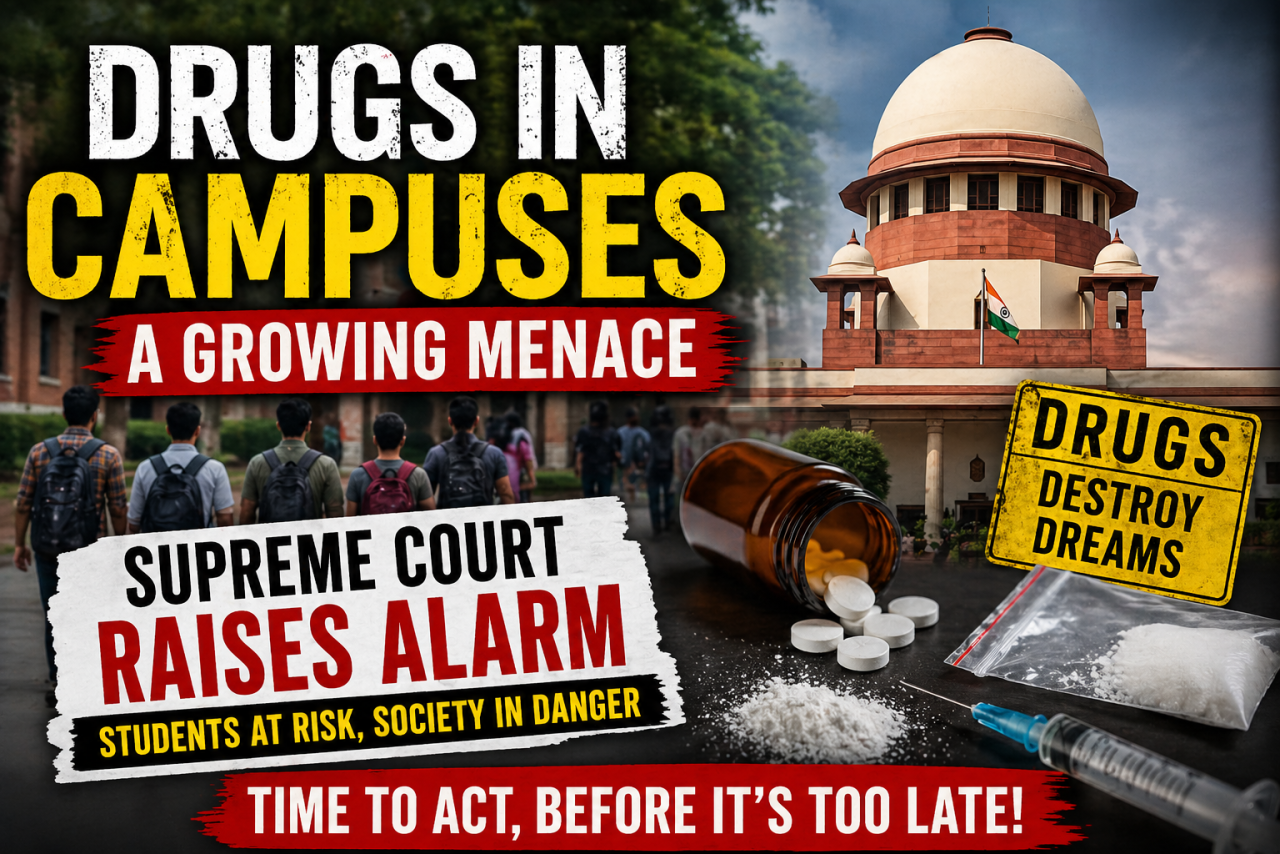
The Supreme Court has raised a serious alarm over the rising presence of drugs in educational campuses, warning that students are increasingly becoming targets of organized drug networks.
The issue of drug abuse in educational institutions has taken a serious turn, with the Supreme Court of India recently expressing concern over the increasing presence of narcotics in schools and colleges. In a recent observation reported from New Delhi, the court warned that drug networks are steadily entering campuses, turning them into “target zones” and putting students at risk both as consumers and carriers.
The court’s remarks came during the hearing of a case under the Narcotic Drugs and Psychotropic Substances Act 1985, where a young law student was accused of procuring Ganja. A bench comprising Justice J.B. Pardiwala and Justice R. Mahadevan highlighted a worrying trend—students are not just falling victim to drug abuse but are also being used by criminal networks to expand their reach within campuses.
According to the observations, drug rackets are deliberately targeting educational institutions because of the vulnerability of young people. Students, often away from home and under academic and social pressure, can be easily influenced. The court noted that such networks are “systematically infiltrating” campuses, making the problem far more serious than isolated cases of substance use.
This warning reflects a broader reality seen across many parts of the country. Reports and investigations have pointed to the availability of drugs near colleges and hostels, sometimes even delivered through digital transactions. In the case heard by the court, digital evidence and alleged transactions were cited as part of the investigation, showing how modern technology is being misused to spread illegal activities among youth.
The concern is not only about law enforcement but also about the future of students. Drug abuse at a young age can have lasting effects on physical and mental health. It affects concentration, reduces academic performance, and can lead to long-term addiction. More importantly, it can push students toward risky or illegal activities, damaging their careers before they even begin.
The Supreme Court also made an important observation about the approach of authorities. While strict action against drug traffickers is necessary, the court cautioned against treating every student involved as a hardened criminal. It stressed that young individuals, especially first-time offenders, should not be pushed deeper into the system without proper evidence and consideration. This balanced view highlights the need for both justice and reform.
At the same time, the judiciary underlined that the growing presence of drugs in campuses cannot be ignored. It called for a more serious and coordinated response from authorities. This includes stricter monitoring of areas around educational institutions, better intelligence on drug networks, and stronger preventive measures.
The role of educational institutions is equally important. Colleges and universities must not treat this issue as a taboo subject. Instead, they should actively create awareness among students about the dangers of drug use. Counseling services, peer support groups, and regular awareness drives can play a key role in prevention. When students feel supported and informed, they are less likely to fall into harmful habits.
Parents and society also have a responsibility. Open communication with young people can help identify early signs of stress or risky behavior. Instead of fear or punishment, guidance and understanding are often more effective in preventing substance abuse.
The warning from the Supreme Court serves as a wake-up call. Drug abuse in campuses is no longer a hidden or minor issue—it is a growing challenge that threatens the well-being of the youth and the safety of society. If educational spaces are compromised, the consequences will be far-reaching.
In the end, the rise of drugs in campuses must be addressed with urgency and seriousness. Strong law enforcement, responsible institutions, aware students, and supportive families together can help tackle this problem. As the court rightly pointed out, protecting students from this growing menace is not just a legal duty but a social responsibility.
The issue of drug abuse in educational institutions has taken a serious turn, with the Supreme Court of India recently expressing concern over the increasing presence of narcotics in schools and colleges. In a recent observation reported from New Delhi, the court warned that drug networks are steadily entering campuses, turning them into “target zones” and putting students at risk both as consumers and carriers.
The court’s remarks came during the hearing of a case under the Narcotic Drugs and Psychotropic Substances Act 1985, where a young law student was accused of procuring Ganja. A bench comprising Justice J.B. Pardiwala and Justice R. Mahadevan highlighted a worrying trend—students are not just falling victim to drug abuse but are also being used by criminal networks to expand their reach within campuses.
According to the observations, drug rackets are deliberately targeting educational institutions because of the vulnerability of young people. Students, often away from home and under academic and social pressure, can be easily influenced. The court noted that such networks are “systematically infiltrating” campuses, making the problem far more serious than isolated cases of substance use.
This warning reflects a broader reality seen across many parts of the country. Reports and investigations have pointed to the availability of drugs near colleges and hostels, sometimes even delivered through digital transactions. In the case heard by the court, digital evidence and alleged transactions were cited as part of the investigation, showing how modern technology is being misused to spread illegal activities among youth.
The concern is not only about law enforcement but also about the future of students. Drug abuse at a young age can have lasting effects on physical and mental health. It affects concentration, reduces academic performance, and can lead to long-term addiction. More importantly, it can push students toward risky or illegal activities, damaging their careers before they even begin.
The Supreme Court also made an important observation about the approach of authorities. While strict action against drug traffickers is necessary, the court cautioned against treating every student involved as a hardened criminal. It stressed that young individuals, especially first-time offenders, should not be pushed deeper into the system without proper evidence and consideration. This balanced view highlights the need for both justice and reform.
At the same time, the judiciary underlined that the growing presence of drugs in campuses cannot be ignored. It called for a more serious and coordinated response from authorities. This includes stricter monitoring of areas around educational institutions, better intelligence on drug networks, and stronger preventive measures.
The role of educational institutions is equally important. Colleges and universities must not treat this issue as a taboo subject. Instead, they should actively create awareness among students about the dangers of drug use. Counseling services, peer support groups, and regular awareness drives can play a key role in prevention. When students feel supported and informed, they are less likely to fall into harmful habits.
Parents and society also have a responsibility. Open communication with young people can help identify early signs of stress or risky behavior. Instead of fear or punishment, guidance and understanding are often more effective in preventing substance abuse.
The warning from the Supreme Court serves as a wake-up call. Drug abuse in campuses is no longer a hidden or minor issue—it is a growing challenge that threatens the well-being of the youth and the safety of society. If educational spaces are compromised, the consequences will be far-reaching.
In the end, the rise of drugs in campuses must be addressed with urgency and seriousness. Strong law enforcement, responsible institutions, aware students, and supportive families together can help tackle this problem. As the court rightly pointed out, protecting students from this growing menace is not just a legal duty but a social responsibility.


























Leave a Comment