
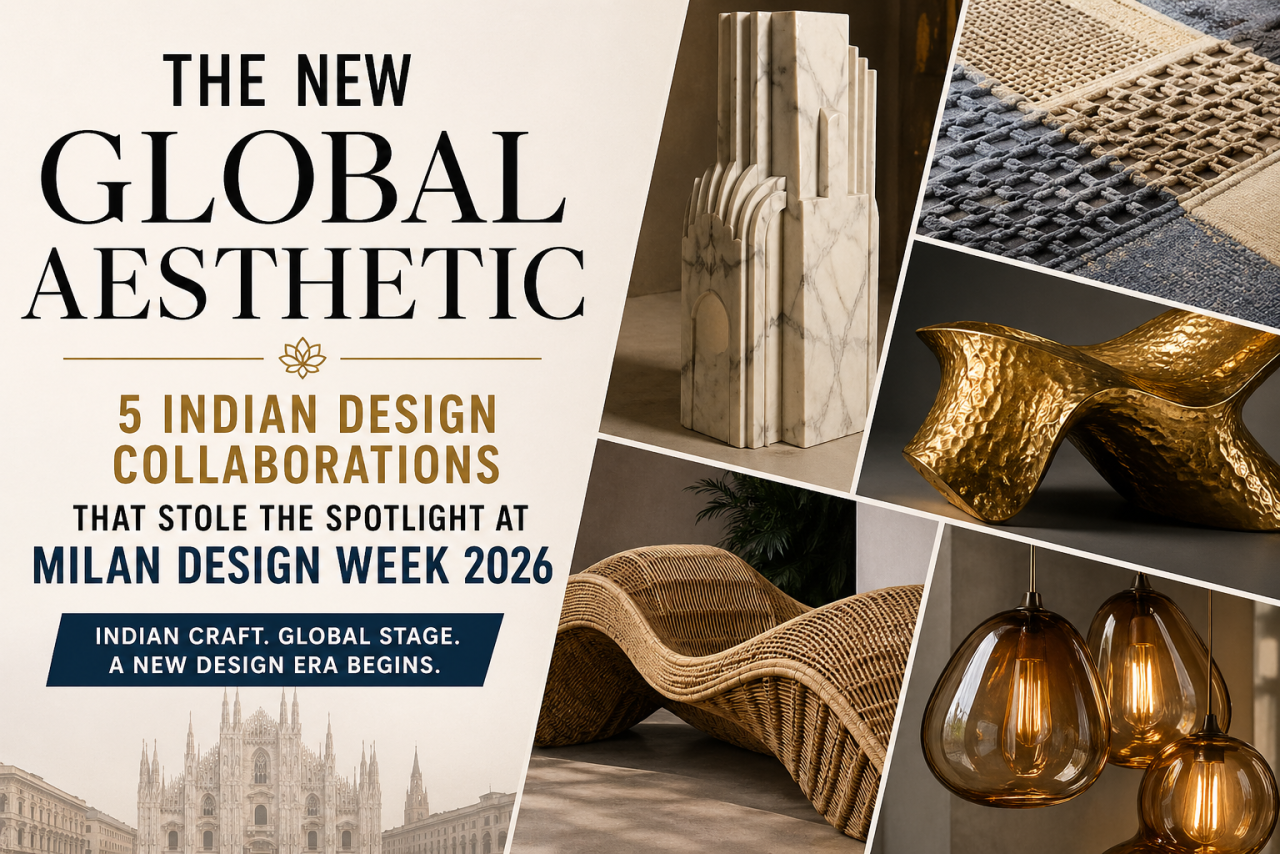
Indian designers played a leading role at Milan Design Week 2026, with collaborations that are shaping global design trends.
At this year’s Milan Design Week 2026, Indian designers were shaping conversations. Across venues like Salone Raritas and Alcova, collaborations led by Indian studios stood out not for their “exotic appeal,” but for their conceptual clarity and material confidence.
For years, Indian craft has been visible on global platforms, often framed as heritage or inspiration. What changed in 2026 is the positioning. These projects placed Indian designers and artisans as equal creative partners, working alongside international names to produce objects aimed squarely at the collectible design market.
Here are five collaborations that defined that shift.
1. Karan Desai x Serafini: Translating Philosophy into Stone
Mumbai-based architect Karan Desai made his Milan debut with JinaShilp, a collaboration with Italian marble company Serafini at Salone Raritas. The collection featured tall, monolithic forms carved from marble, drawing from principles of Jain philosophy—particularly stillness and introspection.
Rather than leaning on ornamentation, the pieces relied on proportion, negative space, and surface detail. The result felt closer to architectural fragments than furniture—objects designed for collectors rather than mass production. In a fair often dominated by spectacle, the restraint worked in its favour.
2. Jaipur Rugs x Kengo Kuma: Architecture Woven into Textiles
In one of the most widely discussed showcases, Jaipur Rugs partnered with Japanese architect Kengo Kuma for the Faces collection, exhibited at the Crespi Bonsai Museum.
The 16-piece series translated Kuma’s architectural language—especially his use of light, layering, and lattice structures—into hand-knotted rugs crafted by artisans in Rajasthan. The influence of Musō-gōshi (traditional Japanese latticework) was visible, but never literal.
What stood out was the tactility. These weren’t flat surfaces but layered textiles with depth, encouraging viewers to engage up close. It was a reminder that Indian craftsmanship can carry complex, contemporary design narratives without losing its identity.
3. Vikram Goyal x Rodolfo Agrella: Reworking Metal as Movement
At Alcova, New Delhi-based designer Vikram Goyal collaborated with New York designer Rodolfo Agrella under the Natyam series.
Known for his mastery of repoussé, Goyal worked with Agrella’s interest in repetition and rhythm to produce sculptural brass pieces that seemed almost fluid. Surfaces were hammered by hand, yet the final forms felt soft and continuous—more like frozen motion than static objects.
The collaboration avoided nostalgia. Instead of presenting craft as preservation, it treated it as a living technique capable of evolving with contemporary form.
4. Heirloom Naga x Global Designers: Craft at a Monumental Scale
The Shakti Design Residency spotlighted artisans from the Heirloom Naga Centre in Dimapur, working alongside designers Maria Tyakina and Tadáš Podracký.
Their most striking piece—an undulating, large-scale bench—pushed the limits of traditional loin loom weaving and cane work. Produced with the support of Cane Concept, the piece blurred the line between furniture and installation.
More importantly, it challenged how indigenous craft is typically positioned. Instead of being confined to small-scale or decorative objects, it was presented here as ambitious, structural, and globally relevant.
5. Klove Studio x Daniel Garber: Rethinking Glass Minimalism
Lighting brand Klove Studio—led by Prateek Jain and Gautam Seth—worked with designer Daniel Garber on Project Reh, a collection of handblown glass lighting.
Produced by artisans in Uttar Pradesh, the pieces used warm amber tones and subtle irregularities to highlight the handmade process. The forms were minimal, but not sterile—each carried slight variations that made the material feel alive.
In a market saturated with polished, machine-finished lighting, this emphasis on imperfection gave the collection its edge.
A Shift That Feels Structural, Not Seasonal
What made these collaborations stand out wasn’t just aesthetics—it was intent. None of the projects diluted their Indian context to fit a global market. Instead, they leaned into material knowledge, regional techniques, and philosophical depth, while engaging with international design frameworks.
This signals a broader shift. Indian design is no longer being framed as a source of inspiration for global brands; it is becoming central to how contemporary design is conceived and produced.
Whether this momentum translates into sustained market demand remains to be seen.
At this year’s Milan Design Week 2026, Indian designers were shaping conversations. Across venues like Salone Raritas and Alcova, collaborations led by Indian studios stood out not for their “exotic appeal,” but for their conceptual clarity and material confidence.
For years, Indian craft has been visible on global platforms, often framed as heritage or inspiration. What changed in 2026 is the positioning. These projects placed Indian designers and artisans as equal creative partners, working alongside international names to produce objects aimed squarely at the collectible design market.
Here are five collaborations that defined that shift.
1. Karan Desai x Serafini: Translating Philosophy into Stone
Mumbai-based architect Karan Desai made his Milan debut with JinaShilp, a collaboration with Italian marble company Serafini at Salone Raritas. The collection featured tall, monolithic forms carved from marble, drawing from principles of Jain philosophy—particularly stillness and introspection.
Rather than leaning on ornamentation, the pieces relied on proportion, negative space, and surface detail. The result felt closer to architectural fragments than furniture—objects designed for collectors rather than mass production. In a fair often dominated by spectacle, the restraint worked in its favour.
2. Jaipur Rugs x Kengo Kuma: Architecture Woven into Textiles
In one of the most widely discussed showcases, Jaipur Rugs partnered with Japanese architect Kengo Kuma for the Faces collection, exhibited at the Crespi Bonsai Museum.
The 16-piece series translated Kuma’s architectural language—especially his use of light, layering, and lattice structures—into hand-knotted rugs crafted by artisans in Rajasthan. The influence of Musō-gōshi (traditional Japanese latticework) was visible, but never literal.
What stood out was the tactility. These weren’t flat surfaces but layered textiles with depth, encouraging viewers to engage up close. It was a reminder that Indian craftsmanship can carry complex, contemporary design narratives without losing its identity.
3. Vikram Goyal x Rodolfo Agrella: Reworking Metal as Movement
At Alcova, New Delhi-based designer Vikram Goyal collaborated with New York designer Rodolfo Agrella under the Natyam series.
Known for his mastery of repoussé, Goyal worked with Agrella’s interest in repetition and rhythm to produce sculptural brass pieces that seemed almost fluid. Surfaces were hammered by hand, yet the final forms felt soft and continuous—more like frozen motion than static objects.
The collaboration avoided nostalgia. Instead of presenting craft as preservation, it treated it as a living technique capable of evolving with contemporary form.
4. Heirloom Naga x Global Designers: Craft at a Monumental Scale
The Shakti Design Residency spotlighted artisans from the Heirloom Naga Centre in Dimapur, working alongside designers Maria Tyakina and Tadáš Podracký.
Their most striking piece—an undulating, large-scale bench—pushed the limits of traditional loin loom weaving and cane work. Produced with the support of Cane Concept, the piece blurred the line between furniture and installation.
More importantly, it challenged how indigenous craft is typically positioned. Instead of being confined to small-scale or decorative objects, it was presented here as ambitious, structural, and globally relevant.
5. Klove Studio x Daniel Garber: Rethinking Glass Minimalism
Lighting brand Klove Studio—led by Prateek Jain and Gautam Seth—worked with designer Daniel Garber on Project Reh, a collection of handblown glass lighting.
Produced by artisans in Uttar Pradesh, the pieces used warm amber tones and subtle irregularities to highlight the handmade process. The forms were minimal, but not sterile—each carried slight variations that made the material feel alive.
In a market saturated with polished, machine-finished lighting, this emphasis on imperfection gave the collection its edge.
A Shift That Feels Structural, Not Seasonal
What made these collaborations stand out wasn’t just aesthetics—it was intent. None of the projects diluted their Indian context to fit a global market. Instead, they leaned into material knowledge, regional techniques, and philosophical depth, while engaging with international design frameworks.
This signals a broader shift. Indian design is no longer being framed as a source of inspiration for global brands; it is becoming central to how contemporary design is conceived and produced.
Whether this momentum translates into sustained market demand remains to be seen.





























Leave a Comment