
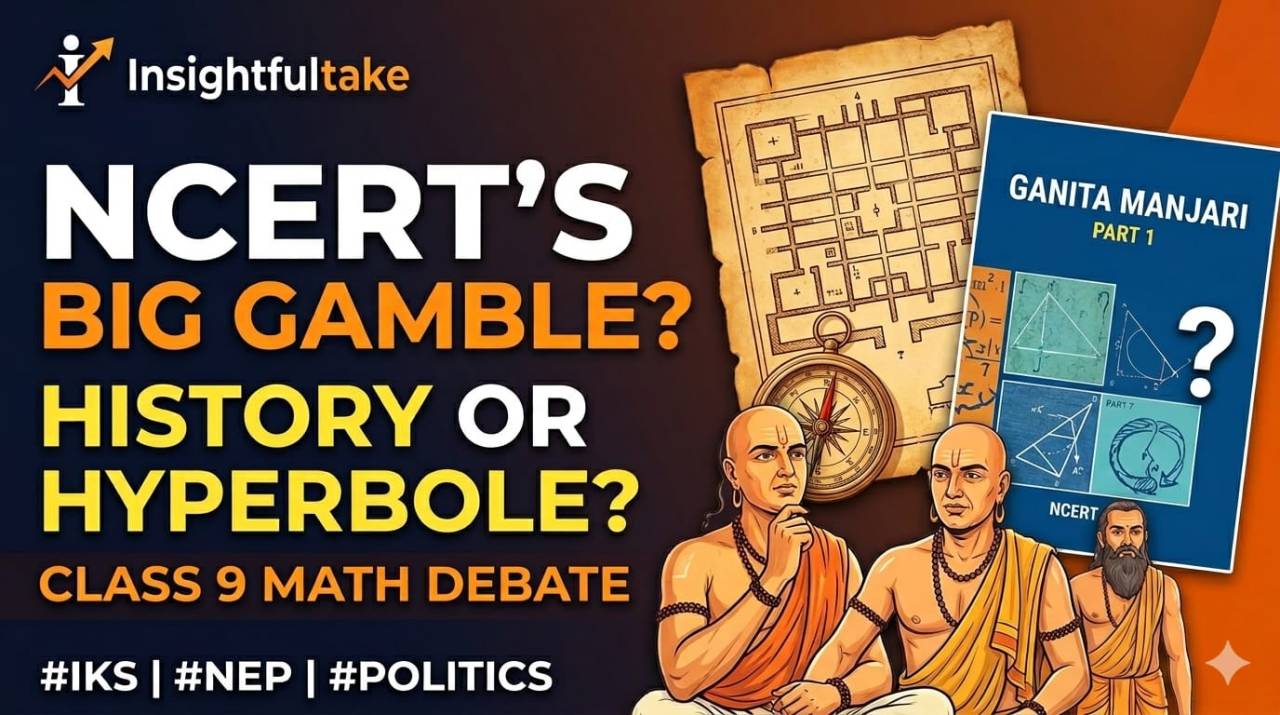
Is NCERT redefining mathematics or rewriting history to fit ideology?
The latest overhaul of the NCERT Class 9 mathematics textbook, titled Ganita Manjari, marks more than just a curricular update; it represents a fundamental shift in how the Indian state intends to frame the history of logic and discovery. While the National Education Policy (NEP) 2020 promised a move away from rote learning toward “conceptual understanding,” the new textbook suggests that this path to the future must first pass through a carefully curated, and at times contested, version of the ancient past.
For decades, Indian mathematics textbooks were criticized for being sterile—dry repositories of formulas and proofs with little regard for the human or historical context of their development. The 2026 edition, which this new volume replaces, was largely procedural. The Ganita Manjari, however, is aggressively narrative. It opens with verses from the Vedanga Jyotisha and attempts to weave the “Indian Knowledge System” (IKS) into the very fabric of geometric and algebraic concepts.
The Grid and the ‘Gilded’ History
One of the most striking claims in the new text is the attribution of coordinate geometry—a field traditionally associated with the 17th-century French philosopher René Descartes—to the urban planning of the “Sindhu-Sarasvati” (Indus Valley) civilization. The book argues that the precision of Harappan street grids constitutes a “coordinate system in practice.”
While the architectural sophistication of the Indus Valley is a matter of archaeological record, historians and mathematicians have been quick to point out the analytical leap being made here. Systematic urban planning is an exercise in engineering and social organization; “coordinate geometry,” as a mathematical discipline, requires an abstract algebraic framework that allows for the representation of geometric shapes through equations. By conflating the two, the NCERT risks presenting a “teleological” history—one where ancient achievements are retrofitted to serve as precursors to modern breakthroughs, often ignoring the distinct contexts in which they arose.
Claims and Counter-claims
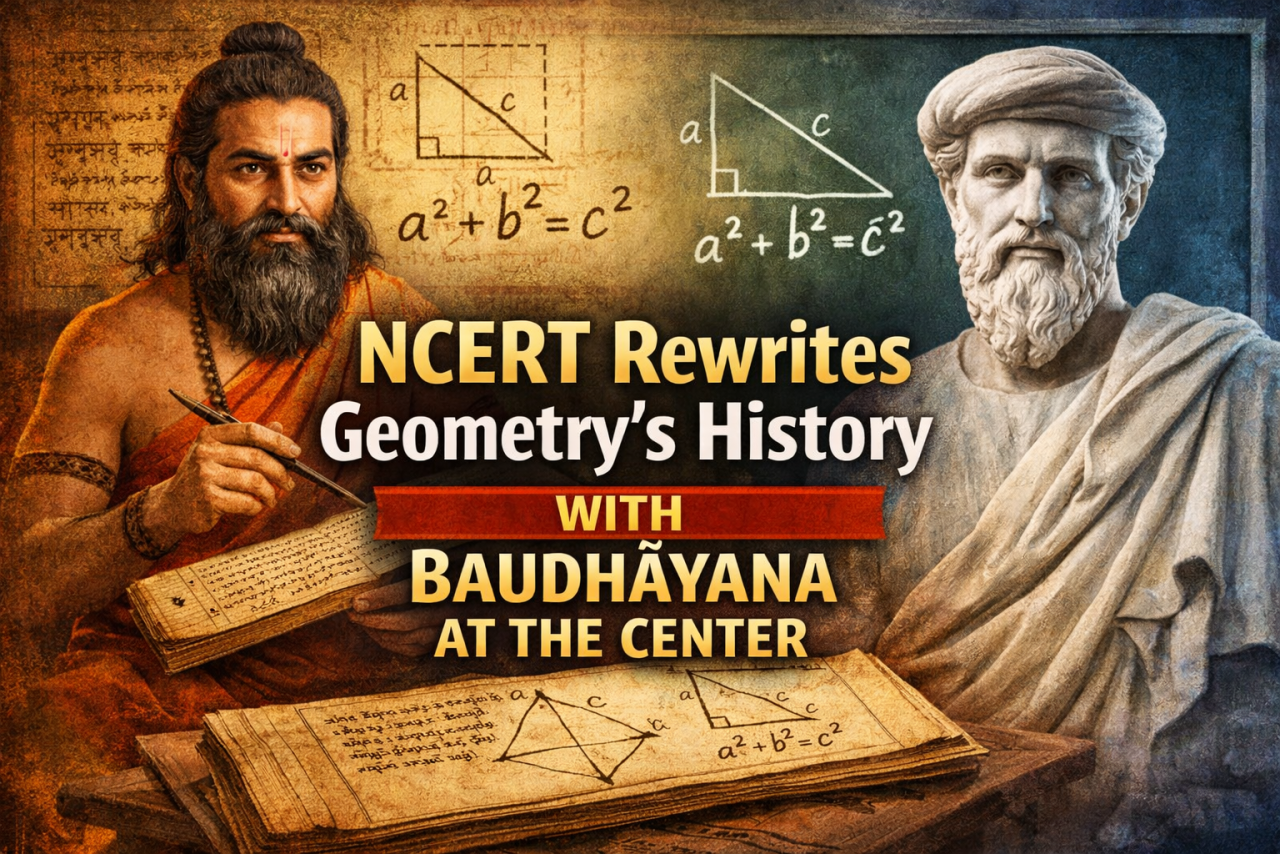
The textbook does not stop at urban planning. It credits the 8th-century BCE scholar Baudhayana with “laying the foundation of coordinate geometry” through his use of cardinal directions in the Sulba Sutras. It further positions the 7th-century mathematician Brahmagupta as the formalizer of zero and negative numbers as “algebraic entities,” essential for the four-quadrant Cartesian plane.
Critics, such as Professor SG Dani of the UM-DAE Centre for Excellence in Basic Sciences, argue that this framing is “quite phoney.” Speaking to the press, Dani noted that Baudhayana’s statements regarding the Pythagorean theorem were framed in terms of areas and geometric constructions for altars, not in terms of coordinate systems or lengths as understood today.
Similarly, Professor Amber Habib of Shiv Nadar University has pointed out that while Brahmagupta’s work was monumental, he was not the sole “creator” of negative numbers—Chinese mathematicians were using them for linear equations nearly a millennium earlier. By framing these developments as exclusively or primarily “indigenous” breakthroughs, the textbook risks isolating Indian students from the global, cross-cultural exchange of ideas that has always defined the history of science.
The Educational Toll of Ideological Framing
The critique of such a move is not just about historical accuracy; it is about the pedagogical impact on the student. Mathematics is, at its core, a language of universal logic. When a textbook shifts its focus from the process of inquiry to the provenance of an idea, the educational objective changes.
The Ganita Manjari aims for “cultural rootedness.” It seeks to instill pride by showing that “indeed, geometry has deep roots in Bharat.” However, when “pride” becomes a metric for curriculum design, scientific rigor often becomes a secondary concern. The danger lies in creating a generation of students who view mathematics as a trophy of civilizational superiority rather than a tool for objective analysis.
Furthermore, the language used—replacing the “Indus Valley Civilisation” with the “Sindhu-Sarasvati Civilisation”—aligns with a specific ideological project to link the Harappan people with the Vedic culture, a theory that remains a subject of intense debate among geneticists and archaeologists.
A Different Kind of Rote Learning?
The NCERT claims the new book will help students “develop a deeper sense of cultural rootedness.” But if this rootedness is built on anachronistic claims and the erasure of global influences, it may produce a new kind of rote learning—one where students memorize “cultural facts” and nationalist narratives with the same unthinking devotion they once gave to formulas.
In its attempt to decolonize the Indian mind, the NCERT may simply be replacing one form of narrowness with another. True mathematical literacy requires an understanding of how ideas evolved through doubt, error, and international collaboration. By turning the textbook into a site for civilizational “reclaiming,” the state may be doing a disservice to the very students it claims to empower.
The latest overhaul of the NCERT Class 9 mathematics textbook, titled Ganita Manjari, marks more than just a curricular update; it represents a fundamental shift in how the Indian state intends to frame the history of logic and discovery. While the National Education Policy (NEP) 2020 promised a move away from rote learning toward “conceptual understanding,” the new textbook suggests that this path to the future must first pass through a carefully curated, and at times contested, version of the ancient past.
For decades, Indian mathematics textbooks were criticized for being sterile—dry repositories of formulas and proofs with little regard for the human or historical context of their development. The 2026 edition, which this new volume replaces, was largely procedural. The Ganita Manjari, however, is aggressively narrative. It opens with verses from the Vedanga Jyotisha and attempts to weave the “Indian Knowledge System” (IKS) into the very fabric of geometric and algebraic concepts.
The Grid and the ‘Gilded’ History
One of the most striking claims in the new text is the attribution of coordinate geometry—a field traditionally associated with the 17th-century French philosopher René Descartes—to the urban planning of the “Sindhu-Sarasvati” (Indus Valley) civilization. The book argues that the precision of Harappan street grids constitutes a “coordinate system in practice.”
While the architectural sophistication of the Indus Valley is a matter of archaeological record, historians and mathematicians have been quick to point out the analytical leap being made here. Systematic urban planning is an exercise in engineering and social organization; “coordinate geometry,” as a mathematical discipline, requires an abstract algebraic framework that allows for the representation of geometric shapes through equations. By conflating the two, the NCERT risks presenting a “teleological” history—one where ancient achievements are retrofitted to serve as precursors to modern breakthroughs, often ignoring the distinct contexts in which they arose.
Claims and Counter-claims
The textbook does not stop at urban planning. It credits the 8th-century BCE scholar Baudhayana with “laying the foundation of coordinate geometry” through his use of cardinal directions in the Sulba Sutras. It further positions the 7th-century mathematician Brahmagupta as the formalizer of zero and negative numbers as “algebraic entities,” essential for the four-quadrant Cartesian plane.
Critics, such as Professor SG Dani of the UM-DAE Centre for Excellence in Basic Sciences, argue that this framing is “quite phoney.” Speaking to the press, Dani noted that Baudhayana’s statements regarding the Pythagorean theorem were framed in terms of areas and geometric constructions for altars, not in terms of coordinate systems or lengths as understood today.
Similarly, Professor Amber Habib of Shiv Nadar University has pointed out that while Brahmagupta’s work was monumental, he was not the sole “creator” of negative numbers—Chinese mathematicians were using them for linear equations nearly a millennium earlier. By framing these developments as exclusively or primarily “indigenous” breakthroughs, the textbook risks isolating Indian students from the global, cross-cultural exchange of ideas that has always defined the history of science.
The Educational Toll of Ideological Framing
The critique of such a move is not just about historical accuracy; it is about the pedagogical impact on the student. Mathematics is, at its core, a language of universal logic. When a textbook shifts its focus from the process of inquiry to the provenance of an idea, the educational objective changes.
The Ganita Manjari aims for “cultural rootedness.” It seeks to instill pride by showing that “indeed, geometry has deep roots in Bharat.” However, when “pride” becomes a metric for curriculum design, scientific rigor often becomes a secondary concern. The danger lies in creating a generation of students who view mathematics as a trophy of civilizational superiority rather than a tool for objective analysis.
Furthermore, the language used—replacing the “Indus Valley Civilisation” with the “Sindhu-Sarasvati Civilisation”—aligns with a specific ideological project to link the Harappan people with the Vedic culture, a theory that remains a subject of intense debate among geneticists and archaeologists.
A Different Kind of Rote Learning?
The NCERT claims the new book will help students “develop a deeper sense of cultural rootedness.” But if this rootedness is built on anachronistic claims and the erasure of global influences, it may produce a new kind of rote learning—one where students memorize “cultural facts” and nationalist narratives with the same unthinking devotion they once gave to formulas.
In its attempt to decolonize the Indian mind, the NCERT may simply be replacing one form of narrowness with another. True mathematical literacy requires an understanding of how ideas evolved through doubt, error, and international collaboration. By turning the textbook into a site for civilizational “reclaiming,” the state may be doing a disservice to the very students it claims to empower.




















Leave a Comment