
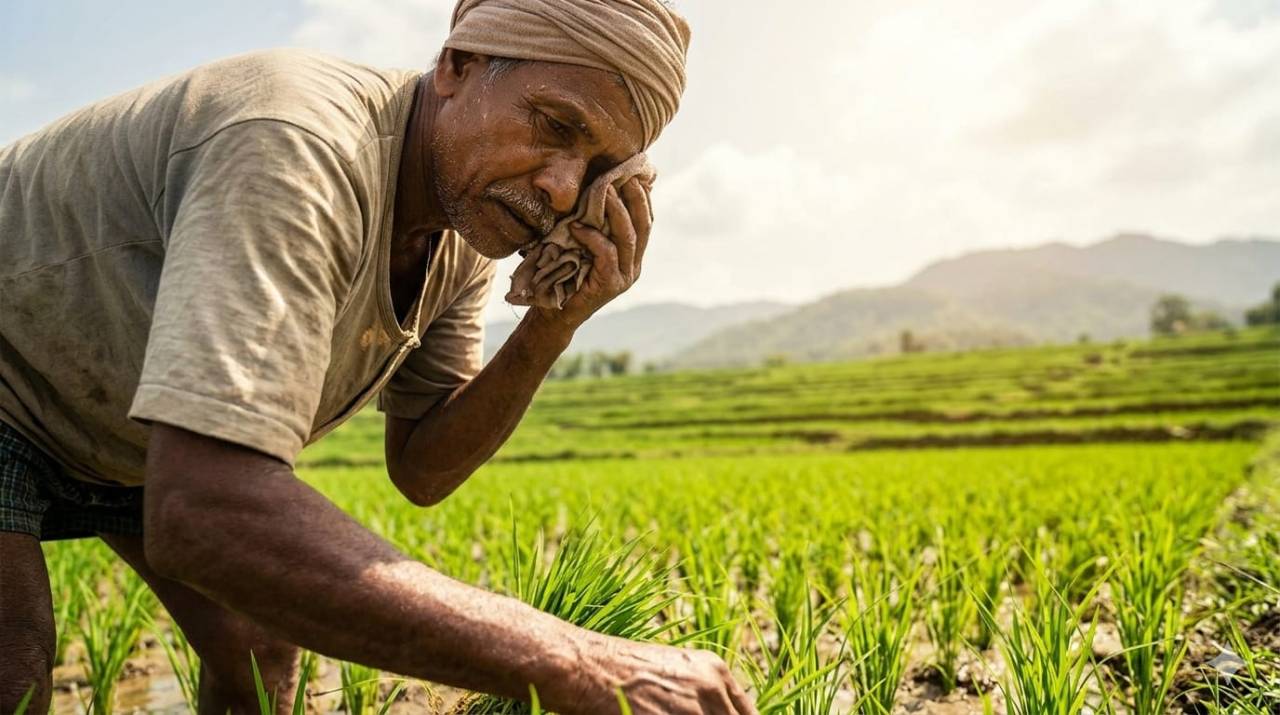
India’s rice belt is entering a dangerous new phase—where rising heat and humidity are no longer just reducing yields, but pushing farmers beyond their physical limits and threatening the country’s food security.
For generations, the rhythmic cycle of the monsoon has been the heartbeat of rural India. Today, that pulse is faltering under a sky that feels increasingly like a furnace. A landmark report titled “Extreme Heat and Agriculture,” released by the Food and Agriculture Organization (FAO) and the World Meteorological Organization (WMO), delivers a stark warning for the Indo-Gangetic plains: the very heat that once ripened crops is now threatening to break the backbone of Indian agriculture.
This is not merely about rising temperatures. It signals a deeper, structural crisis in the survival of the Indian farmer. By the end of the century, the report warns, physical work capacity for agricultural labourers in some of India’s most productive regions could fall below 40%. In practical terms, the human body itself is nearing its thermal limits—placing both livelihoods and national food security at risk.
The Invisible Threat: Wet-Bulb Temperature
The danger lies not just in heat, but in humidity. The concept of wet-bulb temperature—which combines both—offers a more accurate measure of human survivability.
The body cools itself through sweat. But when humidity is high, sweat cannot evaporate effectively, causing the body’s cooling mechanism to fail. While 35°C wet-bulb temperature was once considered the upper survival limit, newer research suggests that for sustained manual labour, danger begins much earlier—around 31°C.
For a farmer transplanting rice in the peak of a humid Indian summer, this is not theoretical. It is the line between earning a day’s wage and risking heatstroke—or worse. South Asia is increasingly approaching these thresholds, making outdoor labour not just strenuous, but potentially fatal.
Rice in the Crosshairs
Rice feeds nearly 70% of India’s population. Yet it is among the most vulnerable crops in a warming climate.
Unlike heavily mechanised systems elsewhere, Indian rice farming relies on millions of labourers working in waterlogged fields under direct sunlight. This makes it uniquely exposed to both heat and humidity stress.
The heatwave of 2022 offered a preview. Temperatures during March and April surged 8°C to 10°C above normal, leading to wheat yield losses of up to 34% in some regions. As heatwaves become more frequent, rice cultivation faces similar risks—if not greater.
The impact is twofold: crops suffer thermal stress, and labour productivity collapses. When a worker can operate at only 40% capacity, costs rise, yields fall, and economic vulnerability deepens across rural India.
A Geography of Risk
The crisis is concentrated in India’s agricultural core:
- Indo-Gangetic Plains: Punjab, Haryana, Uttar Pradesh, Bihar
- Central India: Madhya Pradesh, Maharashtra
- Coastal Regions: Where high humidity amplifies heat stress
According to the Indian Council of Agricultural Research (ICAR), more than 310 districts are now classified as climate-vulnerable. These regions face a convergence of risks—extreme heat, falling groundwater levels, and erratic rainfall patterns.
Adapting to a Warmer Reality
With heatwaves becoming a permanent feature rather than an anomaly, adaptation is no longer optional. Experts and policymakers suggest urgent shifts:
- Rescheduling farm operations to avoid peak heat hours
- Adopting early-morning flowering crop varieties
- Switching to Direct Seeding of Rice (DSR) to reduce labour and water use
- Diversifying into heat-resilient crops such as millets
- Protecting labourers through structured work-rest cycles and shaded workspaces
These changes demand both policy support and grassroots implementation.
Final Take
The FAO-WMO findings underline a reality India can no longer ignore: heat is not just a weather event—it is a structural threat.
Policy discussions often centre on minimum support prices and crop insurance. But if farmers cannot physically endure field conditions, these measures lose relevance. The crisis is shifting from economic to existential.
India’s rice heartland is approaching a tipping point.
For generations, the rhythmic cycle of the monsoon has been the heartbeat of rural India. Today, that pulse is faltering under a sky that feels increasingly like a furnace. A landmark report titled “Extreme Heat and Agriculture,” released by the Food and Agriculture Organization (FAO) and the World Meteorological Organization (WMO), delivers a stark warning for the Indo-Gangetic plains: the very heat that once ripened crops is now threatening to break the backbone of Indian agriculture.
This is not merely about rising temperatures. It signals a deeper, structural crisis in the survival of the Indian farmer. By the end of the century, the report warns, physical work capacity for agricultural labourers in some of India’s most productive regions could fall below 40%. In practical terms, the human body itself is nearing its thermal limits—placing both livelihoods and national food security at risk.
The Invisible Threat: Wet-Bulb Temperature
The danger lies not just in heat, but in humidity. The concept of wet-bulb temperature—which combines both—offers a more accurate measure of human survivability.
The body cools itself through sweat. But when humidity is high, sweat cannot evaporate effectively, causing the body’s cooling mechanism to fail. While 35°C wet-bulb temperature was once considered the upper survival limit, newer research suggests that for sustained manual labour, danger begins much earlier—around 31°C.
For a farmer transplanting rice in the peak of a humid Indian summer, this is not theoretical. It is the line between earning a day’s wage and risking heatstroke—or worse. South Asia is increasingly approaching these thresholds, making outdoor labour not just strenuous, but potentially fatal.
Rice in the Crosshairs
Rice feeds nearly 70% of India’s population. Yet it is among the most vulnerable crops in a warming climate.
Unlike heavily mechanised systems elsewhere, Indian rice farming relies on millions of labourers working in waterlogged fields under direct sunlight. This makes it uniquely exposed to both heat and humidity stress.
The heatwave of 2022 offered a preview. Temperatures during March and April surged 8°C to 10°C above normal, leading to wheat yield losses of up to 34% in some regions. As heatwaves become more frequent, rice cultivation faces similar risks—if not greater.
The impact is twofold: crops suffer thermal stress, and labour productivity collapses. When a worker can operate at only 40% capacity, costs rise, yields fall, and economic vulnerability deepens across rural India.
A Geography of Risk
The crisis is concentrated in India’s agricultural core:
- Indo-Gangetic Plains: Punjab, Haryana, Uttar Pradesh, Bihar
- Central India: Madhya Pradesh, Maharashtra
- Coastal Regions: Where high humidity amplifies heat stress
According to the Indian Council of Agricultural Research (ICAR), more than 310 districts are now classified as climate-vulnerable. These regions face a convergence of risks—extreme heat, falling groundwater levels, and erratic rainfall patterns.
Adapting to a Warmer Reality
With heatwaves becoming a permanent feature rather than an anomaly, adaptation is no longer optional. Experts and policymakers suggest urgent shifts:
- Rescheduling farm operations to avoid peak heat hours
- Adopting early-morning flowering crop varieties
- Switching to Direct Seeding of Rice (DSR) to reduce labour and water use
- Diversifying into heat-resilient crops such as millets
- Protecting labourers through structured work-rest cycles and shaded workspaces
These changes demand both policy support and grassroots implementation.
Final Take
The FAO-WMO findings underline a reality India can no longer ignore: heat is not just a weather event—it is a structural threat.
Policy discussions often centre on minimum support prices and crop insurance. But if farmers cannot physically endure field conditions, these measures lose relevance. The crisis is shifting from economic to existential.
India’s rice heartland is approaching a tipping point.
























Leave a Comment