
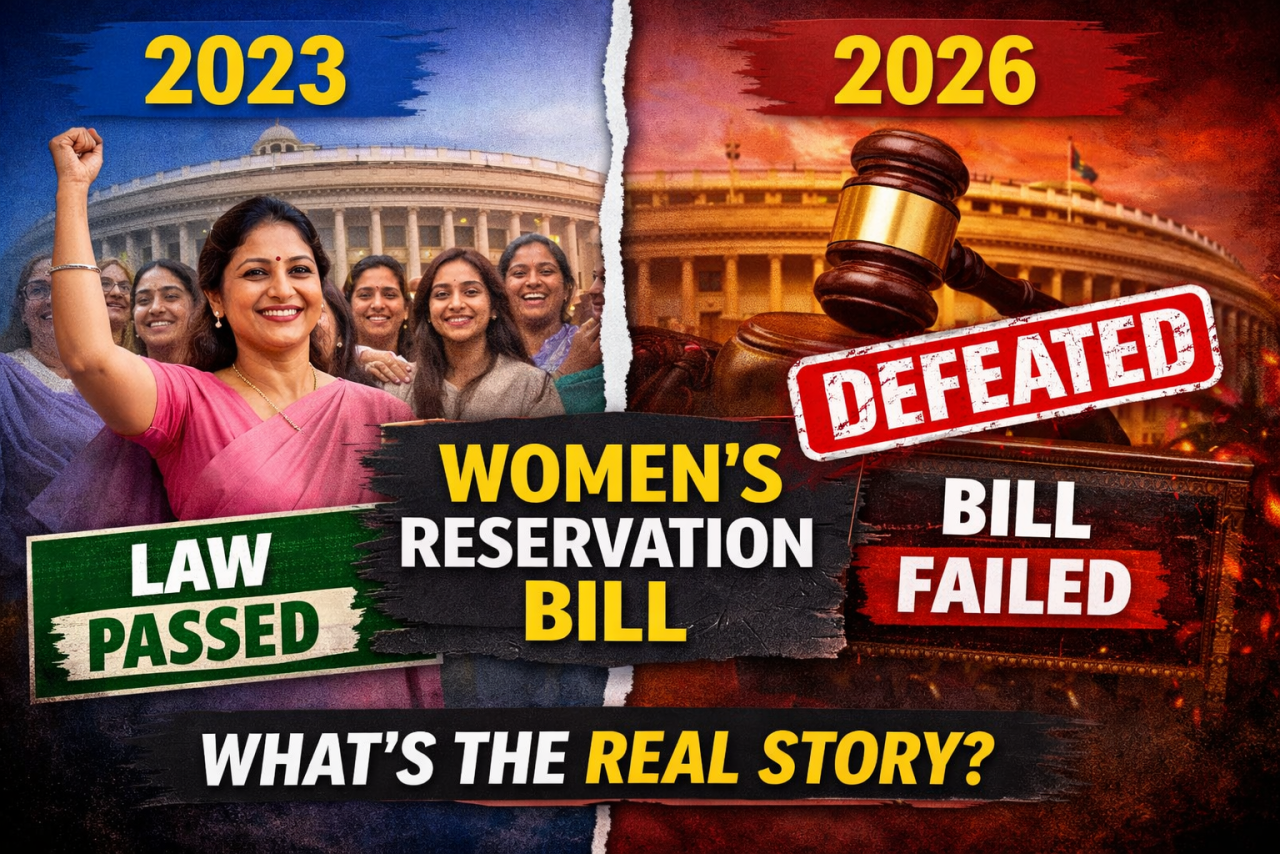
Did India just reject women’s reservation—or is the truth far more complex than the headlines suggest?
In the wake of the recent developments in Parliament, public discourse around women’s reservation has been marked by a high degree of confusion. Reports that a “women’s reservation Bill” was defeated in the Lok Sabha in April 2026 have led many to question the fate of a reform that was widely celebrated just three years ago. A closer examination, however, reveals that the apparent contradiction arises from a misunderstanding between two distinct legislative exercises undertaken in 2023 and 2026.
To begin with, it is important to recall that Parliament, in 2023, enacted the Constitution (One Hundred and Sixth Amendment) Act, 2023, also referred to as the Nari Shakti Vandan Adhiniyam. This landmark amendment provides for one-third reservation for women in the Lok Sabha and State Legislative Assemblies. The legislation was passed with near unanimity, reflecting a rare moment of political consensus on the need to enhance women’s representation in elected bodies.
Yet, the 2023 amendment was not designed for immediate operationalisation. It explicitly tied the implementation of reservation to two prior exercises: the conduct of the next decennial Census and a subsequent delimitation of constituencies. Delimitation, which involves redrawing the boundaries of electoral constituencies to reflect updated population data, is a constitutionally mandated but politically sensitive process. Since neither the Census nor delimitation has been completed, the reservation provisions, though constitutionally valid, remain in abeyance.
It is against this backdrop that the events of April 2026 must be situated. Seeking to address mounting criticism over the delay in implementation, the Union Government introduced a fresh legislative proposal during a specially convened session of Parliament — the Constitution (131st Amendment) Bill, 2026. This Bill did not seek to replace the 2023 amendment; rather, it attempted to modify the pathway to its enforcement.
The 2026 Bill reportedly proposed to expedite the operationalisation of women’s reservation, potentially advancing its implementation timeline to before the next general election cycle. In doing so, however, it also sought to link the reservation framework with a broader exercise of delimitation and an increase in the total number of seats in the Lok Sabha. This coupling of issues — gender representation on the one hand and constituency reconfiguration on the other — proved to be politically contentious.
Opposition parties raised concerns on multiple fronts. Some argued that linking reservation to delimitation could disproportionately affect certain States, particularly in the context of longstanding debates over population control and representation. Others reiterated the demand for a sub-quota for women from Other Backward Classes (OBCs), a provision that was not explicitly addressed in either the 2023 amendment or the 2026 proposal. The result was a fracturing of the broad consensus that had characterised the earlier legislation.
When put to vote in the Lok Sabha, the 2026 Bill failed to secure the constitutionally mandated two-thirds majority required for the passage of an amendment. Its defeat, while significant in political terms, has been widely misconstrued in public discourse as a reversal of the 2023 reform.
Such an interpretation is not accurate. The 2023 amendment remains part of the Constitution and continues to be legally valid. What the Lok Sabha rejected in April 2026 was not the principle of women’s reservation per se, but a specific legislative attempt to alter the conditions and timeline of its implementation. In other words, the foundational commitment to reserving one-third of seats for women has not been undone; rather, the proposed mechanism to accelerate its rollout has failed to secure parliamentary approval.
The distinction, though technical, is crucial. It underscores the layered nature of constitutional reform in India, where the passage of a law does not always translate into immediate effect, particularly when its enforcement is contingent upon subsequent institutional processes. It also highlights the challenges inherent in navigating competing political priorities within a federal and plural polity.
As matters stand, the implementation of women’s reservation will proceed in accordance with the framework laid down in 2023 — that is, after the completion of the Census and delimitation. Whether future governments will revisit the question of expediting this timeline, or attempt alternative legislative routes, remains to be seen.
For now, the central takeaway is clear: the women’s reservation law has not been defeated, but its early implementation has encountered a legislative setback. Distinguishing between these two developments is essential for an informed understanding of both the progress made and the challenges that lie ahead in the pursuit of greater gender parity in India’s democratic institutions.
In the wake of the recent developments in Parliament, public discourse around women’s reservation has been marked by a high degree of confusion. Reports that a “women’s reservation Bill” was defeated in the Lok Sabha in April 2026 have led many to question the fate of a reform that was widely celebrated just three years ago. A closer examination, however, reveals that the apparent contradiction arises from a misunderstanding between two distinct legislative exercises undertaken in 2023 and 2026.
To begin with, it is important to recall that Parliament, in 2023, enacted the Constitution (One Hundred and Sixth Amendment) Act, 2023, also referred to as the Nari Shakti Vandan Adhiniyam. This landmark amendment provides for one-third reservation for women in the Lok Sabha and State Legislative Assemblies. The legislation was passed with near unanimity, reflecting a rare moment of political consensus on the need to enhance women’s representation in elected bodies.
Yet, the 2023 amendment was not designed for immediate operationalisation. It explicitly tied the implementation of reservation to two prior exercises: the conduct of the next decennial Census and a subsequent delimitation of constituencies. Delimitation, which involves redrawing the boundaries of electoral constituencies to reflect updated population data, is a constitutionally mandated but politically sensitive process. Since neither the Census nor delimitation has been completed, the reservation provisions, though constitutionally valid, remain in abeyance.
It is against this backdrop that the events of April 2026 must be situated. Seeking to address mounting criticism over the delay in implementation, the Union Government introduced a fresh legislative proposal during a specially convened session of Parliament — the Constitution (131st Amendment) Bill, 2026. This Bill did not seek to replace the 2023 amendment; rather, it attempted to modify the pathway to its enforcement.
The 2026 Bill reportedly proposed to expedite the operationalisation of women’s reservation, potentially advancing its implementation timeline to before the next general election cycle. In doing so, however, it also sought to link the reservation framework with a broader exercise of delimitation and an increase in the total number of seats in the Lok Sabha. This coupling of issues — gender representation on the one hand and constituency reconfiguration on the other — proved to be politically contentious.
Opposition parties raised concerns on multiple fronts. Some argued that linking reservation to delimitation could disproportionately affect certain States, particularly in the context of longstanding debates over population control and representation. Others reiterated the demand for a sub-quota for women from Other Backward Classes (OBCs), a provision that was not explicitly addressed in either the 2023 amendment or the 2026 proposal. The result was a fracturing of the broad consensus that had characterised the earlier legislation.
When put to vote in the Lok Sabha, the 2026 Bill failed to secure the constitutionally mandated two-thirds majority required for the passage of an amendment. Its defeat, while significant in political terms, has been widely misconstrued in public discourse as a reversal of the 2023 reform.
Such an interpretation is not accurate. The 2023 amendment remains part of the Constitution and continues to be legally valid. What the Lok Sabha rejected in April 2026 was not the principle of women’s reservation per se, but a specific legislative attempt to alter the conditions and timeline of its implementation. In other words, the foundational commitment to reserving one-third of seats for women has not been undone; rather, the proposed mechanism to accelerate its rollout has failed to secure parliamentary approval.
The distinction, though technical, is crucial. It underscores the layered nature of constitutional reform in India, where the passage of a law does not always translate into immediate effect, particularly when its enforcement is contingent upon subsequent institutional processes. It also highlights the challenges inherent in navigating competing political priorities within a federal and plural polity.
As matters stand, the implementation of women’s reservation will proceed in accordance with the framework laid down in 2023 — that is, after the completion of the Census and delimitation. Whether future governments will revisit the question of expediting this timeline, or attempt alternative legislative routes, remains to be seen.
For now, the central takeaway is clear: the women’s reservation law has not been defeated, but its early implementation has encountered a legislative setback. Distinguishing between these two developments is essential for an informed understanding of both the progress made and the challenges that lie ahead in the pursuit of greater gender parity in India’s democratic institutions.



















Leave a Comment