
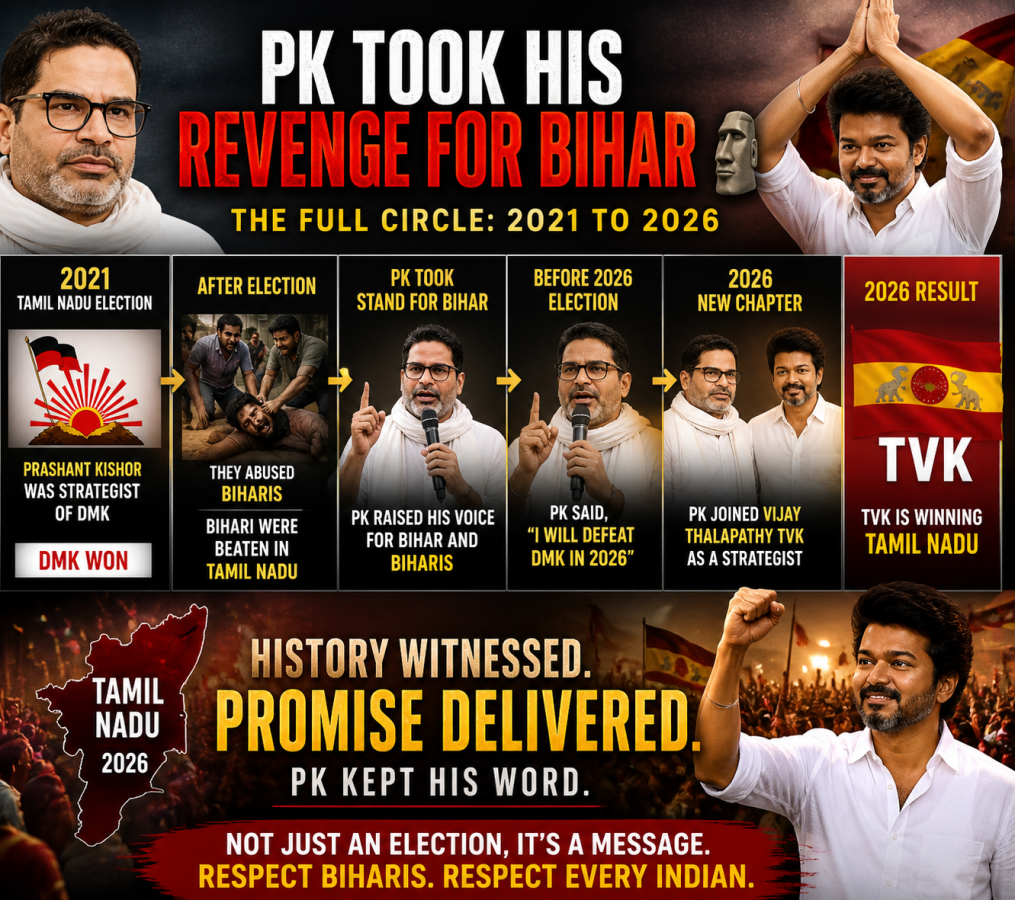
A political earthquake in Tamil Nadu—new faces rise, old equations shift, and a strategy reshapes the game.
The 2026 Tamil Nadu Assembly election has delivered one of the most dramatic political moments in the state’s recent history. With Tamilaga Vettri Kazhagam (TVK) surging ahead and Joseph Vijay—popularly known as Vijay—at the center of a new political wave, the result signals more than just a change in government—it reflects a shift in public mood.
Alongside the numbers, a powerful storyline has taken hold in public discourse: a full-circle political journey involving Prashant Kishor, his past association with the Dravida Munnetra Kazhagam (DMK), and his perceived role in shaping the current outcome.
The 2021 Starting Point
In 2021, Prashant Kishor was widely recognized as the strategist behind DMK’s successful campaign led by M. K. Stalin. That election brought DMK back to power with a decisive mandate, reinforcing Kishor’s reputation as one of India’s most effective political consultants.
His approach—combining data analytics with ground-level messaging—helped craft a narrative that resonated across Tamil Nadu. For many observers, the 2021 victory was as much about political timing as it was about campaign precision.
The Claims That Shaped a Narrative
In later interviews and public discussions, Prashant Kishor is said to have spoken about concerns related to migrant workers, including those from Bihar, in Tamil Nadu. These remarks have since become central to a widely shared narrative that links identity, politics, and strategy.
According to this version, Kishor distanced himself from DMK after 2021 and indicated a desire to challenge the party in the future. The idea that he would return to Tamil Nadu politics with a different alignment began circulating well before the 2026 election cycle.
At the same time, it is important to note that issues involving migrant workers are complex. While concerns may have been raised, broad generalizations about systematic targeting remain debated and layered with multiple perspectives.
The Rise of TVK
By 2026, the political landscape had changed dramatically. TVK, under Vijay’s leadership, emerged as a serious contender—something few would have predicted just a few years earlier.
The party’s rise reflects multiple factors:
- A growing appetite for alternatives beyond traditional Dravidian parties
- Vijay’s mass appeal cutting across demographics
- A campaign narrative focused on change and new leadership
Within this context, claims that Prashant Kishor worked alongside TVK as a strategist gained traction. However, the exact nature of this involvement has not been fully detailed in official public records.
A Story of “Revenge” or Reinvention?
As of now, the exact nature of involvement has not been fully detailed in official public records.
This is where the narrative becomes symbolic:
- A strategist who helped DMK win in 2021
- Distanced himself amid controversy
- Returned in 2026 aligned with a new force
- Watched that force challenge DMK’s dominance
Framed this way, it becomes easy to describe the 2026 result as a form of “revenge.”
But elections rarely operate on personal arcs alone.
Tamil Nadu’s verdict reflects a broader shift:
- Voters reassessing incumbency
- The impact of new political entrants
- Changing expectations in governance and representation
What appears as a personal storyline is, in reality, layered over a much larger democratic process.
What the Verdict Really Means
The success of TVK signals that Tamil Nadu’s electorate is willing to rethink long-standing political loyalties. It marks a moment where charisma, narrative, and timing have intersected with public sentiment.
At the same time, the Prashant Kishor angle shows how modern politics is not just about results, but about how those results are interpreted and remembered. Narratives—especially those rooted in identity and emotion—travel fast and often shape perception as much as facts.
Final Take
The idea that Prashant Kishor “took revenge for Bihar” is powerful because it simplifies a complex political journey into a single, compelling line.
Yet, the 2026 Tamil Nadu election is ultimately about something bigger: a state in transition, a new political force rising, and an electorate willing to reshape its future.
The 2026 Tamil Nadu Assembly election has delivered one of the most dramatic political moments in the state’s recent history. With Tamilaga Vettri Kazhagam (TVK) surging ahead and Joseph Vijay—popularly known as Vijay—at the center of a new political wave, the result signals more than just a change in government—it reflects a shift in public mood.
Alongside the numbers, a powerful storyline has taken hold in public discourse: a full-circle political journey involving Prashant Kishor, his past association with the Dravida Munnetra Kazhagam (DMK), and his perceived role in shaping the current outcome.
The 2021 Starting Point
In 2021, Prashant Kishor was widely recognized as the strategist behind DMK’s successful campaign led by M. K. Stalin. That election brought DMK back to power with a decisive mandate, reinforcing Kishor’s reputation as one of India’s most effective political consultants.
His approach—combining data analytics with ground-level messaging—helped craft a narrative that resonated across Tamil Nadu. For many observers, the 2021 victory was as much about political timing as it was about campaign precision.
The Claims That Shaped a Narrative
In later interviews and public discussions, Prashant Kishor is said to have spoken about concerns related to migrant workers, including those from Bihar, in Tamil Nadu. These remarks have since become central to a widely shared narrative that links identity, politics, and strategy.
According to this version, Kishor distanced himself from DMK after 2021 and indicated a desire to challenge the party in the future. The idea that he would return to Tamil Nadu politics with a different alignment began circulating well before the 2026 election cycle.
At the same time, it is important to note that issues involving migrant workers are complex. While concerns may have been raised, broad generalizations about systematic targeting remain debated and layered with multiple perspectives.
The Rise of TVK
By 2026, the political landscape had changed dramatically. TVK, under Vijay’s leadership, emerged as a serious contender—something few would have predicted just a few years earlier.
The party’s rise reflects multiple factors:
- A growing appetite for alternatives beyond traditional Dravidian parties
- Vijay’s mass appeal cutting across demographics
- A campaign narrative focused on change and new leadership
Within this context, claims that Prashant Kishor worked alongside TVK as a strategist gained traction. However, the exact nature of this involvement has not been fully detailed in official public records.
A Story of “Revenge” or Reinvention?
As of now, the exact nature of involvement has not been fully detailed in official public records.
This is where the narrative becomes symbolic:
- A strategist who helped DMK win in 2021
- Distanced himself amid controversy
- Returned in 2026 aligned with a new force
- Watched that force challenge DMK’s dominance
Framed this way, it becomes easy to describe the 2026 result as a form of “revenge.”
But elections rarely operate on personal arcs alone.
Tamil Nadu’s verdict reflects a broader shift:
- Voters reassessing incumbency
- The impact of new political entrants
- Changing expectations in governance and representation
What appears as a personal storyline is, in reality, layered over a much larger democratic process.
What the Verdict Really Means
The success of TVK signals that Tamil Nadu’s electorate is willing to rethink long-standing political loyalties. It marks a moment where charisma, narrative, and timing have intersected with public sentiment.
At the same time, the Prashant Kishor angle shows how modern politics is not just about results, but about how those results are interpreted and remembered. Narratives—especially those rooted in identity and emotion—travel fast and often shape perception as much as facts.
Final Take
The idea that Prashant Kishor “took revenge for Bihar” is powerful because it simplifies a complex political journey into a single, compelling line.
Yet, the 2026 Tamil Nadu election is ultimately about something bigger: a state in transition, a new political force rising, and an electorate willing to reshape its future.














Leave a Comment