
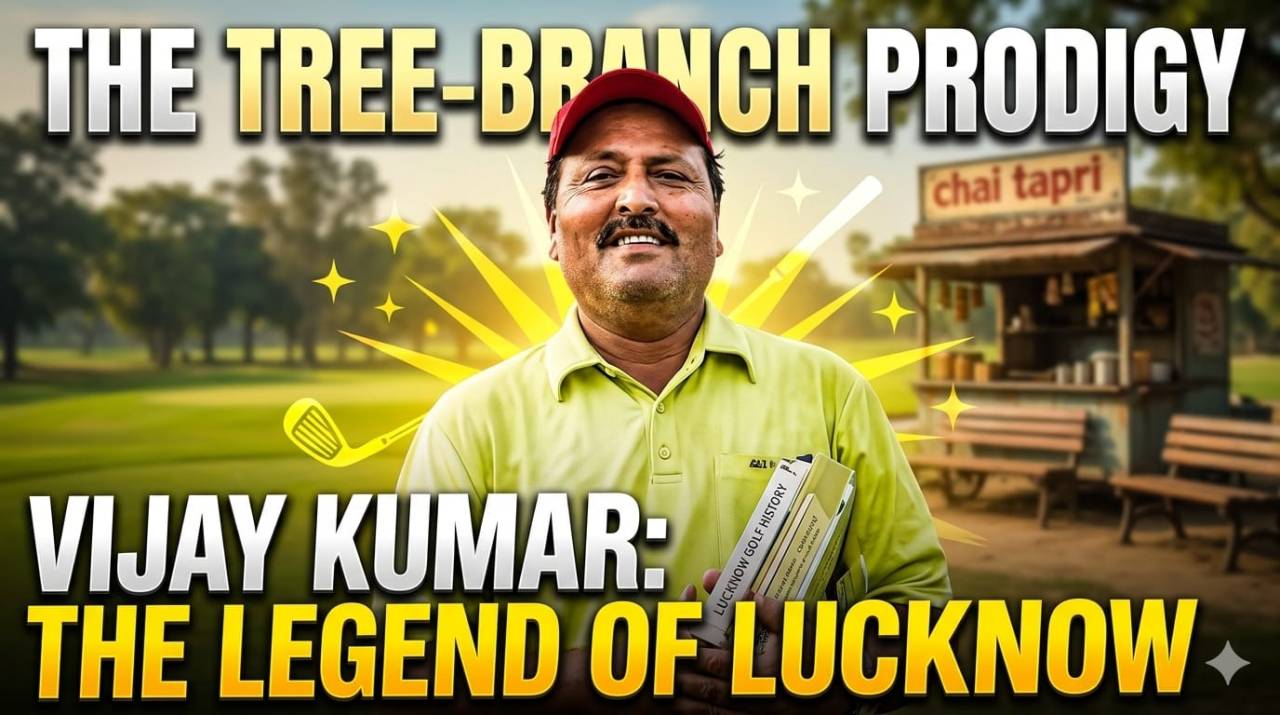
He started with a tree branch—ended with 100 titles. Vijay Kumar’s story redefines what it takes to become a legend.
Vijay Kumar didn’t play golf by the book—he quietly rewrote it. The Lucknow-born professional golfer, who recently passed away at the age of 57, was one of those rare athletes who dominated his sport while refusing to participate in its social hierarchy.
From practicing with wooden branches to winning the 2002 Indian Open, Vijay’s journey remains a masterclass in raw talent, discipline, and understated defiance.
The Science Behind the “Tree-Branch” Swing
Growing up in Martinpurwa, a small settlement nestled between the Lucknow Golf Club and La Martinière, Vijay Kumar began his journey as a caddy. With limited resources and no access to proper equipment, he carved his first golf clubs out of tree branches.
What began as necessity eventually became his greatest technical advantage.
A flexible branch doesn’t forgive brute force. To control it, a player must develop timing, balance, and rhythm. Vijay unknowingly trained himself into a golfer built on precision rather than power. That self-taught rhythm went on to define his professional career.
Between 1996 and 2003, he accumulated nearly 100 domestic titles and won the Order of Merit four times—an era that established him as one of the most consistent performers in Indian golf history.
The Pro Who Stayed at the Tea Stall
Nicknamed the “Nawab of Lucknow,” Vijay Kumar never fully stepped into the elite clubhouse culture that often defines professional sport. Instead, he remained rooted in the spaces that shaped him—often seen at a chai tapri rather than a members-only lounge.
His most defining act of quiet resistance came in the 1990s. When a premier golf club extended an invitation to select caddy-turned-professionals to access its clubhouse facilities, Vijay noticed a crucial exclusion: not all caddies were included.
He declined the offer.
For him, acceptance that left others behind was not acceptance at all. He chose solidarity over privilege, staying back with his peers over tea and conversation in the caddyshack.
A Legacy in Motion
The Professional Golf Tour of India (PGTI) is now working to preserve his legacy. Plans are underway to name a tournament after Vijay Kumar, with a possible launch as early as June 2026 at the Lucknow Golf Club.
It is a fitting tribute for a player whose identity was inseparable from the city where he learned the game.
Quick Facts: The Career of Vijay Kumar
- Major Win: 2002 Indian Open Champion
- Domestic Dominance: Nearly 100 titles (official record-keeping began in 1997)
- Peak Years: Four-time Order of Merit winner (1996–2003)
- Style: Entirely self-taught; renowned for exceptional natural rhythm in Indian golf
Final Take
Vijay Kumar’s passing marks the end of an era in Indian golf. He proved that greatness does not always come from privilege, coaching, or polished systems.
Sometimes, it comes from a tree branch, a patch of ground, and the discipline to stay rooted in where you began.
Vijay Kumar didn’t play golf by the book—he quietly rewrote it. The Lucknow-born professional golfer, who recently passed away at the age of 57, was one of those rare athletes who dominated his sport while refusing to participate in its social hierarchy.
From practicing with wooden branches to winning the 2002 Indian Open, Vijay’s journey remains a masterclass in raw talent, discipline, and understated defiance.
The Science Behind the “Tree-Branch” Swing
Growing up in Martinpurwa, a small settlement nestled between the Lucknow Golf Club and La Martinière, Vijay Kumar began his journey as a caddy. With limited resources and no access to proper equipment, he carved his first golf clubs out of tree branches.
What began as necessity eventually became his greatest technical advantage.
A flexible branch doesn’t forgive brute force. To control it, a player must develop timing, balance, and rhythm. Vijay unknowingly trained himself into a golfer built on precision rather than power. That self-taught rhythm went on to define his professional career.
Between 1996 and 2003, he accumulated nearly 100 domestic titles and won the Order of Merit four times—an era that established him as one of the most consistent performers in Indian golf history.
The Pro Who Stayed at the Tea Stall
Nicknamed the “Nawab of Lucknow,” Vijay Kumar never fully stepped into the elite clubhouse culture that often defines professional sport. Instead, he remained rooted in the spaces that shaped him—often seen at a chai tapri rather than a members-only lounge.
His most defining act of quiet resistance came in the 1990s. When a premier golf club extended an invitation to select caddy-turned-professionals to access its clubhouse facilities, Vijay noticed a crucial exclusion: not all caddies were included.
He declined the offer.
For him, acceptance that left others behind was not acceptance at all. He chose solidarity over privilege, staying back with his peers over tea and conversation in the caddyshack.
A Legacy in Motion
The Professional Golf Tour of India (PGTI) is now working to preserve his legacy. Plans are underway to name a tournament after Vijay Kumar, with a possible launch as early as June 2026 at the Lucknow Golf Club.
It is a fitting tribute for a player whose identity was inseparable from the city where he learned the game.
Quick Facts: The Career of Vijay Kumar
- Major Win: 2002 Indian Open Champion
- Domestic Dominance: Nearly 100 titles (official record-keeping began in 1997)
- Peak Years: Four-time Order of Merit winner (1996–2003)
- Style: Entirely self-taught; renowned for exceptional natural rhythm in Indian golf
Final Take
Vijay Kumar’s passing marks the end of an era in Indian golf. He proved that greatness does not always come from privilege, coaching, or polished systems.
Sometimes, it comes from a tree branch, a patch of ground, and the discipline to stay rooted in where you began.



.jpeg)
















Leave a Comment