
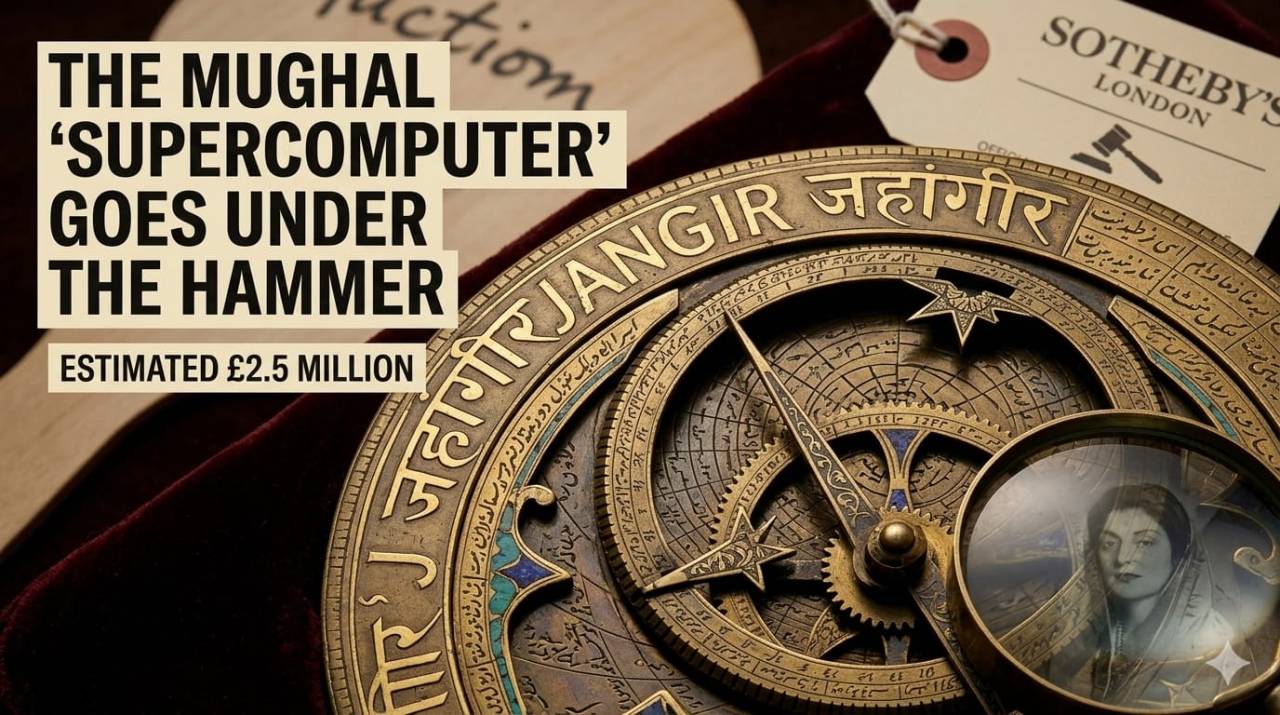
A 414-year-old Mughal astrolabe—once used to map the stars with stunning precision—is now set to command millions at a global auction, challenging modern ideas of when the “Information Age” truly began.
Long before the silicon chip redefined our idea of a “computer,” artisans of the Mughal Empire were shaping brass into instruments of astonishing complexity. A recent report on an upcoming auction at Sotheby's has brought renewed attention to a rare 17th-century astrolabe—once part of the collection of Maharani Gayatri Devi. The piece is expected to fetch more than £2.5 million, underlining its historical and scientific significance.
This astrolabe is not merely an antique. It represents a powerful blend of art, astronomy, and mathematics, crafted at a time when knowledge of the cosmos was both a scientific pursuit and a spiritual quest.
A Masterpiece of Functional Art
Dating back to 1612, during the reign of Jahangir, the instrument is believed to be among the largest and most intricate of its kind. Created by two brothers for Aqa Afzal, it belongs to the category of a “complete astrolabe,” designed to perform a wide range of astronomical calculations.
At first glance, it appears as an ornate brass disc. But for a 17th-century scholar, it functioned as a compact model of the universe.
Its features highlight extraordinary craftsmanship:
- A catalog of coordinates for 94 cities, including Mecca, Bijapur, and Baghdad
- 38 star pointers and multiple calibrated plates for celestial mapping
- Highly precise engravings, with degree divisions refined to a third of a degree
What makes this astrolabe particularly remarkable is its multicultural character. The inscriptions combine Persian star names with Sanskrit terminology written in Devanagari script. This fusion reflects the intellectual exchange that defined the Mughal era, where Islamic astronomy and Indian mathematical traditions came together to advance scientific understanding.
The “Supercomputer” of Its Time
Describing an astrolabe as a “computer” is not an exaggeration. In a single handheld device, users could perform functions that today require multiple digital tools.
By aligning its movable components, an astronomer could:
- Determine the time of day or night
- Calculate latitude for navigation
- Identify the direction of Mecca for prayer
- Predict celestial movements for calendars and agricultural planning
Unlike modern devices that operate through hidden algorithms, the astrolabe demanded direct engagement. Its user needed to understand geometry and the movement of celestial bodies. It was a form of technology that encouraged learning, not just convenience.
From Royal Collection to Global Spotlight
The journey of this astrolabe adds to its allure. Once housed in the private collection of Maharani Gayatri Devi, it moved from being a tool of knowledge to a symbol of heritage. Its upcoming sale at Sotheby's reflects a growing global appreciation for scientific achievements beyond the Western narrative.
For decades, the history of technology has often been framed as a European progression. Artifacts like this astrolabe challenge that view, demonstrating that regions such as South Asia had already developed advanced knowledge of astronomy, metallurgy, and mathematical principles centuries earlier.
Final Take
In today’s world of rapidly outdated gadgets, this 414-year-old instrument stands as a striking contrast. Made entirely of brass and human ingenuity, it continues to function with the same precision it did in the 17th century.
Its auction is more than a commercial event. It is a moment of recognition—an acknowledgment of a time when science, craftsmanship, and culture were deeply interconnected.
The Mughal astrolabe reminds us that humanity’s desire to understand the universe is timeless. Whether through engraved brass or digital code, the goal remains the same for locating ourselves within the vastness of the cosmos.
At £2.5 million, the price may seem high. But for an object that once placed the entire sky in the palm of a hand, it may well be justified.
Long before the silicon chip redefined our idea of a “computer,” artisans of the Mughal Empire were shaping brass into instruments of astonishing complexity. A recent report on an upcoming auction at Sotheby's has brought renewed attention to a rare 17th-century astrolabe—once part of the collection of Maharani Gayatri Devi. The piece is expected to fetch more than £2.5 million, underlining its historical and scientific significance.
This astrolabe is not merely an antique. It represents a powerful blend of art, astronomy, and mathematics, crafted at a time when knowledge of the cosmos was both a scientific pursuit and a spiritual quest.
A Masterpiece of Functional Art
Dating back to 1612, during the reign of Jahangir, the instrument is believed to be among the largest and most intricate of its kind. Created by two brothers for Aqa Afzal, it belongs to the category of a “complete astrolabe,” designed to perform a wide range of astronomical calculations.
At first glance, it appears as an ornate brass disc. But for a 17th-century scholar, it functioned as a compact model of the universe.
Its features highlight extraordinary craftsmanship:
- A catalog of coordinates for 94 cities, including Mecca, Bijapur, and Baghdad
- 38 star pointers and multiple calibrated plates for celestial mapping
- Highly precise engravings, with degree divisions refined to a third of a degree
What makes this astrolabe particularly remarkable is its multicultural character. The inscriptions combine Persian star names with Sanskrit terminology written in Devanagari script. This fusion reflects the intellectual exchange that defined the Mughal era, where Islamic astronomy and Indian mathematical traditions came together to advance scientific understanding.
The “Supercomputer” of Its Time
Describing an astrolabe as a “computer” is not an exaggeration. In a single handheld device, users could perform functions that today require multiple digital tools.
By aligning its movable components, an astronomer could:
- Determine the time of day or night
- Calculate latitude for navigation
- Identify the direction of Mecca for prayer
- Predict celestial movements for calendars and agricultural planning
Unlike modern devices that operate through hidden algorithms, the astrolabe demanded direct engagement. Its user needed to understand geometry and the movement of celestial bodies. It was a form of technology that encouraged learning, not just convenience.
From Royal Collection to Global Spotlight
The journey of this astrolabe adds to its allure. Once housed in the private collection of Maharani Gayatri Devi, it moved from being a tool of knowledge to a symbol of heritage. Its upcoming sale at Sotheby's reflects a growing global appreciation for scientific achievements beyond the Western narrative.
For decades, the history of technology has often been framed as a European progression. Artifacts like this astrolabe challenge that view, demonstrating that regions such as South Asia had already developed advanced knowledge of astronomy, metallurgy, and mathematical principles centuries earlier.
Final Take
In today’s world of rapidly outdated gadgets, this 414-year-old instrument stands as a striking contrast. Made entirely of brass and human ingenuity, it continues to function with the same precision it did in the 17th century.
Its auction is more than a commercial event. It is a moment of recognition—an acknowledgment of a time when science, craftsmanship, and culture were deeply interconnected.
The Mughal astrolabe reminds us that humanity’s desire to understand the universe is timeless. Whether through engraved brass or digital code, the goal remains the same for locating ourselves within the vastness of the cosmos.
At £2.5 million, the price may seem high. But for an object that once placed the entire sky in the palm of a hand, it may well be justified.





























Leave a Comment