
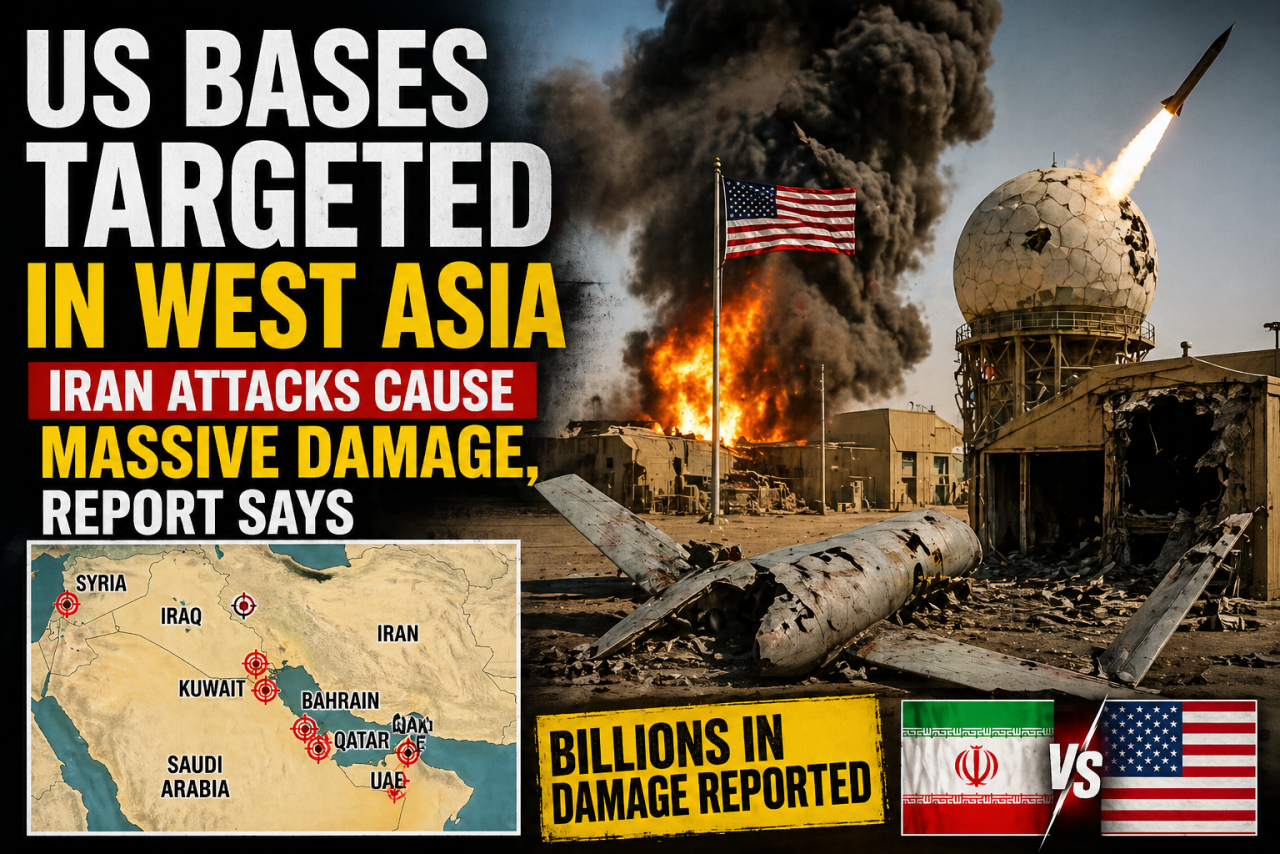
Iran’s latest attacks on US military bases across West Asia have caused billions in damage, raising serious questions about regional security and the risk of a wider conflict.
A recent report claims that Iran has caused heavy damage to United States military bases in West Asia. The report says the damage runs into billions of dollars. It also points to a sharp rise in direct attacks and military tension in the region. For many, this may sound complex. Here is a clear and simple breakdown of what is happening and why it is important.
The report states that Iran targeted more than 100 sites linked to 11 US military bases. These bases are spread across seven countries in West Asia. These countries include Iraq, Syria, Kuwait, Saudi Arabia, Bahrain, Qatar, and the United Arab Emirates. These bases support US military operations in the region. They also help protect key trade routes and allies.
The estimated cost to repair the damage is about 5 billion dollars. This number may rise. It does not include all damaged systems. Some advanced radar systems, aircraft, and weapons may need full replacement. That could add billions more to the total cost.
One of the most serious incidents took place in Kuwait. An Iranian fighter jet from an older class managed to enter US defenses. It bombed a US base and returned safely. This is a rare event. It is the first time in many years that an enemy aircraft has successfully hit a US base in this way. This has raised concerns about the strength of US air defense systems in the region.
The report also mentions attacks on bases in the United Arab Emirates. These strikes damaged fuel storage, buildings, and medical facilities. Other bases in Saudi Arabia and Jordan were also hit. In Bahrain, damage was reported at the headquarters of the US Navy’s Fifth Fleet. This is an important command center for US naval operations in the region.
Some key military equipment was destroyed. This includes an E-3 AWACS aircraft. This aircraft is used for airborne surveillance. It helps detect threats from long distances. The loss of such an aircraft is a major setback. The report also mentions the destruction of several MQ-9 Reaper drones. These drones are used for surveillance and targeted strikes. A few tanker aircraft were also damaged. These planes are used to refuel other aircraft in the air.
The attacks did not happen in one place. They were spread across a wide area. This suggests a planned and coordinated effort. It also shows that Iran has the ability to strike multiple targets at once. This raises concerns for the US and its allies in the region.
The Strait of Hormuz is another key point in this situation. This narrow waterway is one of the most important oil routes in the world. A large part of global oil supply passes through it. Any conflict in this area can affect oil prices. It can also impact global trade. Iran has often shown interest in controlling or influencing this route.
At the same time, there are efforts to reduce tension. Pakistan is trying to help restart talks between the US and Iran. Reports say that talks may happen through indirect channels. Oman may also play a role in mediation. The goal is to avoid further conflict and find a diplomatic solution.
However, the situation remains tense. Both sides have shown strength. The US has a strong military presence in the region. Iran has shown it can carry out targeted strikes. This creates a risky environment. Any mistake can lead to a larger conflict.
A conflict in West Asia can affect global oil prices. This can increase fuel costs in many countries. It can also impact trade and supply chains. In some cases, it can lead to economic pressure worldwide.
In simple terms, this report highlights three key points. First, Iran has carried out serious attacks on US bases. Second, the damage is large and costly. Third, the risk of further conflict is real.
The coming weeks will be important. Diplomatic talks may reduce tension. But if talks fail, the situation may worsen. For now, the world is watching closely.
A recent report claims that Iran has caused heavy damage to United States military bases in West Asia. The report says the damage runs into billions of dollars. It also points to a sharp rise in direct attacks and military tension in the region. For many, this may sound complex. Here is a clear and simple breakdown of what is happening and why it is important.
The report states that Iran targeted more than 100 sites linked to 11 US military bases. These bases are spread across seven countries in West Asia. These countries include Iraq, Syria, Kuwait, Saudi Arabia, Bahrain, Qatar, and the United Arab Emirates. These bases support US military operations in the region. They also help protect key trade routes and allies.
The estimated cost to repair the damage is about 5 billion dollars. This number may rise. It does not include all damaged systems. Some advanced radar systems, aircraft, and weapons may need full replacement. That could add billions more to the total cost.
One of the most serious incidents took place in Kuwait. An Iranian fighter jet from an older class managed to enter US defenses. It bombed a US base and returned safely. This is a rare event. It is the first time in many years that an enemy aircraft has successfully hit a US base in this way. This has raised concerns about the strength of US air defense systems in the region.
The report also mentions attacks on bases in the United Arab Emirates. These strikes damaged fuel storage, buildings, and medical facilities. Other bases in Saudi Arabia and Jordan were also hit. In Bahrain, damage was reported at the headquarters of the US Navy’s Fifth Fleet. This is an important command center for US naval operations in the region.
Some key military equipment was destroyed. This includes an E-3 AWACS aircraft. This aircraft is used for airborne surveillance. It helps detect threats from long distances. The loss of such an aircraft is a major setback. The report also mentions the destruction of several MQ-9 Reaper drones. These drones are used for surveillance and targeted strikes. A few tanker aircraft were also damaged. These planes are used to refuel other aircraft in the air.
The attacks did not happen in one place. They were spread across a wide area. This suggests a planned and coordinated effort. It also shows that Iran has the ability to strike multiple targets at once. This raises concerns for the US and its allies in the region.
The Strait of Hormuz is another key point in this situation. This narrow waterway is one of the most important oil routes in the world. A large part of global oil supply passes through it. Any conflict in this area can affect oil prices. It can also impact global trade. Iran has often shown interest in controlling or influencing this route.
At the same time, there are efforts to reduce tension. Pakistan is trying to help restart talks between the US and Iran. Reports say that talks may happen through indirect channels. Oman may also play a role in mediation. The goal is to avoid further conflict and find a diplomatic solution.
However, the situation remains tense. Both sides have shown strength. The US has a strong military presence in the region. Iran has shown it can carry out targeted strikes. This creates a risky environment. Any mistake can lead to a larger conflict.
A conflict in West Asia can affect global oil prices. This can increase fuel costs in many countries. It can also impact trade and supply chains. In some cases, it can lead to economic pressure worldwide.
In simple terms, this report highlights three key points. First, Iran has carried out serious attacks on US bases. Second, the damage is large and costly. Third, the risk of further conflict is real.
The coming weeks will be important. Diplomatic talks may reduce tension. But if talks fail, the situation may worsen. For now, the world is watching closely.
























Leave a Comment