
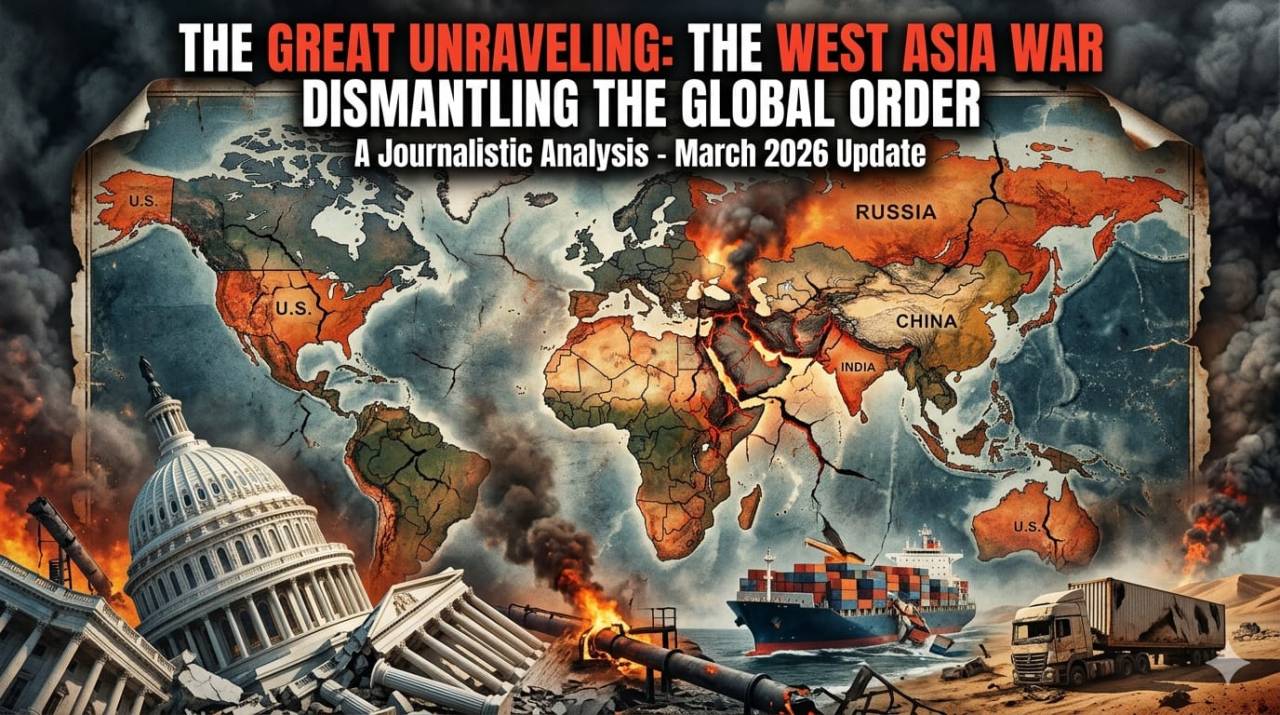
The strikes of February 28 did more than trigger a war in West Asia—they marked a decisive break from the rules that have governed global order for decades.
The ongoing conflict in West Asia, which escalated into a full-scale war following the joint U.S.-Israeli strikes on February 28, 2026, is no longer just a regional crisis. It has become a systemic shock—one that is actively dismantling the so-called “rules-based international order” that has governed global politics since 1945. As of mid-March 2026, the world is navigating a fractured landscape defined by raw power, economic disruption, and the steady erosion of diplomacy.
The Collapse of Global Norms
For decades, the international system rested on an unspoken agreement: certain lines, once drawn, would not be crossed. Among them was the principle that heads of state were off-limits in direct military targeting. The February 28 strikes, which resulted in the death of Iran’s Supreme Leader, shattered that assumption.
It has led many analysts to describe the present moment as the dawn of a “post-legal” global era. When major powers bypass international institutions and engage in high-intensity operations aimed at regime decapitation, the message reverberates far beyond the battlefield. It signals that international law is no longer a binding force, but a flexible tool—invoked selectively, ignored conveniently.
The implications are profound. In such an environment, diplomacy weakens, deterrence becomes unpredictable, and nations increasingly resort to unilateral action. The foundational idea that global stability can be maintained through rules rather than force is now under direct threat.
Economic Disruption and the Energy Shock
If the war has shaken political norms, it has rattled the global economy even more forcefully. West Asia remains the heart of global energy supply, and the conflict has effectively constricted its arteries.
The Strait of Hormuz, a critical maritime chokepoint, has emerged as the epicenter of this disruption. With Iran enforcing a de facto blockade, nearly a fifth of the world’s oil supply and a quarter of liquefied natural gas shipments have been thrown into uncertainty.
The consequences have been immediate:
- Oil prices have surged, with Brent crude crossing $103 per barrel—a sharp 50% increase since the outbreak of hostilities.
- Market volatility has intensified, with projections suggesting prices could breach $120 if the crisis persists.
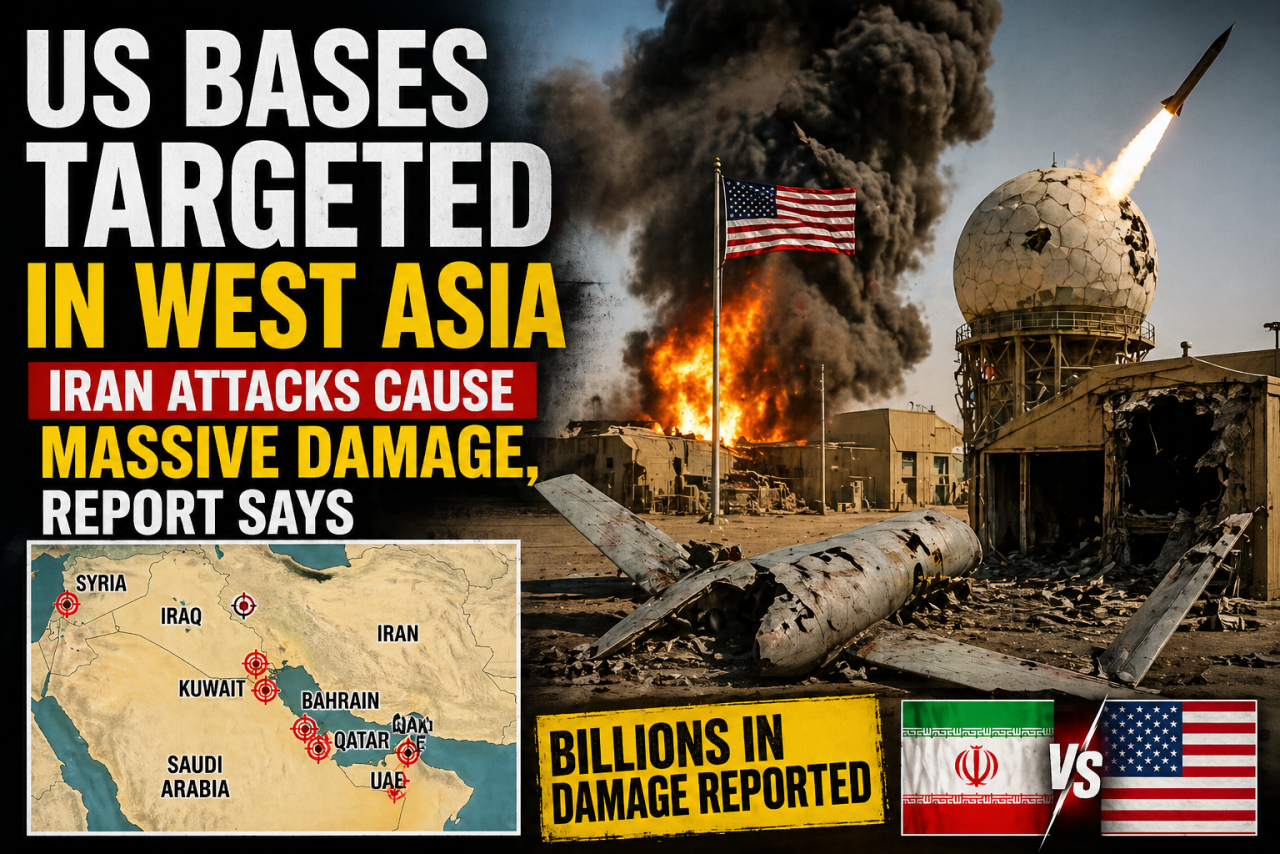
- Energy infrastructure has become a target, with retaliatory strikes hitting key facilities across the Gulf, further tightening supply chains.
For economies like India, heavily dependent on energy imports, this represents a classic stagflationary shock—rising inflation coupled with slowing growth. Emergency policy responses, including temporary relaxations on energy sourcing, reflect the scale of the crisis.
The Geopolitical Realignment
Beyond economics, the war is accelerating a deeper geopolitical shift—one that is redefining alliances and exposing the limits of traditional power structures.
The United States, long seen as the central stabilizing force in the region, now finds its influence tested. Calls for a coordinated international coalition to secure maritime routes have been met with hesitation. Key allies have opted for caution, signaling a growing reluctance to be drawn into prolonged conflict.
Meanwhile, China has adopted a strategy of calculated distance. By avoiding direct involvement while maintaining diplomatic engagement, it is preserving resources and positioning itself as a potential power broker—especially among nations in the Global South seeking alternatives to Western leadership.
Russia, on the other hand, has emerged as an unexpected beneficiary. With global energy markets under strain, the demand for its exports has surged, providing a significant economic windfall despite ongoing geopolitical tensions elsewhere.
This shifting balance points toward a multipolar world—one where influence is fragmented, and power is negotiated rather than assumed.
Humanitarian and Social Costs
Amid the strategic calculations and economic forecasts lies a far more immediate reality: human suffering on a massive scale.
In just weeks, the conflict has claimed thousands of lives across multiple countries. Urban centers have witnessed the destruction of essential infrastructure—hospitals, schools, and power systems—leaving civilian populations vulnerable and displaced.
The ripple effects extend beyond national borders. Millions of expatriate workers in the Gulf now face uncertainty, as instability threatens both employment and safety. For countries like India, this carries serious implications—not only in terms of citizen welfare but also the potential collapse of remittance flows that sustain millions of households.
The war is not just redrawing maps; it is unraveling the social fabric of an entire region.
A World Without a Map
The West Asia war of 2026 may ultimately be remembered not for who won or lost, but for what it ended. The idea of a cohesive, rules-based global order—already under strain—has suffered what may be its most decisive blow.
In its place, a new reality is emerging: a fragmented world of competing blocs, contested trade routes, and transactional diplomacy. Stability is no longer guaranteed by shared norms, but negotiated through shifting alliances and displays of power.
The era of a single global framework is fading. What replaces it remains uncertain.
As the conflict continues, the defining question is no longer about the trajectory of the war itself—but about the kind of world that will exist in its aftermath. A world without clear rules, without reliable institutions, and perhaps, without a shared vision of order.






Leave a Comment