
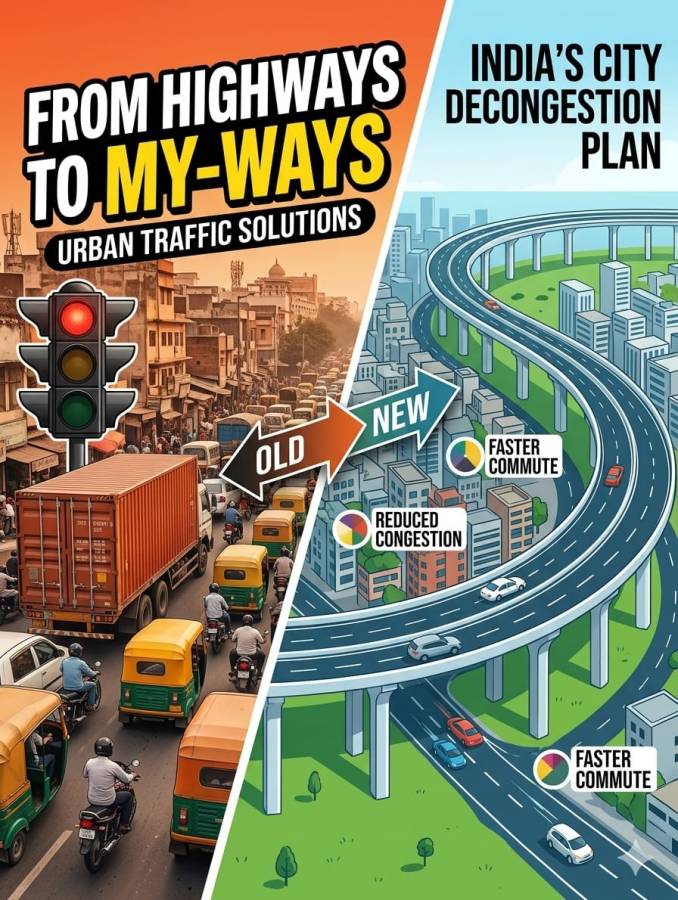
India is building highways and redesigning them to make urban transport more efficient.
For a long time, India’s idea of development was tied to highways. Wider roads, faster corridors, and ambitious projects like the Golden Quadrilateral and Bharatmala became symbols of progress. They connected cities, boosted trade, and cut travel time across states.
But somewhere along the way, a new problem emerged.
While highways made it easier to move between cities, navigating within them became harder. Congestion, pollution, and endless traffic signals turned daily commutes into a grind. In many urban centres, the biggest bottleneck wasn’t the highway—it was the city itself.
Now, the government appears to be acknowledging that gap.
At the Ministry of Road Transport and Highways (MoRTH), there is a visible shift in strategy. Instead of focusing only on long-distance connectivity, the emphasis is moving toward decongesting cities and improving how traffic flows through urban areas.
Keeping Through-Traffic Out
The core idea behind this shift is simple: not all traffic belongs inside a city.
A large share of vehicles, especially trucks are just passing through. They don’t need to stop, but they still end up clogging city roads, competing with local commuters for space.
To fix this, the government is investing in ring roads, bypasses, and elevated corridors that allow such vehicles to go around cities instead of through them.
In practical terms, this means a truck traveling from one state to another won’t have to cross multiple traffic lights in a crowded city. It can simply bypass it.
For residents, that could translate into shorter travel times, less noise, and a noticeable drop in traffic pressure on key roads.
The Scale of the Push
This is a large-scale shift backed by funding and targets.
- A capital expenditure of ₹2.94 trillion has been earmarked for 2026–27
- The government aims to build 10,000 km of highways, including access-controlled corridors and ring roads
- The initial focus is on 47 major cities, followed by those with populations above 5 lakh
- India’s national highway network has expanded to around 146,572 km, marking strong growth over the past decade
The numbers show that India isn’t slowing down road construction. Instead, it is becoming more selective about where new roads can have the biggest impact.
Why It Matters for the Economy
Urban decongestion goes beyond convenience and has clear economic implications
Consider the Urban Extension Road II (UER-II) in Delhi. Designed as a peripheral expressway, it allows freight traffic to move around the capital instead of entering it.
This kind of infrastructure reduces delays, which directly lowers fuel consumption and transportation costs. When goods move faster and more efficiently, logistics becomes cheaper.
India has already seen a shift here. Logistics costs, once estimated at 13–14% of GDP, have come down to nearly 8% in recent years, helped by reforms such as GST, FASTag, and digital tracking systems.
Lower logistics costs make Indian products more competitive, both domestically and globally. For businesses, it improves margins. For consumers, it can eventually mean lower prices.
What It Means for Daily Life
Beyond economics, the impact on everyday life could be significant.
When heavy vehicles are diverted away from city centres:
- Roads become less crowded
- Traffic moves more predictably
- Noise levels drop in residential areas
- The risk of accidents decreases
It also changes the way cities feel. Streets that were once dominated by long-haul trucks and constant honking can become more accessible for local commuters, cyclists, and pedestrians.
In that sense, infrastructure planning is no longer about engineering, but improving urban living conditions.
A Subtle but Important Shift
What stands out in this approach is the change in mindset.
Earlier, success was measured by how many kilometres of highways were built. Now, it is increasingly about how effectively those roads solve real problems.
The focus is shifting from distance to efficiency, from speed to usability.
India is still building highways, and it will continue to do so. But the next phase of growth is likely to be more nuanced—less about headline-grabbing mega projects and more about targeted interventions that improve everyday mobility.
Final Take
As India moves toward becoming a $5 trillion economy, infrastructure will remain central to that journey. But the definition of good infrastructure is evolving.
It is no longer about connecting cities, but making cities work better.
If this strategy delivers, the real change won’t just be visible on maps or project reports. It will be felt in shorter commutes, cleaner air, and less stressful journeys home.
And that, ultimately, may be the most meaningful measure of progress.
For a long time, India’s idea of development was tied to highways. Wider roads, faster corridors, and ambitious projects like the Golden Quadrilateral and Bharatmala became symbols of progress. They connected cities, boosted trade, and cut travel time across states.
But somewhere along the way, a new problem emerged.
While highways made it easier to move between cities, navigating within them became harder. Congestion, pollution, and endless traffic signals turned daily commutes into a grind. In many urban centres, the biggest bottleneck wasn’t the highway—it was the city itself.
Now, the government appears to be acknowledging that gap.
At the Ministry of Road Transport and Highways (MoRTH), there is a visible shift in strategy. Instead of focusing only on long-distance connectivity, the emphasis is moving toward decongesting cities and improving how traffic flows through urban areas.
Keeping Through-Traffic Out
The core idea behind this shift is simple: not all traffic belongs inside a city.
A large share of vehicles, especially trucks are just passing through. They don’t need to stop, but they still end up clogging city roads, competing with local commuters for space.
To fix this, the government is investing in ring roads, bypasses, and elevated corridors that allow such vehicles to go around cities instead of through them.
In practical terms, this means a truck traveling from one state to another won’t have to cross multiple traffic lights in a crowded city. It can simply bypass it.
For residents, that could translate into shorter travel times, less noise, and a noticeable drop in traffic pressure on key roads.
The Scale of the Push
This is a large-scale shift backed by funding and targets.
- A capital expenditure of ₹2.94 trillion has been earmarked for 2026–27
- The government aims to build 10,000 km of highways, including access-controlled corridors and ring roads
- The initial focus is on 47 major cities, followed by those with populations above 5 lakh
- India’s national highway network has expanded to around 146,572 km, marking strong growth over the past decade
The numbers show that India isn’t slowing down road construction. Instead, it is becoming more selective about where new roads can have the biggest impact.
Why It Matters for the Economy
Urban decongestion goes beyond convenience and has clear economic implications
Consider the Urban Extension Road II (UER-II) in Delhi. Designed as a peripheral expressway, it allows freight traffic to move around the capital instead of entering it.
This kind of infrastructure reduces delays, which directly lowers fuel consumption and transportation costs. When goods move faster and more efficiently, logistics becomes cheaper.
India has already seen a shift here. Logistics costs, once estimated at 13–14% of GDP, have come down to nearly 8% in recent years, helped by reforms such as GST, FASTag, and digital tracking systems.
Lower logistics costs make Indian products more competitive, both domestically and globally. For businesses, it improves margins. For consumers, it can eventually mean lower prices.
What It Means for Daily Life
Beyond economics, the impact on everyday life could be significant.
When heavy vehicles are diverted away from city centres:
- Roads become less crowded
- Traffic moves more predictably
- Noise levels drop in residential areas
- The risk of accidents decreases
It also changes the way cities feel. Streets that were once dominated by long-haul trucks and constant honking can become more accessible for local commuters, cyclists, and pedestrians.
In that sense, infrastructure planning is no longer about engineering, but improving urban living conditions.
A Subtle but Important Shift
What stands out in this approach is the change in mindset.
Earlier, success was measured by how many kilometres of highways were built. Now, it is increasingly about how effectively those roads solve real problems.
The focus is shifting from distance to efficiency, from speed to usability.
India is still building highways, and it will continue to do so. But the next phase of growth is likely to be more nuanced—less about headline-grabbing mega projects and more about targeted interventions that improve everyday mobility.
Final Take
As India moves toward becoming a $5 trillion economy, infrastructure will remain central to that journey. But the definition of good infrastructure is evolving.
It is no longer about connecting cities, but making cities work better.
If this strategy delivers, the real change won’t just be visible on maps or project reports. It will be felt in shorter commutes, cleaner air, and less stressful journeys home.
And that, ultimately, may be the most meaningful measure of progress.


















Leave a Comment