
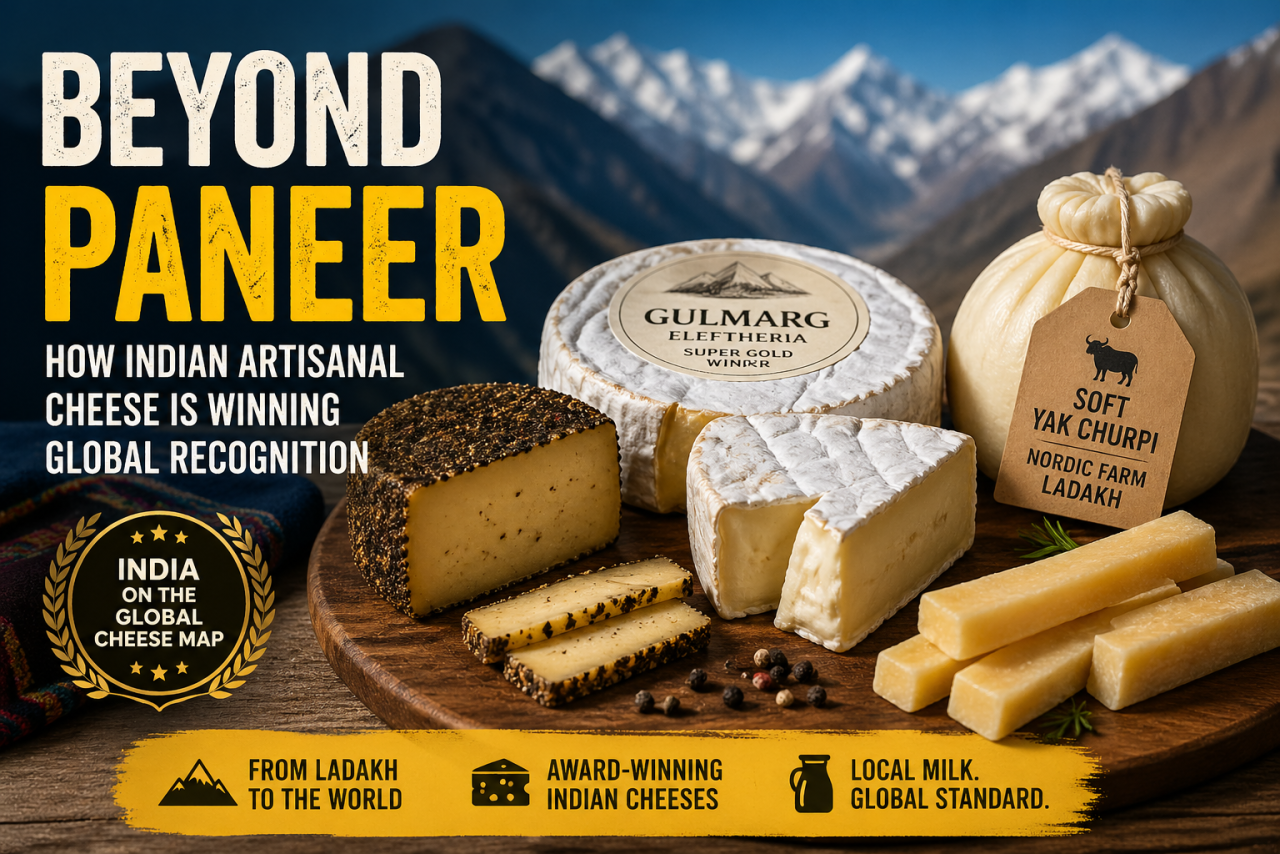
India’s cheese story is no longer limited to paneer—award-winning artisanal varieties from Ladakh to Mumbai are quietly putting the country on the global gourmet map.
For years, India’s cheese story has been simple, paneer dominated the plate. It was fresh, reliable, and deeply embedded in everyday cooking. But beyond that, there was little conversation about Indian cheese in global culinary circles.
That is beginning to change.
At the Mundial do Queijo do Brasil in 2026, Indian cheesemakers drew attention with top honours. Eleftheria’s Gulmarg picked up a Super Gold, while Nordic Farm’s Yak Churpi secured a Gold. The wins were notable not just for the medals, but for what they signal: Indian artisanal cheese is finding a place on the world stage.
Making Cheese Against the Odds
Producing high-quality aged cheese in India is not straightforward. Unlike Europe, where natural caves provide stable, cool conditions, most parts of India are hot and humid—far from ideal for aging dairy.
Cheesemakers have had to adapt. Controlled environments, careful temperature regulation, and precise handling are essential. Producers such as Mausam Narang have focused on building microclimates that replicate the conditions needed for cheeses like Brie-style Gulmarg to mature properly.
The process is technical and demanding, closer to controlled food science than traditional dairy work.
Reworking Tradition: The Case of Churpi
One of the more interesting developments is the evolution of churpi. Traditionally made in the Himalayan region, churpi is known for its hardness—it is often chewed slowly over hours and valued more for endurance than flavour.
At Nordic Farm in Ladakh, that idea has been reworked. By adjusting the process, producers have created a softer, more accessible version of yak milk cheese. The result retains its regional identity but fits more comfortably into contemporary dining.
This kind of adaptation reflects a broader shift: traditional foods are being refined without being discarded.
Moving Past Imitation
Early efforts in Indian artisanal cheese often leaned toward replication—local versions of European classics. That approach is now giving way to something more distinct.
Producers are experimenting with local ingredients and conditions rather than working against them. Black pepper, regional milk variations, and different aging techniques are being used to shape flavour profiles that are recognisably Indian.
There is also a practical dimension. Cheeses are being developed to perform better in warmer conditions, holding texture without losing flavour. It’s a response to climate as much as cuisine.
A Shift in Consumption
This rise in artisanal cheese ties into a gradual change in how urban consumers approach food. There is growing interest in traceability—where food comes from, how it is made, and who produces it.
Unlike processed cheese products, artisanal varieties are typically free from additives such as emulsifiers and vegetable fats. They are closer to the source, often linked to specific farms or regions.
Buying these products supports smaller supply chains, including dairy farmers and local producers, rather than large-scale manufacturing.
Final Take
The recognition at international competitions suggests that Indian cheese is no longer operating on the margins. It is developing its own standards and identity.
Paneer is unlikely to lose its place in Indian kitchens. But alongside it, a broader category is emerging—one that includes aged, region-specific, and experimental cheeses.
For consumers, the change is gradual but visible. Local options are expanding, and the idea of Indian cheese is no longer limited to a single product.
The shift is less about replacing paneer and more about expanding the definition of what Indian dairy can be.
For years, India’s cheese story has been simple, paneer dominated the plate. It was fresh, reliable, and deeply embedded in everyday cooking. But beyond that, there was little conversation about Indian cheese in global culinary circles.
That is beginning to change.
At the Mundial do Queijo do Brasil in 2026, Indian cheesemakers drew attention with top honours. Eleftheria’s Gulmarg picked up a Super Gold, while Nordic Farm’s Yak Churpi secured a Gold. The wins were notable not just for the medals, but for what they signal: Indian artisanal cheese is finding a place on the world stage.
Making Cheese Against the Odds
Producing high-quality aged cheese in India is not straightforward. Unlike Europe, where natural caves provide stable, cool conditions, most parts of India are hot and humid—far from ideal for aging dairy.
Cheesemakers have had to adapt. Controlled environments, careful temperature regulation, and precise handling are essential. Producers such as Mausam Narang have focused on building microclimates that replicate the conditions needed for cheeses like Brie-style Gulmarg to mature properly.
The process is technical and demanding, closer to controlled food science than traditional dairy work.
Reworking Tradition: The Case of Churpi
One of the more interesting developments is the evolution of churpi. Traditionally made in the Himalayan region, churpi is known for its hardness—it is often chewed slowly over hours and valued more for endurance than flavour.
At Nordic Farm in Ladakh, that idea has been reworked. By adjusting the process, producers have created a softer, more accessible version of yak milk cheese. The result retains its regional identity but fits more comfortably into contemporary dining.
This kind of adaptation reflects a broader shift: traditional foods are being refined without being discarded.
Moving Past Imitation
Early efforts in Indian artisanal cheese often leaned toward replication—local versions of European classics. That approach is now giving way to something more distinct.
Producers are experimenting with local ingredients and conditions rather than working against them. Black pepper, regional milk variations, and different aging techniques are being used to shape flavour profiles that are recognisably Indian.
There is also a practical dimension. Cheeses are being developed to perform better in warmer conditions, holding texture without losing flavour. It’s a response to climate as much as cuisine.
A Shift in Consumption
This rise in artisanal cheese ties into a gradual change in how urban consumers approach food. There is growing interest in traceability—where food comes from, how it is made, and who produces it.
Unlike processed cheese products, artisanal varieties are typically free from additives such as emulsifiers and vegetable fats. They are closer to the source, often linked to specific farms or regions.
Buying these products supports smaller supply chains, including dairy farmers and local producers, rather than large-scale manufacturing.
Final Take
The recognition at international competitions suggests that Indian cheese is no longer operating on the margins. It is developing its own standards and identity.
Paneer is unlikely to lose its place in Indian kitchens. But alongside it, a broader category is emerging—one that includes aged, region-specific, and experimental cheeses.
For consumers, the change is gradual but visible. Local options are expanding, and the idea of Indian cheese is no longer limited to a single product.
The shift is less about replacing paneer and more about expanding the definition of what Indian dairy can be.

























Leave a Comment