
India holds steady at 6.5% growth—but can it stay insulated from rising global turmoil and inflation shocks?
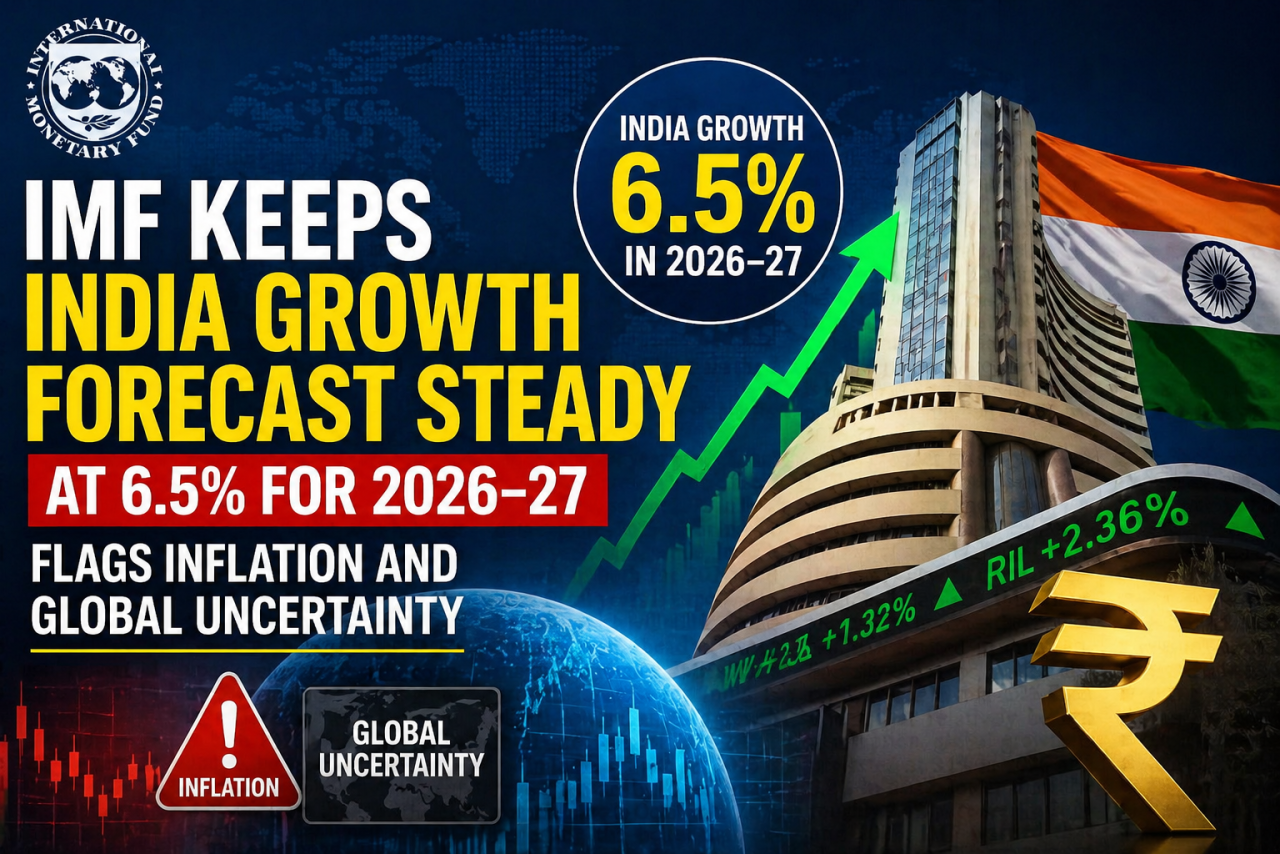
India is expected to maintain a steady economic growth rate of 6.5% in both 2026 and 2027, according to the latest projections by the International Monetary Fund (IMF), even as global economic conditions remain volatile and uncertain. The assessment reinforces India’s position as the fastest-growing major economy, but it also underscores emerging risks tied to inflationary pressures and geopolitical instability.
The IMF’s latest World Economic Outlook presents a cautiously optimistic view of India’s trajectory. While the growth estimate remains unchanged from earlier projections, it comes against the backdrop of a global slowdown. The IMF has revised global growth downward to around 3.1% for 2026, reflecting disruptions caused by ongoing conflicts, particularly in West Asia, and persistent supply chain challenges.
In this context, India’s relative stability appears notable. The IMF attributes this resilience primarily to strong domestic demand, which continues to act as the backbone of the country’s economic expansion. Private consumption, driven by rising incomes and urban demand, remains robust. At the same time, sustained public investment in infrastructure and capital expenditure is helping to maintain growth momentum.
A significant factor supporting the 2026–27 outlook is the strong performance recorded in 2025. The IMF estimates India’s growth for that year at approximately 7.6%, higher than previously expected. This has created a favourable base effect, allowing growth to remain steady even as external conditions become less supportive. Economists often describe this as a “carryover effect,” where strong past performance continues to influence future outcomes.
However, the IMF’s outlook is not without caution. Inflation is expected to rise moderately, with projections indicating an increase to around 4.7% in 2026 before easing to about 4% in 2027. While this remains within the broad tolerance band of the Reserve Bank of India, it reflects underlying pressures from global energy and food prices. Any sustained increase in commodity prices, particularly crude oil, could complicate the inflation outlook further.
The report also highlights the role of external trade conditions in shaping India’s prospects. A reduction in additional tariffs on Indian goods by the United States has provided some relief, potentially supporting export growth. This comes at a time when global trade volumes are under strain, and countries are re-evaluating supply chains. India’s push to position itself as a manufacturing hub, supported by policy initiatives such as production-linked incentives, may further strengthen its export competitiveness.
Despite these positives, the IMF has flagged significant risks arising from the global environment. The ongoing conflict in West Asia remains a key concern, particularly due to its impact on energy markets. India, being heavily dependent on energy imports, is vulnerable to price shocks. A prolonged conflict or escalation could lead to higher inflation and a widening current account deficit.
The IMF has also introduced a “reference forecast” scenario, which assumes that geopolitical tensions remain contained and disruptions ease by mid-2026. Under this scenario, India’s growth is expected to remain stable. However, in a more adverse scenario involving prolonged conflict or damage to critical energy infrastructure, global growth could slow sharply, with spillover effects on emerging economies, including India.
Another dimension of concern is the tightening of global financial conditions. Higher interest rates in advanced economies could affect capital flows to emerging markets. While India’s strong foreign exchange reserves and relatively stable financial system provide a buffer, sudden shifts in global liquidity could still pose challenges.
Domestically, structural issues continue to demand attention. Employment generation remains uneven, particularly in the formal sector, and income inequality persists. Rural demand, although improving, is still sensitive to inflation and agricultural performance. Addressing these challenges will be crucial to sustaining long-term growth.
At the same time, India’s macroeconomic fundamentals remain relatively strong. The banking sector has shown improved stability, with lower levels of non-performing assets and better capitalisation. Government spending on infrastructure continues to crowd in private investment, creating a multiplier effect across sectors.
The IMF’s projections ultimately reflect a balance between resilience and risk. India’s growth story is being driven largely by domestic factors, making it less vulnerable to external shocks compared to more export-dependent economies. However, it is not insulated from global developments.
As the global economy navigates an uncertain path, India’s ability to sustain a 6.5% growth rate will depend on how effectively it manages inflation, navigates external risks, and advances structural reforms. The IMF’s outlook suggests that while India remains on a strong footing, the road ahead will require careful calibration of policy and continued focus on inclusive growth.
In a world marked by economic fragmentation and geopolitical tensions, India’s steady growth projection offers a rare measure of stability—but one that will need constant reinforcement in the face of evolving global challenges.
India is expected to maintain a steady economic growth rate of 6.5% in both 2026 and 2027, according to the latest projections by the International Monetary Fund (IMF), even as global economic conditions remain volatile and uncertain. The assessment reinforces India’s position as the fastest-growing major economy, but it also underscores emerging risks tied to inflationary pressures and geopolitical instability.
The IMF’s latest World Economic Outlook presents a cautiously optimistic view of India’s trajectory. While the growth estimate remains unchanged from earlier projections, it comes against the backdrop of a global slowdown. The IMF has revised global growth downward to around 3.1% for 2026, reflecting disruptions caused by ongoing conflicts, particularly in West Asia, and persistent supply chain challenges.
In this context, India’s relative stability appears notable. The IMF attributes this resilience primarily to strong domestic demand, which continues to act as the backbone of the country’s economic expansion. Private consumption, driven by rising incomes and urban demand, remains robust. At the same time, sustained public investment in infrastructure and capital expenditure is helping to maintain growth momentum.
A significant factor supporting the 2026–27 outlook is the strong performance recorded in 2025. The IMF estimates India’s growth for that year at approximately 7.6%, higher than previously expected. This has created a favourable base effect, allowing growth to remain steady even as external conditions become less supportive. Economists often describe this as a “carryover effect,” where strong past performance continues to influence future outcomes.
However, the IMF’s outlook is not without caution. Inflation is expected to rise moderately, with projections indicating an increase to around 4.7% in 2026 before easing to about 4% in 2027. While this remains within the broad tolerance band of the Reserve Bank of India, it reflects underlying pressures from global energy and food prices. Any sustained increase in commodity prices, particularly crude oil, could complicate the inflation outlook further.
The report also highlights the role of external trade conditions in shaping India’s prospects. A reduction in additional tariffs on Indian goods by the United States has provided some relief, potentially supporting export growth. This comes at a time when global trade volumes are under strain, and countries are re-evaluating supply chains. India’s push to position itself as a manufacturing hub, supported by policy initiatives such as production-linked incentives, may further strengthen its export competitiveness.
Despite these positives, the IMF has flagged significant risks arising from the global environment. The ongoing conflict in West Asia remains a key concern, particularly due to its impact on energy markets. India, being heavily dependent on energy imports, is vulnerable to price shocks. A prolonged conflict or escalation could lead to higher inflation and a widening current account deficit.
The IMF has also introduced a “reference forecast” scenario, which assumes that geopolitical tensions remain contained and disruptions ease by mid-2026. Under this scenario, India’s growth is expected to remain stable. However, in a more adverse scenario involving prolonged conflict or damage to critical energy infrastructure, global growth could slow sharply, with spillover effects on emerging economies, including India.
Another dimension of concern is the tightening of global financial conditions. Higher interest rates in advanced economies could affect capital flows to emerging markets. While India’s strong foreign exchange reserves and relatively stable financial system provide a buffer, sudden shifts in global liquidity could still pose challenges.
Domestically, structural issues continue to demand attention. Employment generation remains uneven, particularly in the formal sector, and income inequality persists. Rural demand, although improving, is still sensitive to inflation and agricultural performance. Addressing these challenges will be crucial to sustaining long-term growth.
At the same time, India’s macroeconomic fundamentals remain relatively strong. The banking sector has shown improved stability, with lower levels of non-performing assets and better capitalisation. Government spending on infrastructure continues to crowd in private investment, creating a multiplier effect across sectors.
The IMF’s projections ultimately reflect a balance between resilience and risk. India’s growth story is being driven largely by domestic factors, making it less vulnerable to external shocks compared to more export-dependent economies. However, it is not insulated from global developments.
As the global economy navigates an uncertain path, India’s ability to sustain a 6.5% growth rate will depend on how effectively it manages inflation, navigates external risks, and advances structural reforms. The IMF’s outlook suggests that while India remains on a strong footing, the road ahead will require careful calibration of policy and continued focus on inclusive growth.
In a world marked by economic fragmentation and geopolitical tensions, India’s steady growth projection offers a rare measure of stability—but one that will need constant reinforcement in the face of evolving global challenges.




















Leave a Comment