
Even as global trade falters, India’s textile sector is quietly stitching a story of resilience, growth, and expanding global reach.
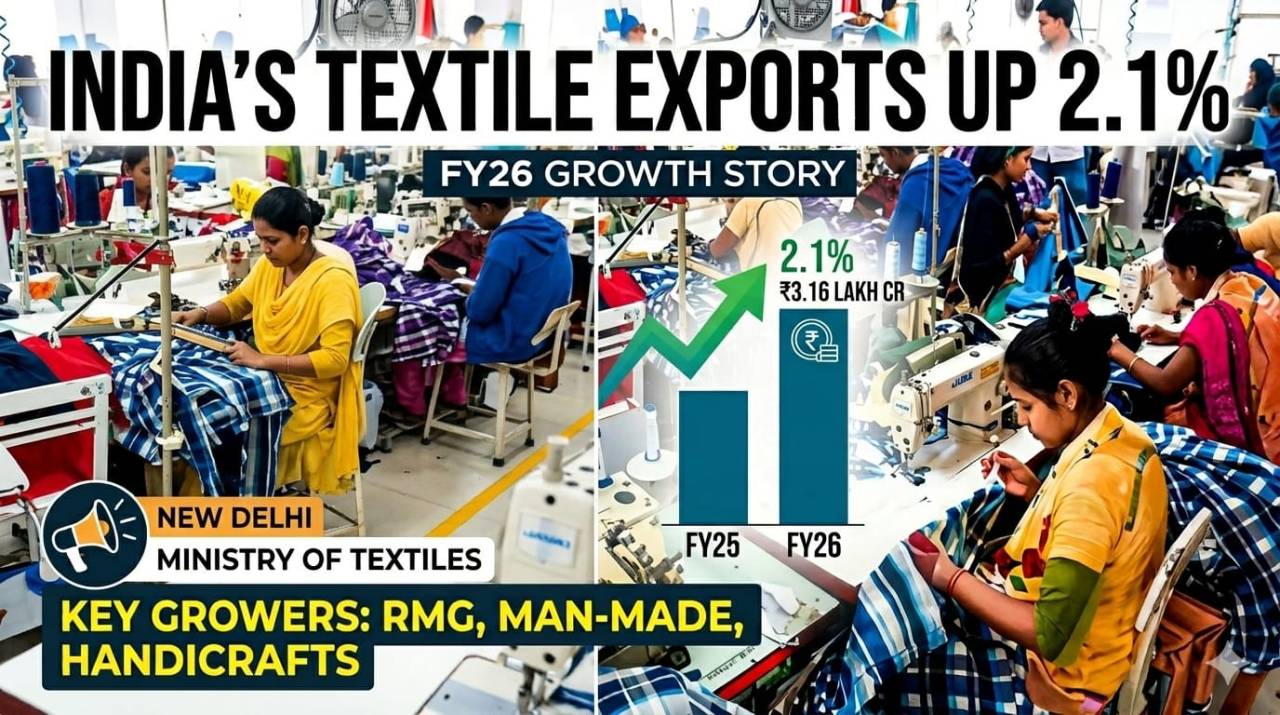
India’s textile industry showcased notable resilience in the financial year 2025–26 (FY26), registering steady growth despite a challenging global trade environment. According to the latest data released by the Ministry of Textiles, the country’s total textile exports grew by 2.1%, reaching ₹3.16 lakh crore, up from ₹3.09 lakh crore in the previous fiscal year.
While the growth rate appears modest, it reflects the sector’s ability to sustain momentum amid geopolitical tensions, supply chain disruptions, and fluctuating global demand.
Mixed Performance Across Key Segments
The performance across textile segments remained uneven, with certain categories driving growth while others recorded marginal gains.
The ready-made garments (RMG) segment continued to anchor India’s textile exports. It expanded by 2.9% to ₹1.39 lakh crore, reinforcing India’s strong positioning in global apparel manufacturing and its ability to cater to evolving fashion trends.
A notable shift was observed in man-made textiles, where exports of synthetic yarn and fabrics rose by 3.6%, reaching ₹42,687 crore. This growth aligns with changing global preferences toward blended and performance-based fabrics.
The handicrafts sector emerged as the fastest-growing category. Excluding handmade carpets, exports surged by 6.1% to ₹15,855 crore, reflecting increasing international demand for artisanal, handmade, and niche Indian products.
In contrast, traditional textile segments such as cotton yarn, fabrics, and handloom products recorded a modest growth of 0.4%, totaling ₹1.02 lakh crore. Despite slower expansion, these categories remain crucial to the industry’s overall volume and employment base.
Navigating Global Trade Headwinds
The textile sector’s performance comes against the backdrop of persistent global challenges. Geopolitical tensions, particularly in West Asia, and disruptions in the Red Sea shipping routes led to increased freight costs and delays in deliveries.
Additionally, evolving trade policies in key markets like the United States created a cautious and constrained export environment.
Despite these hurdles, India expanded its global footprint, exporting to more than 120 countries. Established markets showed strong growth, with exports to the UAE rising by 22.3%, Japan by 20.6%, and Germany by 9.9%.
Emerging markets also played a crucial role. African nations such as Senegal (54.4%) and Sudan (205.6%) recorded sharp increases in imports of Indian textiles, indicating successful market diversification and growing global acceptance.
Policy Support and Future Outlook
Government support has remained a key pillar for the industry’s stability. Export incentive schemes such as the Rebate of State and Central Taxes and Levies (RoSCTL) and the Remission of Duties and Taxes on Exported Products (RoDTEP) have been extended beyond March 2026, helping exporters stay cost-competitive.
India is also advancing its trade diplomacy through Free Trade Agreements (FTAs). The agreement with the European Free Trade Association (EFTA) is already operational, while negotiations with the United Kingdom and the European Union are progressing. These agreements are expected to reduce import duties and improve market access for Indian textiles.
On the domestic front, large-scale initiatives such as the PM MITRA Parks and the Production Linked Incentive (PLI) Scheme are attracting investments aimed at modernizing infrastructure and boosting production of high-value segments like technical textiles and man-made fibers.
A Sector Poised for Expansion
The textile industry remains one of India’s largest employment generators, supporting nearly 45 million workers, second only to agriculture.
With an ambitious export target of $100 billion in the coming years, the sector is positioning itself for long-term expansion. The steady 2.1% growth in FY26 may seem incremental, but it signals a deeper structural strength—an industry that is adapting to global shifts, diversifying markets, and preparing for a larger role in international trade.
India’s textile industry showcased notable resilience in the financial year 2025–26 (FY26), registering steady growth despite a challenging global trade environment. According to the latest data released by the Ministry of Textiles, the country’s total textile exports grew by 2.1%, reaching ₹3.16 lakh crore, up from ₹3.09 lakh crore in the previous fiscal year.
While the growth rate appears modest, it reflects the sector’s ability to sustain momentum amid geopolitical tensions, supply chain disruptions, and fluctuating global demand.
Mixed Performance Across Key Segments
The performance across textile segments remained uneven, with certain categories driving growth while others recorded marginal gains.
The ready-made garments (RMG) segment continued to anchor India’s textile exports. It expanded by 2.9% to ₹1.39 lakh crore, reinforcing India’s strong positioning in global apparel manufacturing and its ability to cater to evolving fashion trends.
A notable shift was observed in man-made textiles, where exports of synthetic yarn and fabrics rose by 3.6%, reaching ₹42,687 crore. This growth aligns with changing global preferences toward blended and performance-based fabrics.
The handicrafts sector emerged as the fastest-growing category. Excluding handmade carpets, exports surged by 6.1% to ₹15,855 crore, reflecting increasing international demand for artisanal, handmade, and niche Indian products.
In contrast, traditional textile segments such as cotton yarn, fabrics, and handloom products recorded a modest growth of 0.4%, totaling ₹1.02 lakh crore. Despite slower expansion, these categories remain crucial to the industry’s overall volume and employment base.
Navigating Global Trade Headwinds
The textile sector’s performance comes against the backdrop of persistent global challenges. Geopolitical tensions, particularly in West Asia, and disruptions in the Red Sea shipping routes led to increased freight costs and delays in deliveries.
Additionally, evolving trade policies in key markets like the United States created a cautious and constrained export environment.
Despite these hurdles, India expanded its global footprint, exporting to more than 120 countries. Established markets showed strong growth, with exports to the UAE rising by 22.3%, Japan by 20.6%, and Germany by 9.9%.
Emerging markets also played a crucial role. African nations such as Senegal (54.4%) and Sudan (205.6%) recorded sharp increases in imports of Indian textiles, indicating successful market diversification and growing global acceptance.
Policy Support and Future Outlook
Government support has remained a key pillar for the industry’s stability. Export incentive schemes such as the Rebate of State and Central Taxes and Levies (RoSCTL) and the Remission of Duties and Taxes on Exported Products (RoDTEP) have been extended beyond March 2026, helping exporters stay cost-competitive.
India is also advancing its trade diplomacy through Free Trade Agreements (FTAs). The agreement with the European Free Trade Association (EFTA) is already operational, while negotiations with the United Kingdom and the European Union are progressing. These agreements are expected to reduce import duties and improve market access for Indian textiles.
On the domestic front, large-scale initiatives such as the PM MITRA Parks and the Production Linked Incentive (PLI) Scheme are attracting investments aimed at modernizing infrastructure and boosting production of high-value segments like technical textiles and man-made fibers.
A Sector Poised for Expansion
The textile industry remains one of India’s largest employment generators, supporting nearly 45 million workers, second only to agriculture.
With an ambitious export target of $100 billion in the coming years, the sector is positioning itself for long-term expansion. The steady 2.1% growth in FY26 may seem incremental, but it signals a deeper structural strength—an industry that is adapting to global shifts, diversifying markets, and preparing for a larger role in international trade.






















Leave a Comment