
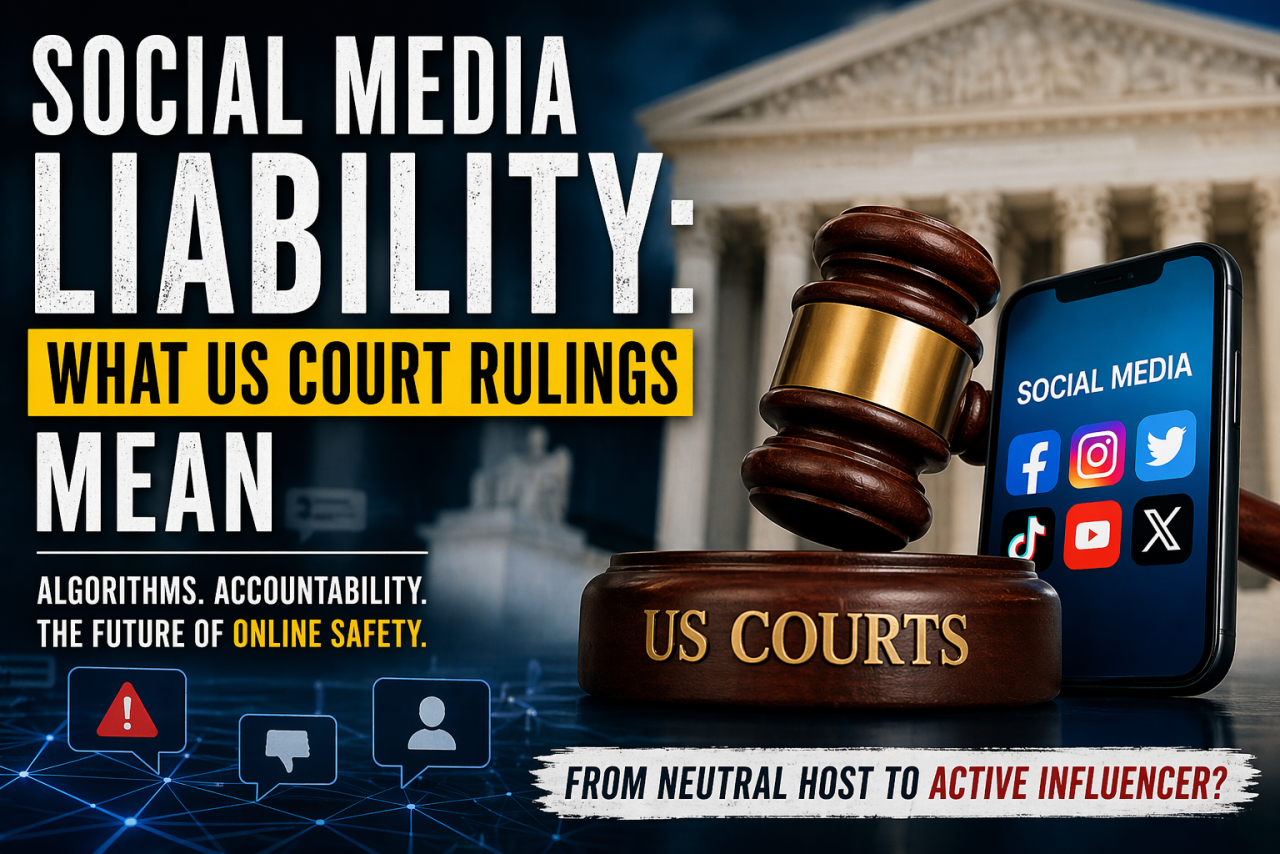
Are social media platforms just hosts—or are their algorithms making them responsible for what you see?
The debate over social media liability is no longer confined to policy circles or tech conferences. It has steadily moved into courtrooms, where judges are being asked to decide a difficult question: when harmful content spreads online, who should be held responsible—the user who posts it, or the platform that amplifies it?
Recent developments in the United States offer a window into how this question is evolving. For years, platforms have relied on legal protections that shield them from being treated as publishers of user-generated content. This protection, rooted in the idea that platforms are intermediaries rather than creators, has allowed social media companies to scale rapidly without facing the same legal risks as traditional media. But the rise of algorithm-driven feeds has complicated that distinction.
Courts are increasingly being asked to examine whether platforms are merely hosting content or actively promoting it. Algorithms today are not passive tools. They decide what billions of people see, often optimizing for engagement rather than accuracy or safety. This has raised concerns that platforms are not just neutral spaces but active participants in shaping online discourse.
One of the key tensions in recent US court discussions has been around whether algorithmic recommendations should be treated differently from simple hosting. If a platform’s system actively suggests harmful or misleading content to users, can it still claim neutrality? Some legal arguments suggest that once a platform curates and amplifies content, it crosses into editorial territory. Others warn that weakening protections could open the floodgates to endless litigation, potentially stifling innovation and free expression.
The courts have so far taken a cautious approach. Rather than dismantling existing protections outright, they appear to be drawing subtle distinctions. There is recognition that while platforms cannot realistically monitor every piece of content, they also cannot ignore the consequences of systems designed to maximize user engagement at any cost. This middle ground reflects an attempt to balance competing priorities: protecting free speech, ensuring accountability, and maintaining a functional digital ecosystem.
Another important takeaway from US cases is the growing emphasis on foreseeability. If harm caused by certain types of content is predictable, should platforms be expected to act? This shifts the conversation from reactive moderation to proactive responsibility. It suggests that liability may not depend solely on the presence of harmful content, but on whether platforms took reasonable steps to prevent its amplification.
For online readers and digital citizens, this legal evolution matters more than it might seem. The outcome of these debates will shape the future of the internet. A stricter liability regime could force platforms to rethink how their algorithms work, possibly leading to safer but less dynamic online spaces. On the other hand, maintaining broad protections could preserve openness but at the cost of continued risks associated with misinformation, hate speech, and harmful trends.
There is also a global dimension to consider. Decisions in US courts often influence regulatory thinking in other countries, including India. As governments worldwide grapple with similar challenges, the legal principles emerging from these cases could serve as reference points. However, local contexts will still play a crucial role. What works in one jurisdiction may not translate seamlessly to another with different social, political, and technological landscapes.
What stands out most in the US experience is the recognition that the internet has outgrown the frameworks designed for its early days. Social media platforms are no longer simple conduits of information. They are powerful entities that shape opinions, behaviors, and even societal outcomes. With that power comes a level of responsibility that is still being defined.
The conversation is far from settled. Courts will continue to refine their interpretations, lawmakers may step in with new regulations, and platforms themselves might adapt in response to public pressure. But one thing is clear: the question of social media liability is no longer about whether platforms should be accountable, but how that accountability should be structured.
For readers navigating this digital landscape, the implications are immediate. The content that appears on a feed is not random; it is the result of complex systems designed with specific goals. Understanding this reality is the first step toward more informed engagement. As legal systems catch up with technology, users too must evolve in how they consume, question, and share information.
The lessons from US courts are not definitive answers, but they are important signals. They suggest a future where responsibility is shared, where platforms cannot entirely step back from the consequences of their designs, and where the law seeks to keep pace with a rapidly changing digital world.
The debate over social media liability is no longer confined to policy circles or tech conferences. It has steadily moved into courtrooms, where judges are being asked to decide a difficult question: when harmful content spreads online, who should be held responsible—the user who posts it, or the platform that amplifies it?
Recent developments in the United States offer a window into how this question is evolving. For years, platforms have relied on legal protections that shield them from being treated as publishers of user-generated content. This protection, rooted in the idea that platforms are intermediaries rather than creators, has allowed social media companies to scale rapidly without facing the same legal risks as traditional media. But the rise of algorithm-driven feeds has complicated that distinction.
Courts are increasingly being asked to examine whether platforms are merely hosting content or actively promoting it. Algorithms today are not passive tools. They decide what billions of people see, often optimizing for engagement rather than accuracy or safety. This has raised concerns that platforms are not just neutral spaces but active participants in shaping online discourse.
One of the key tensions in recent US court discussions has been around whether algorithmic recommendations should be treated differently from simple hosting. If a platform’s system actively suggests harmful or misleading content to users, can it still claim neutrality? Some legal arguments suggest that once a platform curates and amplifies content, it crosses into editorial territory. Others warn that weakening protections could open the floodgates to endless litigation, potentially stifling innovation and free expression.
The courts have so far taken a cautious approach. Rather than dismantling existing protections outright, they appear to be drawing subtle distinctions. There is recognition that while platforms cannot realistically monitor every piece of content, they also cannot ignore the consequences of systems designed to maximize user engagement at any cost. This middle ground reflects an attempt to balance competing priorities: protecting free speech, ensuring accountability, and maintaining a functional digital ecosystem.
Another important takeaway from US cases is the growing emphasis on foreseeability. If harm caused by certain types of content is predictable, should platforms be expected to act? This shifts the conversation from reactive moderation to proactive responsibility. It suggests that liability may not depend solely on the presence of harmful content, but on whether platforms took reasonable steps to prevent its amplification.
For online readers and digital citizens, this legal evolution matters more than it might seem. The outcome of these debates will shape the future of the internet. A stricter liability regime could force platforms to rethink how their algorithms work, possibly leading to safer but less dynamic online spaces. On the other hand, maintaining broad protections could preserve openness but at the cost of continued risks associated with misinformation, hate speech, and harmful trends.
There is also a global dimension to consider. Decisions in US courts often influence regulatory thinking in other countries, including India. As governments worldwide grapple with similar challenges, the legal principles emerging from these cases could serve as reference points. However, local contexts will still play a crucial role. What works in one jurisdiction may not translate seamlessly to another with different social, political, and technological landscapes.
What stands out most in the US experience is the recognition that the internet has outgrown the frameworks designed for its early days. Social media platforms are no longer simple conduits of information. They are powerful entities that shape opinions, behaviors, and even societal outcomes. With that power comes a level of responsibility that is still being defined.
The conversation is far from settled. Courts will continue to refine their interpretations, lawmakers may step in with new regulations, and platforms themselves might adapt in response to public pressure. But one thing is clear: the question of social media liability is no longer about whether platforms should be accountable, but how that accountability should be structured.
For readers navigating this digital landscape, the implications are immediate. The content that appears on a feed is not random; it is the result of complex systems designed with specific goals. Understanding this reality is the first step toward more informed engagement. As legal systems catch up with technology, users too must evolve in how they consume, question, and share information.
The lessons from US courts are not definitive answers, but they are important signals. They suggest a future where responsibility is shared, where platforms cannot entirely step back from the consequences of their designs, and where the law seeks to keep pace with a rapidly changing digital world.










Leave a Comment