
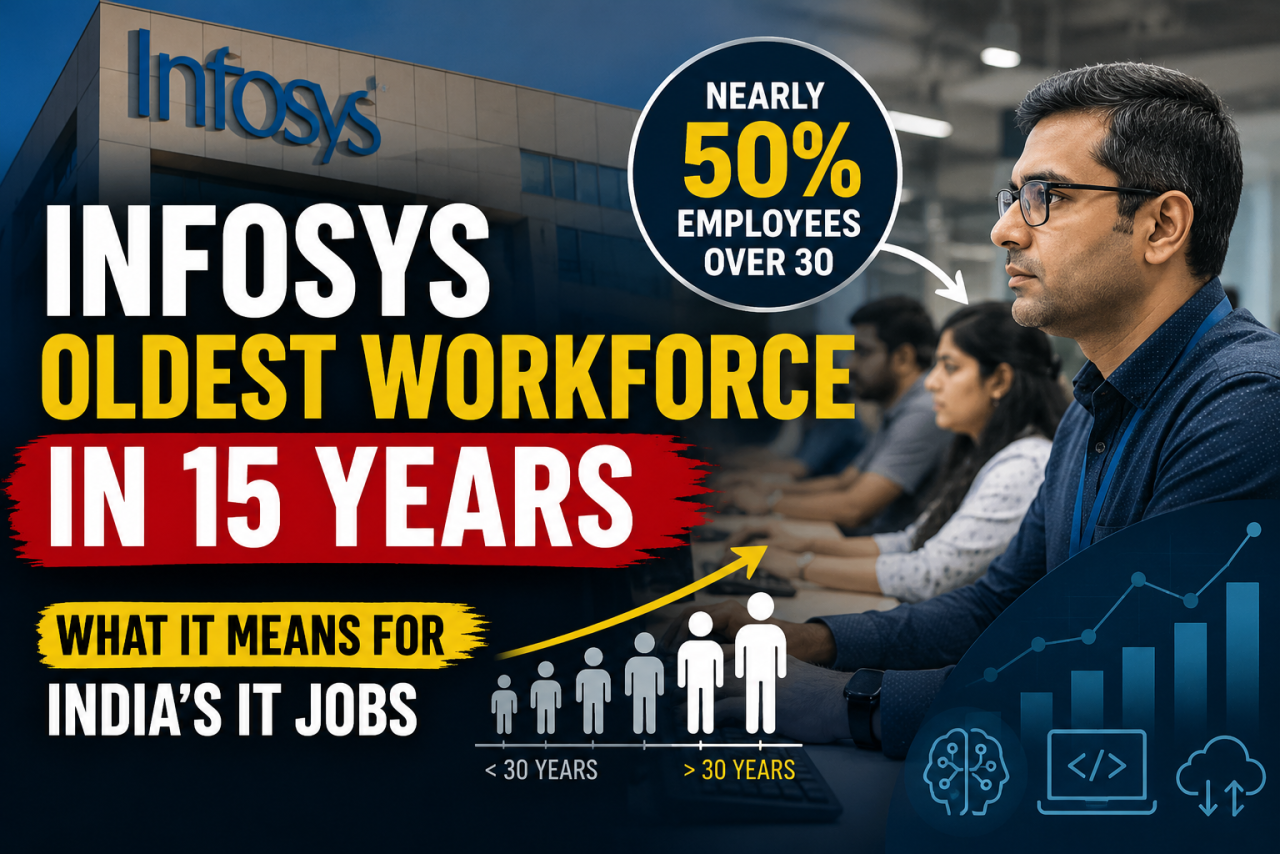
For decades, a job in India’s IT sector was seen as a guaranteed ticket to a stable middle-class life. But as the workforce ages and hiring patterns shift, a new question is emerging—has the country’s most trusted career engine started to change its course
For decades, India’s information technology (IT) industry represented the country’s most reliable path to middle-class success. Engineering graduates poured into technology companies, attracted by stable jobs, global exposure, and the promise of upward mobility. But a recent workforce trend at Infosys, one of India’s largest IT services firms, suggests that this long-standing equation may be changing.
According to company data, nearly half of Infosys’s workforce is now above the age of 30, the highest proportion seen in the last 15 years. At the same time, the share of younger employees has been steadily declining. While this may appear to be a routine demographic change, it reflects deeper transformations taking place in India’s labor market, education system, and technology sector.
Traditionally, large IT services companies relied heavily on fresh graduates. Every year, thousands of engineering students entered the workforce through campus placements, receiving training before being deployed on projects for global clients. This model helped create millions of jobs and contributed significantly to India’s economic rise.
Today, however, the landscape is different.
One major factor is the emergence of Global Capability Centres (GCCs), the in-house technology and operations hubs established by multinational corporations in India. These centres increasingly recruit directly from colleges, often offering higher salaries, more specialized work, and stronger long-term career prospects than traditional outsourcing firms. As a result, many of the country’s best young graduates are choosing these opportunities over conventional IT services roles.
At the same time, students themselves are becoming more selective. The new generation of professionals is looking beyond job security alone. Many seek roles in artificial intelligence, cybersecurity, data science, research, and product development. They are often attracted to organizations that provide intellectual challenges and opportunities to build cutting-edge technologies rather than simply maintaining existing systems.
This shift reflects a broader evolution in career aspirations. A decade ago, landing a job at a major IT services company was considered a dream outcome for many engineering graduates. Today, it is just one option among many. Startups, research institutions, multinational technology firms, fintech companies, and digital platforms now compete aggressively for talent.
The aging workforce at Infosys also points to another reality: companies are hiring fewer freshers while retaining more experienced employees. As technology projects become increasingly complex, organizations require professionals who possess specialized expertise and domain knowledge. Experience has become a more valuable asset than ever before.
Artificial intelligence is accelerating this trend. Many entry-level tasks that once required large teams of junior employees can now be partially automated through AI-powered tools. This does not necessarily eliminate jobs, but it changes the nature of hiring. Companies may need fewer people for routine work while seeking professionals who can manage, supervise, and improve AI-driven systems.
For India, this development presents both opportunities and challenges.
On the positive side, an older workforce often indicates a more mature and skilled industry. Employees staying longer in their careers contribute deeper expertise, stronger client relationships, and greater organizational stability. This can help Indian firms move up the value chain and compete in more sophisticated technology segments.
However, the decline in entry-level hiring raises concerns about opportunities for fresh graduates. India produces hundreds of thousands of engineering graduates every year. If traditional employers absorb fewer newcomers, educational institutions and policymakers will need to ensure that students acquire skills aligned with emerging industry needs.
The message for young professionals is becoming increasingly clear. A degree alone is no longer enough. Skills in AI, cloud computing, cybersecurity, machine learning, analytics, and digital product development are becoming essential for long-term employability. Continuous learning is rapidly replacing the old model of obtaining a qualification and relying on it throughout an entire career.
The changing age profile at Infosys is therefore more than a workforce statistic. It serves as a window into the future of India’s technology economy. The country is moving from an era driven by mass recruitment and standardized services toward one shaped by specialization, innovation, and advanced digital capabilities.
As India seeks to remain a global technology powerhouse, the challenge will be balancing experience with opportunity—ensuring that seasoned professionals continue to drive innovation while the next generation finds meaningful pathways into the workforce. The future of India’s IT sector may depend on how successfully it manages that transition.
For decades, India’s information technology (IT) industry represented the country’s most reliable path to middle-class success. Engineering graduates poured into technology companies, attracted by stable jobs, global exposure, and the promise of upward mobility. But a recent workforce trend at Infosys, one of India’s largest IT services firms, suggests that this long-standing equation may be changing.
According to company data, nearly half of Infosys’s workforce is now above the age of 30, the highest proportion seen in the last 15 years. At the same time, the share of younger employees has been steadily declining. While this may appear to be a routine demographic change, it reflects deeper transformations taking place in India’s labor market, education system, and technology sector.
Traditionally, large IT services companies relied heavily on fresh graduates. Every year, thousands of engineering students entered the workforce through campus placements, receiving training before being deployed on projects for global clients. This model helped create millions of jobs and contributed significantly to India’s economic rise.
Today, however, the landscape is different.
One major factor is the emergence of Global Capability Centres (GCCs), the in-house technology and operations hubs established by multinational corporations in India. These centres increasingly recruit directly from colleges, often offering higher salaries, more specialized work, and stronger long-term career prospects than traditional outsourcing firms. As a result, many of the country’s best young graduates are choosing these opportunities over conventional IT services roles.
At the same time, students themselves are becoming more selective. The new generation of professionals is looking beyond job security alone. Many seek roles in artificial intelligence, cybersecurity, data science, research, and product development. They are often attracted to organizations that provide intellectual challenges and opportunities to build cutting-edge technologies rather than simply maintaining existing systems.
This shift reflects a broader evolution in career aspirations. A decade ago, landing a job at a major IT services company was considered a dream outcome for many engineering graduates. Today, it is just one option among many. Startups, research institutions, multinational technology firms, fintech companies, and digital platforms now compete aggressively for talent.
The aging workforce at Infosys also points to another reality: companies are hiring fewer freshers while retaining more experienced employees. As technology projects become increasingly complex, organizations require professionals who possess specialized expertise and domain knowledge. Experience has become a more valuable asset than ever before.
Artificial intelligence is accelerating this trend. Many entry-level tasks that once required large teams of junior employees can now be partially automated through AI-powered tools. This does not necessarily eliminate jobs, but it changes the nature of hiring. Companies may need fewer people for routine work while seeking professionals who can manage, supervise, and improve AI-driven systems.
For India, this development presents both opportunities and challenges.
On the positive side, an older workforce often indicates a more mature and skilled industry. Employees staying longer in their careers contribute deeper expertise, stronger client relationships, and greater organizational stability. This can help Indian firms move up the value chain and compete in more sophisticated technology segments.
However, the decline in entry-level hiring raises concerns about opportunities for fresh graduates. India produces hundreds of thousands of engineering graduates every year. If traditional employers absorb fewer newcomers, educational institutions and policymakers will need to ensure that students acquire skills aligned with emerging industry needs.
The message for young professionals is becoming increasingly clear. A degree alone is no longer enough. Skills in AI, cloud computing, cybersecurity, machine learning, analytics, and digital product development are becoming essential for long-term employability. Continuous learning is rapidly replacing the old model of obtaining a qualification and relying on it throughout an entire career.
The changing age profile at Infosys is therefore more than a workforce statistic. It serves as a window into the future of India’s technology economy. The country is moving from an era driven by mass recruitment and standardized services toward one shaped by specialization, innovation, and advanced digital capabilities.
As India seeks to remain a global technology powerhouse, the challenge will be balancing experience with opportunity—ensuring that seasoned professionals continue to drive innovation while the next generation finds meaningful pathways into the workforce. The future of India’s IT sector may depend on how successfully it manages that transition.




.jpeg)



















Leave a Comment