
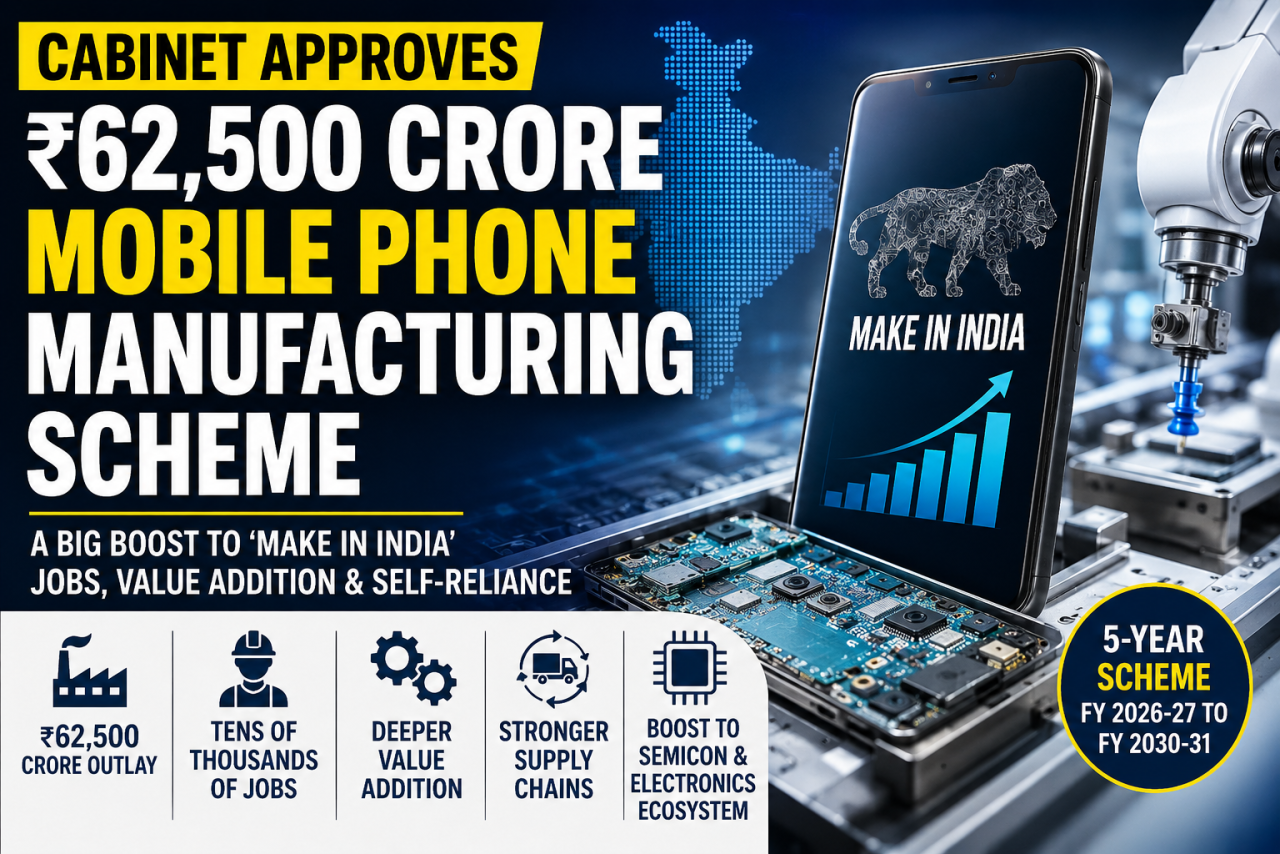
India is already the world's second-largest mobile phone manufacturer. Now, with a ₹62,500 crore push, the government wants the country to build not just smartphones, but the critical components that power them.
The Union Cabinet on Wednesday approved the Mobile Phone Manufacturing Scheme (MPMS) with an outlay of ₹62,500 crore, marking a significant step toward strengthening India's position in global smartphone manufacturing. While India is already the world's second-largest mobile phone manufacturer, the new scheme aims to increase domestic value addition by encouraging the production of key components rather than merely expanding assembly operations.
The MPMS will run for five years, from FY 2026-27 to FY 2030-31, and is expected to be formally notified within the next 20 days.
The approval comes at a time when global smartphone manufacturers are diversifying their production bases beyond China to reduce exposure to geopolitical tensions and tariff uncertainties. India has emerged as a preferred destination for this shift, supported by earlier incentive programmes that boosted electronics manufacturing.
Prime Minister Narendra Modi said the scheme would provide a major boost to the Make in India initiative and strengthen the country's electronics manufacturing ecosystem. In a post on X, he said the programme would expand production, deepen domestic value addition, reinforce supply chains, and help create a globally competitive manufacturing base. The government also expects the initiative to generate tens of thousands of jobs across the electronics manufacturing value chain over the next five years.
Other Key Cabinet Decisions
Alongside the mobile manufacturing scheme, the Cabinet approved several other major proposals.
National Investment Policy for Urea
The Cabinet cleared the National Investment Policy for Urea, 2026, which aims to encourage the establishment of eight to nine new urea production plants across the country. Once operational, these facilities are expected to add 10 million tonnes of annual production capacity, reducing India's dependence on fertiliser imports and moving the country closer to self-reliance in urea production.
Semicon 2.0 Gets ₹1.27 Lakh Crore
The government also approved ₹1.27 lakh crore for the second phase of the India Semiconductor Mission (Semicon 2.0). The expanded programme seeks to strengthen India's semiconductor ecosystem by supporting chip design, fabrication, packaging, and other critical manufacturing capabilities.
Varanasi Elevated Corridor Projects
To improve urban mobility, the Cabinet approved two elevated highway corridor projects in Varanasi at a combined cost of ₹25,500 crore. The projects are intended to ease traffic congestion and improve multimodal connectivity by integrating road transport more efficiently with other transport networks.
Railway Projects in Odisha and Jharkhand
The Cabinet also sanctioned two railway multi-tracking projects in Odisha and Jharkhand worth ₹3,907 crore. These projects will increase railway line capacity, reduce congestion, and improve freight movement, particularly for commodities such as coal, steel, and other bulk cargo.
Why the Mobile Manufacturing Push Matters
India's electronics manufacturing sector has expanded rapidly over the past few years, driven largely by production-linked incentive (PLI) schemes that attracted global smartphone manufacturers and component suppliers. The new MPMS builds on that success but shifts the focus toward developing a stronger domestic manufacturing ecosystem.
Although India has become the world's second-largest mobile phone producer, much of the industry's value still lies in imported components such as displays, semiconductors, camera modules, and other high-value parts. Increasing local production of these components would significantly raise domestic value addition, reduce import dependence, and strengthen India's role in global supply chains.
The government's decision to simultaneously expand the India Semiconductor Mission complements this objective, as a stronger domestic chip ecosystem would support the broader electronics and smartphone manufacturing industry.
Further details regarding the scheme, including eligibility criteria, incentive structures, and targeted manufacturing segments, are expected when the official notification is issued in the coming weeks.
The Union Cabinet on Wednesday approved the Mobile Phone Manufacturing Scheme (MPMS) with an outlay of ₹62,500 crore, marking a significant step toward strengthening India's position in global smartphone manufacturing. While India is already the world's second-largest mobile phone manufacturer, the new scheme aims to increase domestic value addition by encouraging the production of key components rather than merely expanding assembly operations.
The MPMS will run for five years, from FY 2026-27 to FY 2030-31, and is expected to be formally notified within the next 20 days.
The approval comes at a time when global smartphone manufacturers are diversifying their production bases beyond China to reduce exposure to geopolitical tensions and tariff uncertainties. India has emerged as a preferred destination for this shift, supported by earlier incentive programmes that boosted electronics manufacturing.
Prime Minister Narendra Modi said the scheme would provide a major boost to the Make in India initiative and strengthen the country's electronics manufacturing ecosystem. In a post on X, he said the programme would expand production, deepen domestic value addition, reinforce supply chains, and help create a globally competitive manufacturing base. The government also expects the initiative to generate tens of thousands of jobs across the electronics manufacturing value chain over the next five years.
Other Key Cabinet Decisions
Alongside the mobile manufacturing scheme, the Cabinet approved several other major proposals.
National Investment Policy for Urea
The Cabinet cleared the National Investment Policy for Urea, 2026, which aims to encourage the establishment of eight to nine new urea production plants across the country. Once operational, these facilities are expected to add 10 million tonnes of annual production capacity, reducing India's dependence on fertiliser imports and moving the country closer to self-reliance in urea production.
Semicon 2.0 Gets ₹1.27 Lakh Crore
The government also approved ₹1.27 lakh crore for the second phase of the India Semiconductor Mission (Semicon 2.0). The expanded programme seeks to strengthen India's semiconductor ecosystem by supporting chip design, fabrication, packaging, and other critical manufacturing capabilities.
Varanasi Elevated Corridor Projects
To improve urban mobility, the Cabinet approved two elevated highway corridor projects in Varanasi at a combined cost of ₹25,500 crore. The projects are intended to ease traffic congestion and improve multimodal connectivity by integrating road transport more efficiently with other transport networks.
Railway Projects in Odisha and Jharkhand
The Cabinet also sanctioned two railway multi-tracking projects in Odisha and Jharkhand worth ₹3,907 crore. These projects will increase railway line capacity, reduce congestion, and improve freight movement, particularly for commodities such as coal, steel, and other bulk cargo.
Why the Mobile Manufacturing Push Matters
India's electronics manufacturing sector has expanded rapidly over the past few years, driven largely by production-linked incentive (PLI) schemes that attracted global smartphone manufacturers and component suppliers. The new MPMS builds on that success but shifts the focus toward developing a stronger domestic manufacturing ecosystem.
Although India has become the world's second-largest mobile phone producer, much of the industry's value still lies in imported components such as displays, semiconductors, camera modules, and other high-value parts. Increasing local production of these components would significantly raise domestic value addition, reduce import dependence, and strengthen India's role in global supply chains.
The government's decision to simultaneously expand the India Semiconductor Mission complements this objective, as a stronger domestic chip ecosystem would support the broader electronics and smartphone manufacturing industry.
Further details regarding the scheme, including eligibility criteria, incentive structures, and targeted manufacturing segments, are expected when the official notification is issued in the coming weeks.

























Leave a Comment