
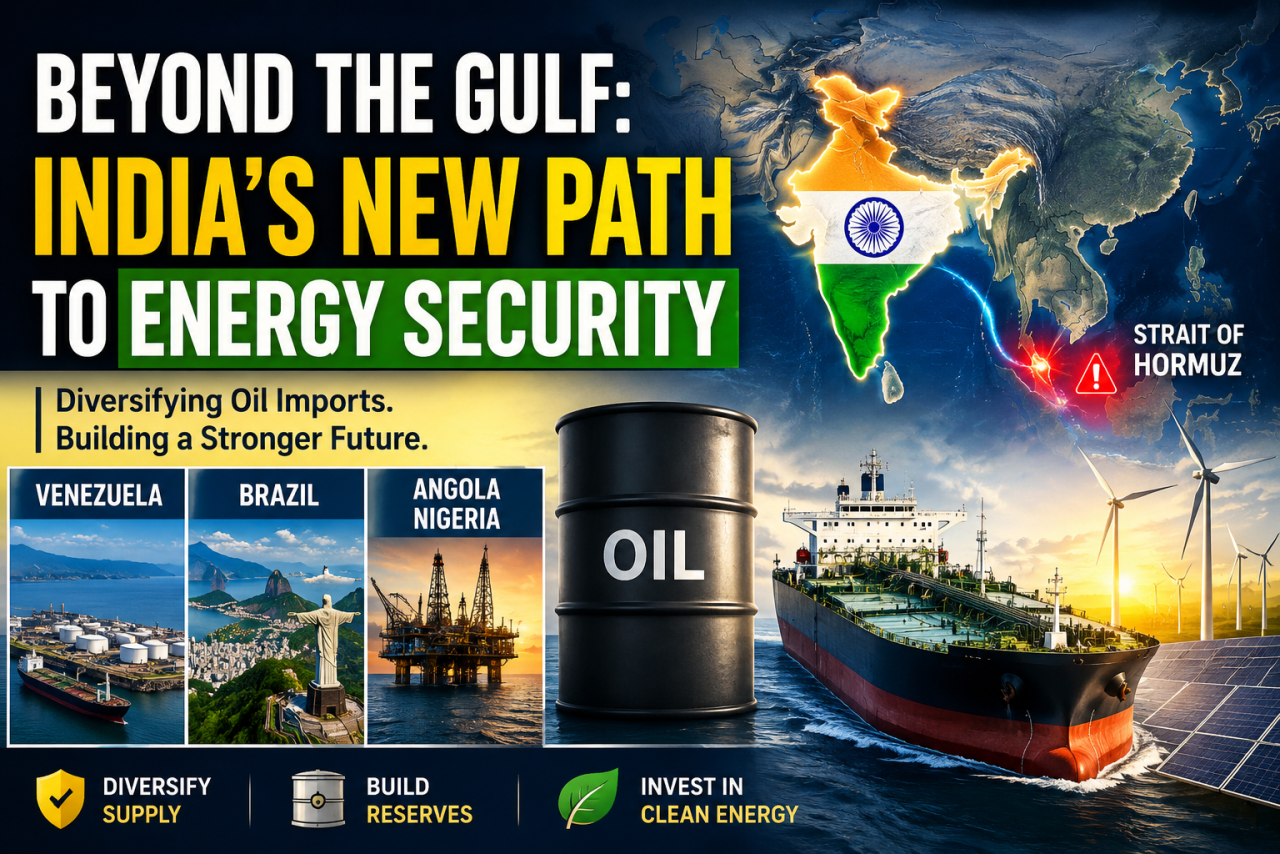
As tensions choke the Strait of Hormuz, India is quietly building a new energy map — stretching from Latin America to Africa to secure its future.
For decades, India’s energy story has depended heavily on one region — West Asia. From Iraq and Saudi Arabia to the UAE, the Gulf has powered India’s industries, transport systems, and economic growth. But the recent disruption around the Strait of Hormuz has exposed a difficult truth: depending too much on a single region is no longer safe in a world shaped by wars, sanctions, and geopolitical tensions.
The recent report that Indian refiners have increased oil imports from Latin America and Africa is therefore not just a temporary adjustment. It may actually mark the beginning of a major transformation in India’s long-term energy strategy.
India appears to be moving toward what can be called an “energy diversification doctrine” — a system where no single country or region can threaten the nation’s fuel supply.
The change is already visible.
According to the report, Indian refiners increased imports from countries such as Venezuela, Brazil, Angola, and Nigeria after disruptions in West Asian shipping routes. The Hormuz crisis, triggered by growing tensions involving Iran, Israel, and the United States, created uncertainty in one of the world’s most important oil transit chokepoints. Nearly one-fifth of global oil trade passes through the Strait of Hormuz. Any disruption there immediately affects countries like India that import most of their crude oil.
But instead of panicking, India responded differently.
Rather than relying solely on emergency reserves or diplomatic appeals, Indian refiners rapidly shifted purchasing patterns across continents. This flexibility reveals something important: India’s energy system is becoming more adaptive, commercially agile, and strategically independent.
That is the real story.
For years, India’s energy security depended mainly on geography. Gulf oil was cheaper to transport, quicker to access, and supported by long-established trade relationships. But modern geopolitical risks are changing the economics of energy itself. Today, reliability matters as much as distance.
This is where Latin America and Africa become important.
Countries like Brazil and Guyana are emerging as major oil producers with expanding export capacity. African producers such as Angola and Nigeria also offer alternatives outside conflict-heavy shipping routes. Venezuela, despite sanctions and political instability, still holds some of the world’s largest oil reserves. India’s willingness to source crude from these regions shows it is building a more distributed energy network.
In simple terms, India is learning not to keep all its eggs in one basket.
However, the bigger transformation may happen beyond oil imports themselves.
The Hormuz crisis has likely accelerated India’s thinking about energy resilience. Policymakers now understand that future energy security cannot depend only on buying crude from different countries. It also requires reducing vulnerability altogether.
This is why India’s response may unfold in three parallel directions.
First, India will continue diversifying crude suppliers globally. The country is increasingly comfortable buying discounted or politically complicated oil if it serves national interests. Earlier, Russia became a major supplier after Western sanctions reshaped global oil flows. Now Africa and Latin America are filling additional gaps. This multi-source approach gives India stronger bargaining power and protects it from sudden regional shocks.
Second, India is expected to expand its strategic petroleum reserves. Emergency stockpiles act like a national insurance system during global crises. The more reserves India builds, the less vulnerable it becomes to temporary disruptions in shipping lanes or wars.
Third — and perhaps most importantly — the current crisis strengthens the case for renewable energy and electrification.
Every geopolitical oil crisis quietly pushes countries toward cleaner alternatives. India already leads in solar energy expansion and electric mobility adoption. But until now, renewable energy was often discussed mainly in environmental terms. The Hormuz disruption changes the conversation. Clean energy is no longer just about climate goals; it is increasingly about national security.
An electric bus powered by domestic solar energy is unaffected by naval tensions in West Asia. A rooftop solar system does not depend on tanker routes through dangerous waters. In that sense, renewable energy reduces strategic dependence on unstable global regions.
This could become India’s biggest long-term lesson from the crisis.
Another overlooked factor is the rise of Indian private refiners. Companies such as Reliance Industries and Nayara Energy have developed the flexibility to process different grades of crude from multiple countries. This refining capability gives India an advantage many developing nations do not possess. Indian refiners can quickly adapt to changing global supply conditions, making the country more resilient during international disruptions.
The global energy order itself is also changing. Earlier, energy security meant maintaining good relations with a few oil-rich allies. Today, it means building a flexible global network, investing in storage, developing domestic renewables, and maintaining strategic neutrality in international conflicts.
India seems to be preparing for exactly that future.
The shift toward Latin America and Africa may look like a short-term response to a shipping crisis. But beneath the surface, it reflects a deeper reality: India is slowly redesigning its energy strategy for a more uncertain world — one where adaptability may become more valuable than abundance itself.
For decades, India’s energy story has depended heavily on one region — West Asia. From Iraq and Saudi Arabia to the UAE, the Gulf has powered India’s industries, transport systems, and economic growth. But the recent disruption around the Strait of Hormuz has exposed a difficult truth: depending too much on a single region is no longer safe in a world shaped by wars, sanctions, and geopolitical tensions.
The recent report that Indian refiners have increased oil imports from Latin America and Africa is therefore not just a temporary adjustment. It may actually mark the beginning of a major transformation in India’s long-term energy strategy.
India appears to be moving toward what can be called an “energy diversification doctrine” — a system where no single country or region can threaten the nation’s fuel supply.
The change is already visible.
According to the report, Indian refiners increased imports from countries such as Venezuela, Brazil, Angola, and Nigeria after disruptions in West Asian shipping routes. The Hormuz crisis, triggered by growing tensions involving Iran, Israel, and the United States, created uncertainty in one of the world’s most important oil transit chokepoints. Nearly one-fifth of global oil trade passes through the Strait of Hormuz. Any disruption there immediately affects countries like India that import most of their crude oil.
But instead of panicking, India responded differently.
Rather than relying solely on emergency reserves or diplomatic appeals, Indian refiners rapidly shifted purchasing patterns across continents. This flexibility reveals something important: India’s energy system is becoming more adaptive, commercially agile, and strategically independent.
That is the real story.
For years, India’s energy security depended mainly on geography. Gulf oil was cheaper to transport, quicker to access, and supported by long-established trade relationships. But modern geopolitical risks are changing the economics of energy itself. Today, reliability matters as much as distance.
This is where Latin America and Africa become important.
Countries like Brazil and Guyana are emerging as major oil producers with expanding export capacity. African producers such as Angola and Nigeria also offer alternatives outside conflict-heavy shipping routes. Venezuela, despite sanctions and political instability, still holds some of the world’s largest oil reserves. India’s willingness to source crude from these regions shows it is building a more distributed energy network.
In simple terms, India is learning not to keep all its eggs in one basket.
However, the bigger transformation may happen beyond oil imports themselves.
The Hormuz crisis has likely accelerated India’s thinking about energy resilience. Policymakers now understand that future energy security cannot depend only on buying crude from different countries. It also requires reducing vulnerability altogether.
This is why India’s response may unfold in three parallel directions.
First, India will continue diversifying crude suppliers globally. The country is increasingly comfortable buying discounted or politically complicated oil if it serves national interests. Earlier, Russia became a major supplier after Western sanctions reshaped global oil flows. Now Africa and Latin America are filling additional gaps. This multi-source approach gives India stronger bargaining power and protects it from sudden regional shocks.
Second, India is expected to expand its strategic petroleum reserves. Emergency stockpiles act like a national insurance system during global crises. The more reserves India builds, the less vulnerable it becomes to temporary disruptions in shipping lanes or wars.
Third — and perhaps most importantly — the current crisis strengthens the case for renewable energy and electrification.
Every geopolitical oil crisis quietly pushes countries toward cleaner alternatives. India already leads in solar energy expansion and electric mobility adoption. But until now, renewable energy was often discussed mainly in environmental terms. The Hormuz disruption changes the conversation. Clean energy is no longer just about climate goals; it is increasingly about national security.
An electric bus powered by domestic solar energy is unaffected by naval tensions in West Asia. A rooftop solar system does not depend on tanker routes through dangerous waters. In that sense, renewable energy reduces strategic dependence on unstable global regions.
This could become India’s biggest long-term lesson from the crisis.
Another overlooked factor is the rise of Indian private refiners. Companies such as Reliance Industries and Nayara Energy have developed the flexibility to process different grades of crude from multiple countries. This refining capability gives India an advantage many developing nations do not possess. Indian refiners can quickly adapt to changing global supply conditions, making the country more resilient during international disruptions.
The global energy order itself is also changing. Earlier, energy security meant maintaining good relations with a few oil-rich allies. Today, it means building a flexible global network, investing in storage, developing domestic renewables, and maintaining strategic neutrality in international conflicts.
India seems to be preparing for exactly that future.
The shift toward Latin America and Africa may look like a short-term response to a shipping crisis. But beneath the surface, it reflects a deeper reality: India is slowly redesigning its energy strategy for a more uncertain world — one where adaptability may become more valuable than abundance itself.




















Leave a Comment