
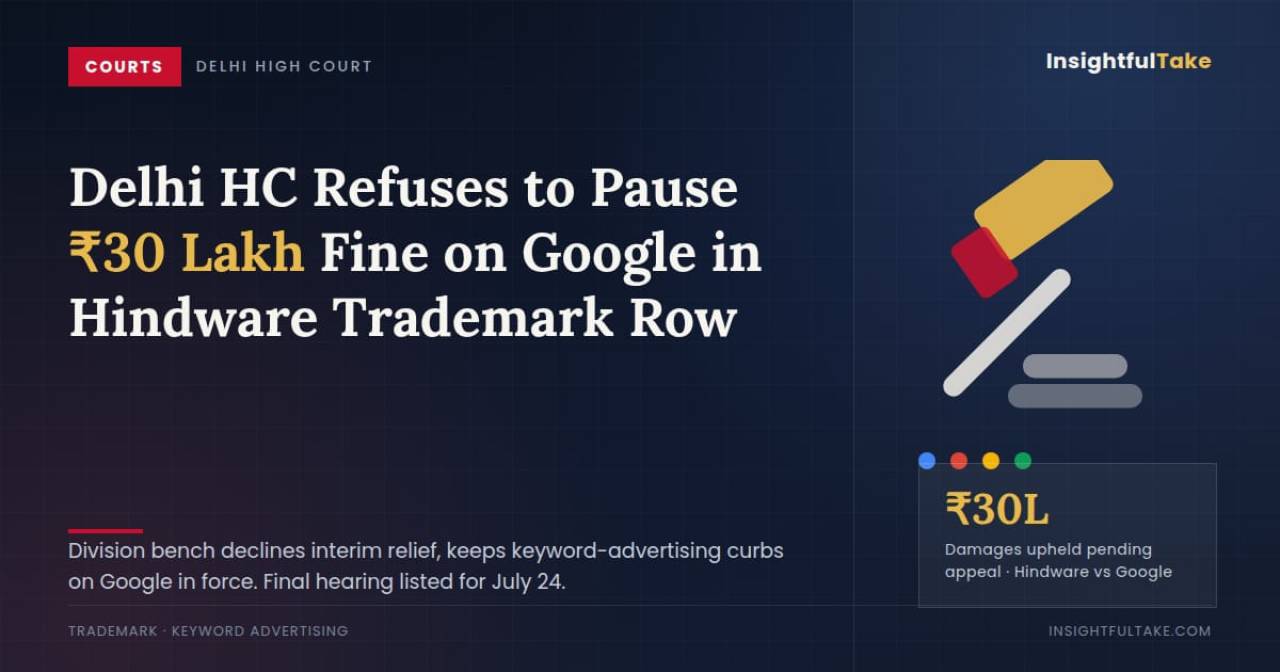
Can Google allow businesses to bid on a competitor's brand name? The Delhi High Court's refusal to stay a ₹30 lakh penalty in the Hindware trademark case could redefine digital advertising and trademark protection in India.
Google has failed to secure immediate relief from a Delhi High Court order that held it liable for trademark infringement over its advertising practices, with the court refusing to stay a ₹30 lakh penalty and restrictions on the use of the "Hindware" trademark in its keyword advertising system.
A division bench comprising Justices V. Kameshwar Rao and Manmeet P.S. Arora heard Google's appeal against a May 22 judgment but declined to grant interim protection.
"No interim protection, not at this stage. We'll hear it. Issue notice. List on July 24," the bench observed.
The order means that the damages awarded against Google and the restrictions imposed by the single judge will remain effective until the appeal is decided.
How Google's Keyword Advertising Triggered the Dispute
The case originated after Hindware found that competitors, including Grohe and Cera, had purchased "Hindware" and related terms such as "Hindware Sanitaryware" as keywords on Google's advertising platform.
As a result, consumers searching specifically for Hindware could first encounter sponsored advertisements from rival brands instead of Hindware's own website. Although Grohe, Cera and another party eventually settled the dispute with Hindware, Google continued to contest the allegations.
The single judge rejected Google's defence that it merely provided an automated advertising platform and therefore could not be held responsible for advertisers' keyword choices.
Instead, the court concluded that Google actively suggested trademarked keywords to advertisers and generated revenue every time users clicked on those advertisements. The judgment described this as commercial "free-riding" on Hindware's established goodwill.
The 163-page ruling directed Google to pay ₹30 lakh in damages within eight weeks and prohibited the company from selling "Hindware" and its variants as advertising keywords.
Google's Defence Hinges on Global Practice
Representing Google, senior advocate Abhishek Singhvi argued that the ruling departs from internationally accepted legal principles governing online advertising.
According to Google, merely allowing advertisers to bid on trademarked words does not amount to trademark infringement. Singhvi submitted that courts in at least 14 countries have declined to treat keyword bidding as unlawful and cautioned that India's approach could create inconsistency in Google's globally standardised advertising model.
Google also maintains that keyword advertising benefits consumers by increasing competition, allowing smaller businesses to appear alongside established market leaders instead of limiting visibility to dominant brands alone.
The company argues that advertisers, rather than the platform itself, should bear responsibility for the keywords they choose.
Why the Verdict Could Redefine Digital Advertising in India
While the dispute centres on a sanitaryware manufacturer, its implications extend far beyond one industry.
Google Ads operates through an auction-based system where businesses bid for search terms to secure premium placement in search results. For years, bidding on competitors' brand names has been a common marketing strategy across industries ranging from fintech and real estate to education and e-commerce.
The May judgment has therefore drawn considerable attention from India's startup ecosystem.
Zerodha founder Nithin Kamath publicly remarked that his company had encountered similar challenges for years. Shaadi.com founder Anupam Mittal similarly questioned a system in which businesses invest heavily to build a brand, competitors bid on that very brand name, and Google earns advertising revenue regardless of which advertiser wins.
For smaller businesses, the financial implications are even more significant. Companies that spend years building consumer trust may ultimately find themselves paying advertising fees simply to ensure customers searching for their own brand reach their official website instead of a competitor's sponsored advertisement.
If the Hindware judgment is upheld, businesses across India may need to rethink long-standing digital marketing strategies, while technology platforms could face greater responsibility for how trademarked keywords are bought and sold.
What Happens Next
The division bench has not overturned the single judge's ruling. It has only refused to suspend its operation while Google's appeal is pending.
The matter will now come up for detailed hearing on July 24, when the Delhi High Court is expected to examine a question that has implications well beyond this dispute: whether permitting advertisers to bid on a competitor's registered trademark without consent is a legitimate feature of digital competition or an act of trademark infringement.
Until that decision is delivered, Google's ₹30 lakh liability and the restrictions on selling "Hindware" as an advertising keyword will continue to remain in force, making the case one of the most closely watched legal battles involving digital advertising and trademark law in India.
Google has failed to secure immediate relief from a Delhi High Court order that held it liable for trademark infringement over its advertising practices, with the court refusing to stay a ₹30 lakh penalty and restrictions on the use of the "Hindware" trademark in its keyword advertising system.
A division bench comprising Justices V. Kameshwar Rao and Manmeet P.S. Arora heard Google's appeal against a May 22 judgment but declined to grant interim protection.
"No interim protection, not at this stage. We'll hear it. Issue notice. List on July 24," the bench observed.
The order means that the damages awarded against Google and the restrictions imposed by the single judge will remain effective until the appeal is decided.
How Google's Keyword Advertising Triggered the Dispute
The case originated after Hindware found that competitors, including Grohe and Cera, had purchased "Hindware" and related terms such as "Hindware Sanitaryware" as keywords on Google's advertising platform.
As a result, consumers searching specifically for Hindware could first encounter sponsored advertisements from rival brands instead of Hindware's own website. Although Grohe, Cera and another party eventually settled the dispute with Hindware, Google continued to contest the allegations.
The single judge rejected Google's defence that it merely provided an automated advertising platform and therefore could not be held responsible for advertisers' keyword choices.
Instead, the court concluded that Google actively suggested trademarked keywords to advertisers and generated revenue every time users clicked on those advertisements. The judgment described this as commercial "free-riding" on Hindware's established goodwill.
The 163-page ruling directed Google to pay ₹30 lakh in damages within eight weeks and prohibited the company from selling "Hindware" and its variants as advertising keywords.
Google's Defence Hinges on Global Practice
Representing Google, senior advocate Abhishek Singhvi argued that the ruling departs from internationally accepted legal principles governing online advertising.
According to Google, merely allowing advertisers to bid on trademarked words does not amount to trademark infringement. Singhvi submitted that courts in at least 14 countries have declined to treat keyword bidding as unlawful and cautioned that India's approach could create inconsistency in Google's globally standardised advertising model.
Google also maintains that keyword advertising benefits consumers by increasing competition, allowing smaller businesses to appear alongside established market leaders instead of limiting visibility to dominant brands alone.
The company argues that advertisers, rather than the platform itself, should bear responsibility for the keywords they choose.
Why the Verdict Could Redefine Digital Advertising in India
While the dispute centres on a sanitaryware manufacturer, its implications extend far beyond one industry.
Google Ads operates through an auction-based system where businesses bid for search terms to secure premium placement in search results. For years, bidding on competitors' brand names has been a common marketing strategy across industries ranging from fintech and real estate to education and e-commerce.
The May judgment has therefore drawn considerable attention from India's startup ecosystem.
Zerodha founder Nithin Kamath publicly remarked that his company had encountered similar challenges for years. Shaadi.com founder Anupam Mittal similarly questioned a system in which businesses invest heavily to build a brand, competitors bid on that very brand name, and Google earns advertising revenue regardless of which advertiser wins.
For smaller businesses, the financial implications are even more significant. Companies that spend years building consumer trust may ultimately find themselves paying advertising fees simply to ensure customers searching for their own brand reach their official website instead of a competitor's sponsored advertisement.
If the Hindware judgment is upheld, businesses across India may need to rethink long-standing digital marketing strategies, while technology platforms could face greater responsibility for how trademarked keywords are bought and sold.
What Happens Next
The division bench has not overturned the single judge's ruling. It has only refused to suspend its operation while Google's appeal is pending.
The matter will now come up for detailed hearing on July 24, when the Delhi High Court is expected to examine a question that has implications well beyond this dispute: whether permitting advertisers to bid on a competitor's registered trademark without consent is a legitimate feature of digital competition or an act of trademark infringement.
Until that decision is delivered, Google's ₹30 lakh liability and the restrictions on selling "Hindware" as an advertising keyword will continue to remain in force, making the case one of the most closely watched legal battles involving digital advertising and trademark law in India.





















Leave a Comment