
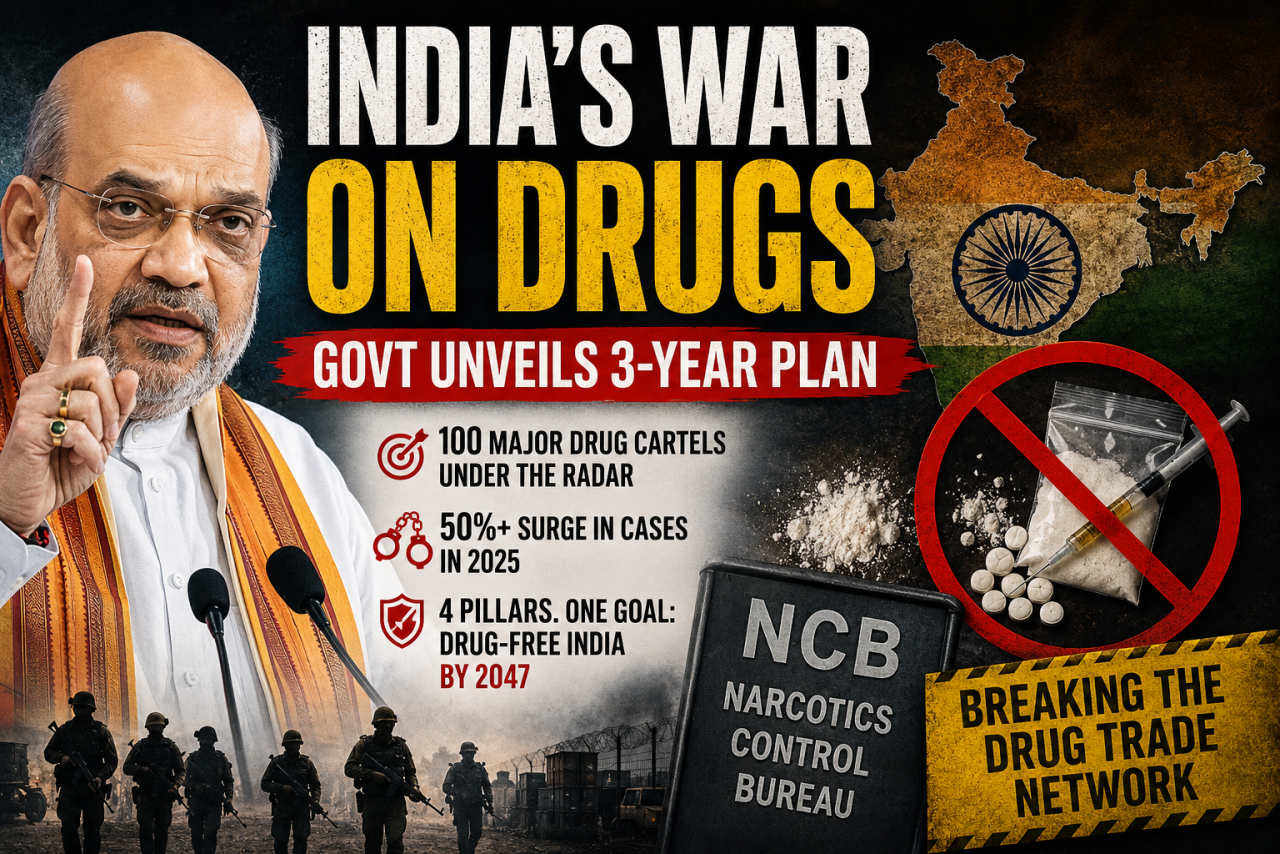
Drug cases have surged by over 50%, and the Centre now promises to dismantle India's narcotics networks within three years. Can this ambitious strategy succeed where earlier efforts struggled?
India's battle against narcotics has entered a new phase. The Union government has unveiled an ambitious three-year roadmap that seeks not merely to seize drugs or arrest peddlers but to dismantle the entire ecosystem that sustains the illegal narcotics trade. If implemented effectively, it could mark the most comprehensive anti-drug campaign undertaken by the country in decades.
Union Home Minister Amit Shah, while releasing the government's Vision Document on Drug Control (2026–2029) and the Narcotics Control Bureau (NCB) Annual Report 2025, declared that the next three years would be decisive in determining whether India defeats organised drug trafficking or allows it to grow stronger. The government has linked this strategy with its broader goal of making India drug-free by 2047.
The announcement comes at a time when official figures show an alarming rise in drug-related crimes, indicating that the challenge has become far more complex than street-level peddling.
Drug Cases Have Increased Sharply
According to the NCB's Annual Report 2025, law enforcement agencies across India registered 148,063 drug-related cases in 2025, an increase of nearly 53% over the previous year. This is the highest number recorded in at least five years.
Arrests have also risen dramatically. Agencies arrested 183,675 people during the year, reflecting an aggressive nationwide crackdown. State police forces accounted for nearly 95% of these cases, highlighting that the fight against narcotics is no longer confined to central agencies alone.
Drug seizures have also reached unprecedented levels. Authorities confiscated around 1,240 tonnes of narcotics worth nearly ₹18,227 crore during 2025. Cannabis products—including marijuana, hashish and hash oil—formed more than half of the total seizures, while opiates such as heroin, opium, morphine and codeine accounted for almost one-third.
At first glance, rising crime numbers may appear to suggest that the drug problem is worsening. However, they also indicate that enforcement agencies are detecting and registering more cases than before. Whether the increase reflects stronger policing, expanding trafficking networks, or both, remains a matter for continued assessment.
A Shift From Arresting Couriers to Destroying Networks
The government's new strategy marks an important shift in thinking.
For years, anti-drug operations largely focused on arresting individual carriers or street-level peddlers. While such arrests removed drugs from circulation temporarily, the larger criminal syndicates often continued operating without disruption.
The new roadmap instead aims to dismantle trafficking networks from the top down.
Officials say the focus will now be on identifying entire drug cartels, tracing financial transactions, attaching illegally acquired assets and breaking supply chains rather than merely intercepting consignments. Investigators will increasingly follow money trails to expose the masterminds behind trafficking operations.
The government has reportedly identified around 100 major interstate and transnational drug cartels for focused action over the next three years.
This represents a significant change because organised crime survives primarily through financial networks. Disrupting profits often proves more effective than repeatedly arresting lower-level operatives.
Four Pillars of the New Strategy
The Vision Document is built around four broad pillars.
The first is stronger enforcement, intelligence gathering and operational coordination among multiple agencies.
The second focuses on precursor and synthetic drug control. Synthetic narcotics have emerged as one of the fastest-growing threats worldwide because they can be manufactured in illegal laboratories using chemicals that often have legitimate industrial uses. The government plans to tighten monitoring of precursor chemicals and review the scheduling of substances commonly diverted into illegal drug production.
The third pillar emphasises demand reduction and rehabilitation. Recognising that enforcement alone cannot eliminate drug abuse, the strategy seeks to expand de-addiction facilities and rehabilitation programmes while involving educational institutions and civil society in awareness campaigns.
The fourth pillar centres on capacity building and coordination, bringing together more than 40 ministries, departments, state governments and institutions to create an integrated national response.
Technology Will Play a Larger Role
Another notable aspect of the plan is the increasing use of technology.
Authorities intend to strengthen border surveillance using artificial intelligence-based monitoring systems and anti-drone technologies. This assumes particular significance because drones have increasingly been used to transport narcotics across India's international borders.
The government also plans tighter monitoring of pharmaceutical drugs that are diverted into illegal markets, along with stronger coordination between central agencies and state governments.
Each state has also been asked to establish dedicated units under the Director General of Police to improve coordination with central agencies, especially in tracking fugitives operating drug cartels from abroad.
The Regional Challenge
India's drug problem cannot be viewed in isolation.
The NCB report notes that Myanmar has overtaken Afghanistan as the world's largest illicit opium producer following the Taliban's ban on poppy cultivation in Afghanistan in 2022.
This development has important implications for India, particularly its northeastern states, which share long and often difficult-to-monitor international borders. Drug trafficking routes have increasingly shifted towards the region, making border management an essential part of the country's anti-narcotics strategy.
India also faces challenges from maritime trafficking, dark web transactions, encrypted communication platforms and international organised crime syndicates that constantly adapt to enforcement measures.
Why Success Will Depend on More Than Enforcement
While the government's roadmap is ambitious, its success will ultimately depend on consistent implementation.
Drug trafficking flourishes because it combines organised crime, financial incentives, corruption and addiction. Breaking one link in the chain is rarely sufficient. Sustained intelligence sharing, speedy investigations, stronger prosecution, international cooperation and financial disruption will all be necessary to weaken criminal networks.
Equally important is addressing the demand side. Without effective rehabilitation, counselling and public awareness, new consumers can continue to replace those who leave the drug trade.
Educational institutions, families, healthcare systems and local communities therefore have a critical role alongside police and investigative agencies.
A Defining Three Years
The government's declaration that the next three years will determine the future of India's fight against narcotics is a significant political and administrative commitment. Unlike earlier approaches that concentrated mainly on seizures and arrests, the new strategy seeks to attack every stage of the narcotics economy—from chemical supply and production to trafficking, financing and rehabilitation.
Whether India can truly "break the backbone" of organised drug trafficking will become clear only through measurable outcomes over the coming years. If the promised coordination among dozens of ministries, state governments and enforcement agencies translates into effective action, the campaign could reshape India's anti-drug architecture. If implementation falters, however, the growing sophistication of trafficking networks may continue to outpace enforcement.
For a country with one of the world's youngest populations, the stakes extend well beyond law enforcement. They concern public health, national security, social stability and the future of an entire generation.
India's battle against narcotics has entered a new phase. The Union government has unveiled an ambitious three-year roadmap that seeks not merely to seize drugs or arrest peddlers but to dismantle the entire ecosystem that sustains the illegal narcotics trade. If implemented effectively, it could mark the most comprehensive anti-drug campaign undertaken by the country in decades.
Union Home Minister Amit Shah, while releasing the government's Vision Document on Drug Control (2026–2029) and the Narcotics Control Bureau (NCB) Annual Report 2025, declared that the next three years would be decisive in determining whether India defeats organised drug trafficking or allows it to grow stronger. The government has linked this strategy with its broader goal of making India drug-free by 2047.
The announcement comes at a time when official figures show an alarming rise in drug-related crimes, indicating that the challenge has become far more complex than street-level peddling.
Drug Cases Have Increased Sharply
According to the NCB's Annual Report 2025, law enforcement agencies across India registered 148,063 drug-related cases in 2025, an increase of nearly 53% over the previous year. This is the highest number recorded in at least five years.
Arrests have also risen dramatically. Agencies arrested 183,675 people during the year, reflecting an aggressive nationwide crackdown. State police forces accounted for nearly 95% of these cases, highlighting that the fight against narcotics is no longer confined to central agencies alone.
Drug seizures have also reached unprecedented levels. Authorities confiscated around 1,240 tonnes of narcotics worth nearly ₹18,227 crore during 2025. Cannabis products—including marijuana, hashish and hash oil—formed more than half of the total seizures, while opiates such as heroin, opium, morphine and codeine accounted for almost one-third.
At first glance, rising crime numbers may appear to suggest that the drug problem is worsening. However, they also indicate that enforcement agencies are detecting and registering more cases than before. Whether the increase reflects stronger policing, expanding trafficking networks, or both, remains a matter for continued assessment.
A Shift From Arresting Couriers to Destroying Networks
The government's new strategy marks an important shift in thinking.
For years, anti-drug operations largely focused on arresting individual carriers or street-level peddlers. While such arrests removed drugs from circulation temporarily, the larger criminal syndicates often continued operating without disruption.
The new roadmap instead aims to dismantle trafficking networks from the top down.
Officials say the focus will now be on identifying entire drug cartels, tracing financial transactions, attaching illegally acquired assets and breaking supply chains rather than merely intercepting consignments. Investigators will increasingly follow money trails to expose the masterminds behind trafficking operations.
The government has reportedly identified around 100 major interstate and transnational drug cartels for focused action over the next three years.
This represents a significant change because organised crime survives primarily through financial networks. Disrupting profits often proves more effective than repeatedly arresting lower-level operatives.
Four Pillars of the New Strategy
The Vision Document is built around four broad pillars.
The first is stronger enforcement, intelligence gathering and operational coordination among multiple agencies.
The second focuses on precursor and synthetic drug control. Synthetic narcotics have emerged as one of the fastest-growing threats worldwide because they can be manufactured in illegal laboratories using chemicals that often have legitimate industrial uses. The government plans to tighten monitoring of precursor chemicals and review the scheduling of substances commonly diverted into illegal drug production.
The third pillar emphasises demand reduction and rehabilitation. Recognising that enforcement alone cannot eliminate drug abuse, the strategy seeks to expand de-addiction facilities and rehabilitation programmes while involving educational institutions and civil society in awareness campaigns.
The fourth pillar centres on capacity building and coordination, bringing together more than 40 ministries, departments, state governments and institutions to create an integrated national response.
Technology Will Play a Larger Role
Another notable aspect of the plan is the increasing use of technology.
Authorities intend to strengthen border surveillance using artificial intelligence-based monitoring systems and anti-drone technologies. This assumes particular significance because drones have increasingly been used to transport narcotics across India's international borders.
The government also plans tighter monitoring of pharmaceutical drugs that are diverted into illegal markets, along with stronger coordination between central agencies and state governments.
Each state has also been asked to establish dedicated units under the Director General of Police to improve coordination with central agencies, especially in tracking fugitives operating drug cartels from abroad.
The Regional Challenge
India's drug problem cannot be viewed in isolation.
The NCB report notes that Myanmar has overtaken Afghanistan as the world's largest illicit opium producer following the Taliban's ban on poppy cultivation in Afghanistan in 2022.
This development has important implications for India, particularly its northeastern states, which share long and often difficult-to-monitor international borders. Drug trafficking routes have increasingly shifted towards the region, making border management an essential part of the country's anti-narcotics strategy.
India also faces challenges from maritime trafficking, dark web transactions, encrypted communication platforms and international organised crime syndicates that constantly adapt to enforcement measures.
Why Success Will Depend on More Than Enforcement
While the government's roadmap is ambitious, its success will ultimately depend on consistent implementation.
Drug trafficking flourishes because it combines organised crime, financial incentives, corruption and addiction. Breaking one link in the chain is rarely sufficient. Sustained intelligence sharing, speedy investigations, stronger prosecution, international cooperation and financial disruption will all be necessary to weaken criminal networks.
Equally important is addressing the demand side. Without effective rehabilitation, counselling and public awareness, new consumers can continue to replace those who leave the drug trade.
Educational institutions, families, healthcare systems and local communities therefore have a critical role alongside police and investigative agencies.
A Defining Three Years
The government's declaration that the next three years will determine the future of India's fight against narcotics is a significant political and administrative commitment. Unlike earlier approaches that concentrated mainly on seizures and arrests, the new strategy seeks to attack every stage of the narcotics economy—from chemical supply and production to trafficking, financing and rehabilitation.
Whether India can truly "break the backbone" of organised drug trafficking will become clear only through measurable outcomes over the coming years. If the promised coordination among dozens of ministries, state governments and enforcement agencies translates into effective action, the campaign could reshape India's anti-drug architecture. If implementation falters, however, the growing sophistication of trafficking networks may continue to outpace enforcement.
For a country with one of the world's youngest populations, the stakes extend well beyond law enforcement. They concern public health, national security, social stability and the future of an entire generation.




















Leave a Comment