
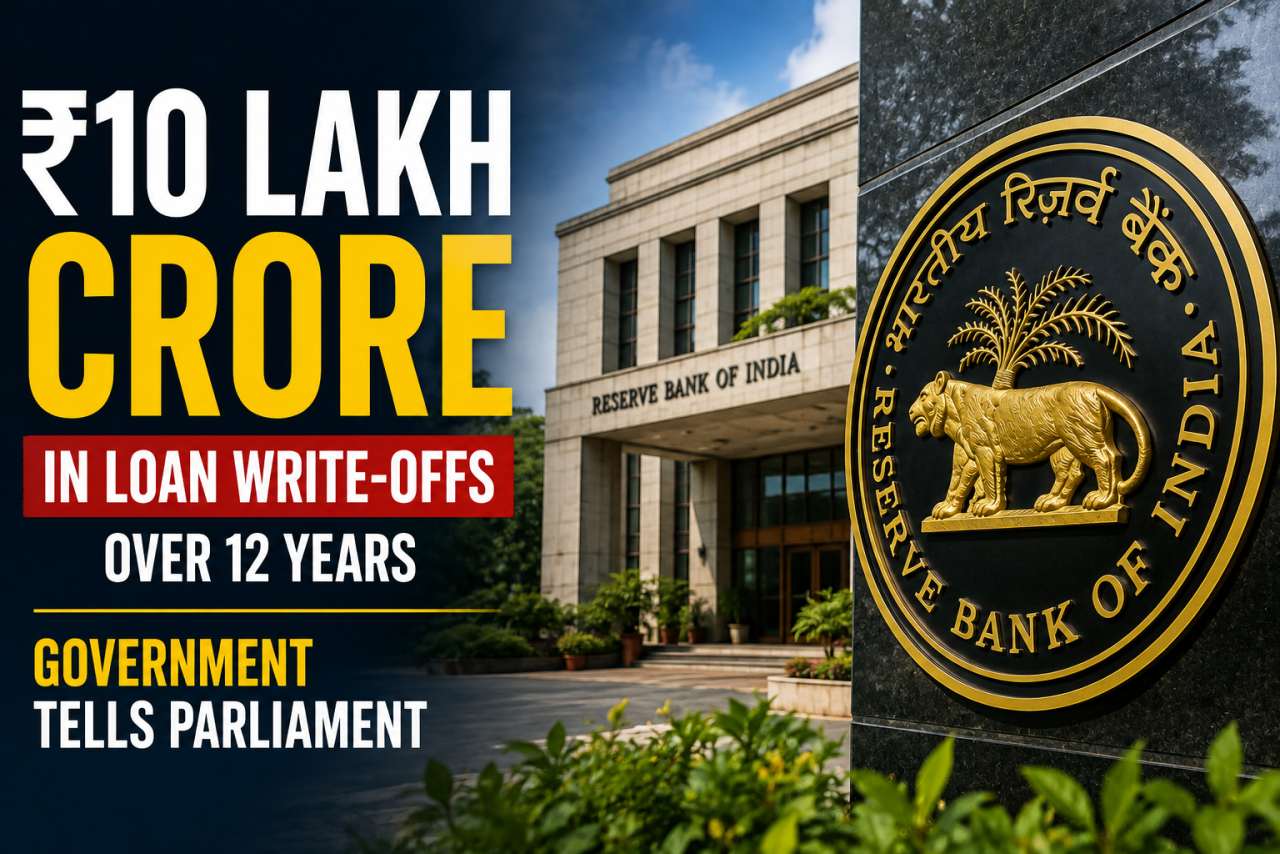
Nearly ₹10 lakh crore in corporate loans written off over 12 years raises fresh questions about bad debt, recovery and how India's banks manage large-business lending.
Indian banks have written off loans worth ₹9,95,000 crore extended to large corporates and service-sector firms over the past 12 financial years, the government informed Parliament this week. The disclosure, made by Minister of State for Finance Pankaj Chaudhary in a written reply, has renewed scrutiny of how the banking system handles bad debt owed by big businesses, even as the government insists that write-offs do not amount to loan waivers.
According to the data shared by the minister, write-offs peaked at ₹1,48,753 crore in 2018-19, the highest single-year figure during the 12-year period. Since then, the numbers have fallen sharply, with write-offs standing at ₹20,485 crore in 2025-26.
The steep decline suggests that banks have become more cautious about extending large loans in recent years, while recovery mechanisms have also strengthened following the banking sector's stress during the late 2010s.
At the same time, total outstanding loans to large industries and services have continued to grow. The figure rose from ₹63,19,057 crore in FY25 to ₹69,21,734 crore in FY26, based on Reserve Bank of India data cited in the parliamentary reply.
The rise in outstanding credit alongside a decline in write-offs points to a banking sector that is lending more while attempting to manage stressed assets more carefully than during the peak years of banking-sector stress.
What a Write-Off Actually Means
The minister's reply also sought to clarify a point that is often misunderstood by the public. A loan write-off is an accounting procedure, not a loan waiver.
When a bank writes off a loan, it removes the amount from its active balance sheet, usually after the loan has remained a bad asset for a prolonged period or recovery through normal banking channels has become difficult.
The move is undertaken for technical and prudential reasons. In many cases, recovery proceedings against the borrower can continue even after the loan has been written off.
Crucially, a write-off does not extinguish the borrower's liability. Whether the borrower is an individual or a large corporate entity, the amount remains legally recoverable, and banks can continue pursuing recovery through mechanisms such as Debt Recovery Tribunals, the Insolvency and Bankruptcy Code and asset reconstruction companies.
In simple terms, the loan may be removed from the bank's books, but the borrower's obligation to repay does not automatically disappear.
To support borrowers facing genuine financial distress, rather than those deliberately avoiding repayment, the Reserve Bank of India has separately issued the Resolution of Stressed Assets Directions, 2025.
Dated November 28, 2025, and last updated on July 1, 2026, the framework gives lenders discretion to restructure the debt of stressed borrowers under board-approved policies and regulatory safeguards. It is therefore distinct from a blanket approach to writing off loans.
The Fiscal Picture
The government's response also placed the banking data within the broader picture of India's fiscal management.
India's fiscal deficit declined from 9.2% of GDP in 2020-21 to 4.4% in 2025-26, based on provisional actuals. Total outstanding government liabilities also moderated during the period, falling from 61.5% of GDP in 2020-21 to 58.2% in 2025-26.
At the same time, the government says fiscal consolidation has not come at the expense of public investment.
Capital expenditure more than doubled over the same period, rising from ₹4.3 lakh crore in 2020-21 to ₹10.7 lakh crore in 2025-26, on a provisional basis.
The government has cited the figures as evidence that it has attempted to combine fiscal discipline with continued investment in infrastructure and other capital projects.
Why the Numbers Still Matter
Even with the important distinction between a write-off and a waiver, the scale of the figure remains significant.
Nearly ₹10 lakh crore in corporate and service-sector loans written off over 12 years raises questions about the quality of credit assessment, risk management and monitoring that allowed such large amounts of lending to become stressed in the first place.
The ₹1.49 lakh crore peak in 2018-19 is particularly significant because it reflects the extent of stress that had accumulated in the banking system during the preceding years.
The subsequent decline in annual write-offs is encouraging, but it does not eliminate the need for scrutiny.
As outstanding credit to large industries and services continues to rise, the effectiveness of banks' lending standards, recovery mechanisms and monitoring systems will remain important indicators of the health of India's financial sector.
For taxpayers and depositors, the distinction between a write-off and a waiver is important. But so is the larger question: how did such a massive volume of corporate debt become difficult enough to require write-offs in the first place?
That question remains central to understanding India's banking story.
Indian banks have written off loans worth ₹9,95,000 crore extended to large corporates and service-sector firms over the past 12 financial years, the government informed Parliament this week. The disclosure, made by Minister of State for Finance Pankaj Chaudhary in a written reply, has renewed scrutiny of how the banking system handles bad debt owed by big businesses, even as the government insists that write-offs do not amount to loan waivers.
According to the data shared by the minister, write-offs peaked at ₹1,48,753 crore in 2018-19, the highest single-year figure during the 12-year period. Since then, the numbers have fallen sharply, with write-offs standing at ₹20,485 crore in 2025-26.
The steep decline suggests that banks have become more cautious about extending large loans in recent years, while recovery mechanisms have also strengthened following the banking sector's stress during the late 2010s.
At the same time, total outstanding loans to large industries and services have continued to grow. The figure rose from ₹63,19,057 crore in FY25 to ₹69,21,734 crore in FY26, based on Reserve Bank of India data cited in the parliamentary reply.
The rise in outstanding credit alongside a decline in write-offs points to a banking sector that is lending more while attempting to manage stressed assets more carefully than during the peak years of banking-sector stress.
What a Write-Off Actually Means
The minister's reply also sought to clarify a point that is often misunderstood by the public. A loan write-off is an accounting procedure, not a loan waiver.
When a bank writes off a loan, it removes the amount from its active balance sheet, usually after the loan has remained a bad asset for a prolonged period or recovery through normal banking channels has become difficult.
The move is undertaken for technical and prudential reasons. In many cases, recovery proceedings against the borrower can continue even after the loan has been written off.
Crucially, a write-off does not extinguish the borrower's liability. Whether the borrower is an individual or a large corporate entity, the amount remains legally recoverable, and banks can continue pursuing recovery through mechanisms such as Debt Recovery Tribunals, the Insolvency and Bankruptcy Code and asset reconstruction companies.
In simple terms, the loan may be removed from the bank's books, but the borrower's obligation to repay does not automatically disappear.
To support borrowers facing genuine financial distress, rather than those deliberately avoiding repayment, the Reserve Bank of India has separately issued the Resolution of Stressed Assets Directions, 2025.
Dated November 28, 2025, and last updated on July 1, 2026, the framework gives lenders discretion to restructure the debt of stressed borrowers under board-approved policies and regulatory safeguards. It is therefore distinct from a blanket approach to writing off loans.
The Fiscal Picture
The government's response also placed the banking data within the broader picture of India's fiscal management.
India's fiscal deficit declined from 9.2% of GDP in 2020-21 to 4.4% in 2025-26, based on provisional actuals. Total outstanding government liabilities also moderated during the period, falling from 61.5% of GDP in 2020-21 to 58.2% in 2025-26.
At the same time, the government says fiscal consolidation has not come at the expense of public investment.
Capital expenditure more than doubled over the same period, rising from ₹4.3 lakh crore in 2020-21 to ₹10.7 lakh crore in 2025-26, on a provisional basis.
The government has cited the figures as evidence that it has attempted to combine fiscal discipline with continued investment in infrastructure and other capital projects.
Why the Numbers Still Matter
Even with the important distinction between a write-off and a waiver, the scale of the figure remains significant.
Nearly ₹10 lakh crore in corporate and service-sector loans written off over 12 years raises questions about the quality of credit assessment, risk management and monitoring that allowed such large amounts of lending to become stressed in the first place.
The ₹1.49 lakh crore peak in 2018-19 is particularly significant because it reflects the extent of stress that had accumulated in the banking system during the preceding years.
The subsequent decline in annual write-offs is encouraging, but it does not eliminate the need for scrutiny.
As outstanding credit to large industries and services continues to rise, the effectiveness of banks' lending standards, recovery mechanisms and monitoring systems will remain important indicators of the health of India's financial sector.
For taxpayers and depositors, the distinction between a write-off and a waiver is important. But so is the larger question: how did such a massive volume of corporate debt become difficult enough to require write-offs in the first place?
That question remains central to understanding India's banking story.





















Leave a Comment