
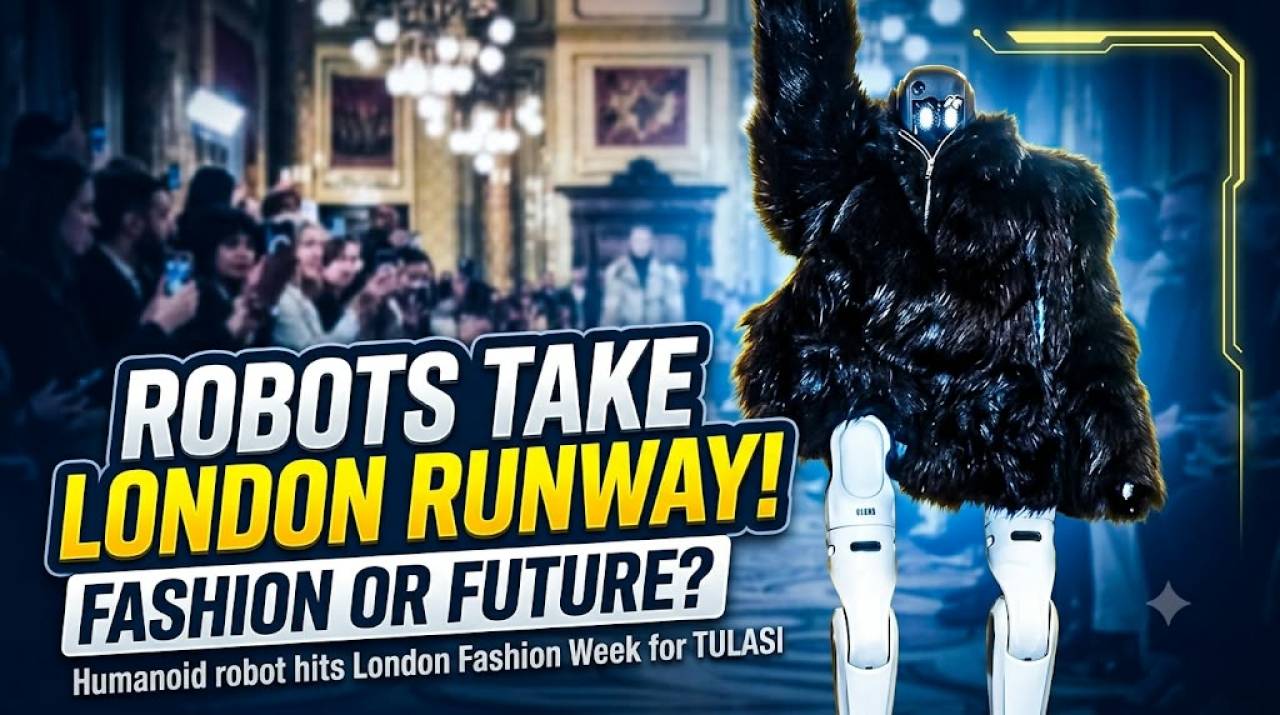
Humanoid robots are learning to walk the runway, but Indian fashion voices say technology still cannot reproduce the human presence behind couture.
The fashion world has always had a soft spot for spectacle. But its latest experiment is taking the conversation somewhere more fundamental. Can a runway still work without a human being on it?
Humanoid robots have begun appearing on catwalks abroad, prompting a debate about how far technology should enter an industry built around human creativity and expression. In India, the response from fashion insiders has been largely consistent. They are not convinced that robots can take the place of human models, at least not when it comes to presenting couture.
The debate gained attention after a showcase in South Korea, where engineers sent robots down a runway dressed in couture. The machines were designed to imitate the gait, poise and movements of professional models. For their creators, the demonstration offered a glimpse of what could happen when artificial intelligence and robotics enter an industry that has long depended on aesthetics and human expression.
The experiment comes at a time when AI-generated images are already finding their way into fashion campaigns, advertisements and lookbooks. That has made the industry increasingly aware that technology is changing not only how fashion is created but also how it is presented.
For India's fashion fraternity, however, the physical runway remains a different matter.
Why the Human Form Still Matters
Sunil Sethi, Chairman of the Fashion Design Council of India (FDCI), has dismissed the idea that robots could replace human models on the runway.
A fashion show is not simply about putting a garment in front of an audience. It allows people to see how the clothes move, fall and respond to a living body. The shape of the body, the movement of the fabric and the way a model carries the garment all contribute to how a designer's work is experienced.
That is difficult to reproduce with a machine, however advanced the technology may become.
Model and show director Alessia Raut has expressed a similar view. Fashion has already embraced artificial intelligence in several areas, from digital design tools to computer-generated visuals. Putting that technology into a physical runway performance, however, is a very different proposition.
A runway show is built around people. The designer creates the garment, the model brings it to life and the audience responds to what it sees. At major fashion events, including those in Milan, that relationship between the garment and the person wearing it remains an important part of the experience.
What a Robot Cannot Easily Reproduce
Designer Nachiket Barve has made another case for keeping robots away from the runway.
Clothes are ultimately made for human bodies. A real model allows an audience to see how a garment fits, moves and changes with every step. The differences in body shape, posture and movement are not distractions from the design. They are part of the way the design is understood.
There is also something less tangible about a human model walking the ramp.
Every model brings a different presence. A newcomer may carry a little nervousness onto the runway. An experienced model may have developed a distinctive walk over years of work. Facial expressions, gestures and even small imperfections can influence how a garment is perceived.
Those details are difficult to manufacture.
A robot can be programmed to walk at a particular pace, turn at a particular point and hold a particular pose. What it cannot easily reproduce is the individual personality that a human model brings to the same piece of clothing.
The Debate Goes Beyond Fashion
The discussion also reflects a much larger change taking place across creative industries.
Technology is moving into areas that were once considered deeply dependent on human ability. Writing, music, photography, design and advertising are all being reshaped by AI and automation. Fashion is now confronting a similar moment.
But fashion has never been only about function. It is closely connected to identity, aspiration, emotion and storytelling. A runway show brings all of those elements together through the interaction between the designer, the clothes, the model and the audience.
A humanoid robot may be able to walk with remarkable precision and reproduce a model's movements. Whether it can create the same connection with an audience is another matter.
That distinction could become more important as robotics continues to improve.
Technology Is Already Here
The appearance of humanoid robots on international runways does not mean that the fashion industry is rejecting technology. Quite the opposite. AI and digital tools are already being used in fashion design, visualisation, marketing and production.
The debate is more specifically about the final presentation of the clothes.
For now, Indian fashion professionals appear to see a difference between using technology to support creativity and replacing the human presence that gives a runway show its character.
Robots may become more sophisticated. They may eventually walk with greater realism, respond to music and lighting, and perform movements that are difficult to distinguish from those of a professional model.
Even then, the fashion industry will have to decide whether technical perfection is enough.
For the moment, the answer from India's fashion voices is that it is not. A runway needs more than a garment in motion. It needs the person wearing it, the individuality they bring and the connection that develops between the clothes and the audience.
That human element remains at the heart of fashion, even as machines begin to walk the ramp.
The fashion world has always had a soft spot for spectacle. But its latest experiment is taking the conversation somewhere more fundamental. Can a runway still work without a human being on it?
Humanoid robots have begun appearing on catwalks abroad, prompting a debate about how far technology should enter an industry built around human creativity and expression. In India, the response from fashion insiders has been largely consistent. They are not convinced that robots can take the place of human models, at least not when it comes to presenting couture.
The debate gained attention after a showcase in South Korea, where engineers sent robots down a runway dressed in couture. The machines were designed to imitate the gait, poise and movements of professional models. For their creators, the demonstration offered a glimpse of what could happen when artificial intelligence and robotics enter an industry that has long depended on aesthetics and human expression.
The experiment comes at a time when AI-generated images are already finding their way into fashion campaigns, advertisements and lookbooks. That has made the industry increasingly aware that technology is changing not only how fashion is created but also how it is presented.
For India's fashion fraternity, however, the physical runway remains a different matter.
Why the Human Form Still Matters
Sunil Sethi, Chairman of the Fashion Design Council of India (FDCI), has dismissed the idea that robots could replace human models on the runway.
A fashion show is not simply about putting a garment in front of an audience. It allows people to see how the clothes move, fall and respond to a living body. The shape of the body, the movement of the fabric and the way a model carries the garment all contribute to how a designer's work is experienced.
That is difficult to reproduce with a machine, however advanced the technology may become.
Model and show director Alessia Raut has expressed a similar view. Fashion has already embraced artificial intelligence in several areas, from digital design tools to computer-generated visuals. Putting that technology into a physical runway performance, however, is a very different proposition.
A runway show is built around people. The designer creates the garment, the model brings it to life and the audience responds to what it sees. At major fashion events, including those in Milan, that relationship between the garment and the person wearing it remains an important part of the experience.
What a Robot Cannot Easily Reproduce
Designer Nachiket Barve has made another case for keeping robots away from the runway.
Clothes are ultimately made for human bodies. A real model allows an audience to see how a garment fits, moves and changes with every step. The differences in body shape, posture and movement are not distractions from the design. They are part of the way the design is understood.
There is also something less tangible about a human model walking the ramp.
Every model brings a different presence. A newcomer may carry a little nervousness onto the runway. An experienced model may have developed a distinctive walk over years of work. Facial expressions, gestures and even small imperfections can influence how a garment is perceived.
Those details are difficult to manufacture.
A robot can be programmed to walk at a particular pace, turn at a particular point and hold a particular pose. What it cannot easily reproduce is the individual personality that a human model brings to the same piece of clothing.
The Debate Goes Beyond Fashion
The discussion also reflects a much larger change taking place across creative industries.
Technology is moving into areas that were once considered deeply dependent on human ability. Writing, music, photography, design and advertising are all being reshaped by AI and automation. Fashion is now confronting a similar moment.
But fashion has never been only about function. It is closely connected to identity, aspiration, emotion and storytelling. A runway show brings all of those elements together through the interaction between the designer, the clothes, the model and the audience.
A humanoid robot may be able to walk with remarkable precision and reproduce a model's movements. Whether it can create the same connection with an audience is another matter.
That distinction could become more important as robotics continues to improve.
Technology Is Already Here
The appearance of humanoid robots on international runways does not mean that the fashion industry is rejecting technology. Quite the opposite. AI and digital tools are already being used in fashion design, visualisation, marketing and production.
The debate is more specifically about the final presentation of the clothes.
For now, Indian fashion professionals appear to see a difference between using technology to support creativity and replacing the human presence that gives a runway show its character.
Robots may become more sophisticated. They may eventually walk with greater realism, respond to music and lighting, and perform movements that are difficult to distinguish from those of a professional model.
Even then, the fashion industry will have to decide whether technical perfection is enough.
For the moment, the answer from India's fashion voices is that it is not. A runway needs more than a garment in motion. It needs the person wearing it, the individuality they bring and the connection that develops between the clothes and the audience.
That human element remains at the heart of fashion, even as machines begin to walk the ramp.

























Leave a Comment