
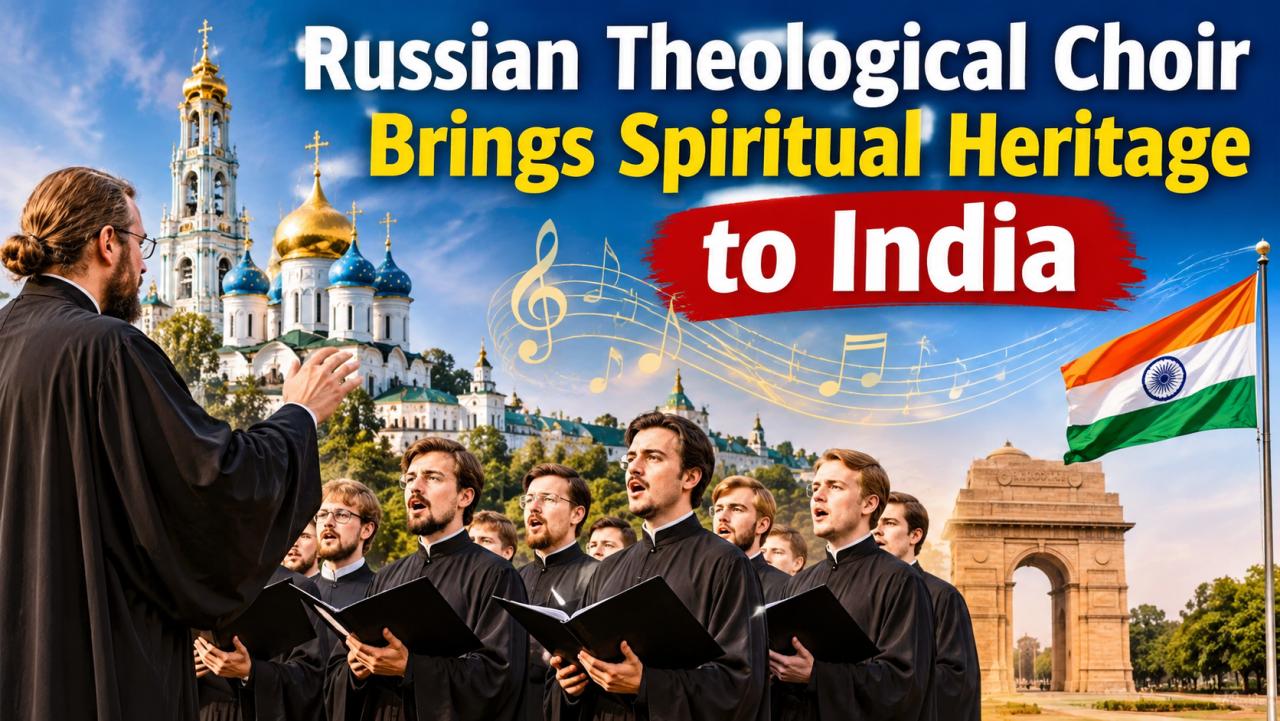
Centuries-old Russian chants travel across continents, bringing faith, music and a living spiritual heritage to Indian audiences.
In the soft glow of chandeliers at the Russian Embassy in New Delhi and the intimate setting of the India Habitat Centre’s Stein Auditorium, something rare unfolded in early November 2026. A group of men dressed in black cassocks, comprising students, graduates and clergy of one of Russia’s most revered religious institutions, stood shoulder to shoulder and sang.
Their voices rose through ancient chants of the Russian Orthodox Church before moving into spiritual songs and, finally, the warm, earthy cadence of Russian folk and patriotic music. For the audience, it was more than a concert. It was an encounter with a living tradition rooted in medieval Russia and brought to India through the power of music.
The ensemble was the United Choir of the Moscow Theological Academy and the Holy Trinity Lavra of St. Sergius, directed by Hieromonk Nestor (Volkov). Its performances on November 1 and 2 in New Delhi, followed by a concluding concert on November 4 at the Russian House in Chennai, formed the centrepiece of the Days of Russian Spiritual Culture in India.
The programme was organised under the long-running Russian Seasons initiative of Russia’s Ministry of Culture. An accompanying exhibition, titled For the Peace of the Whole World, dedicated to the jubilee of Patriarch Kirill of Moscow and All Russia, travelled alongside the choir.
The performances offered more than a musical presentation. They brought together religious heritage, historical continuity and cultural exchange, revealing how a centuries-old musical tradition continues to find resonance beyond its geographical and linguistic boundaries.
A Monastery That Taught Russia to Sing
Founded in 1337 by St. Sergius of Radonezh, northeast of Moscow, the Holy Trinity Lavra of St. Sergius is among the most important monasteries in Russian Orthodox Christianity. Its influence, however, extends beyond religious life. Over the centuries, it became one of the principal centres of Russia's ancient ecclesiastical singing tradition.
By the fifteenth and sixteenth centuries, its choir was already helping shape the musical identity of Muscovite Orthodoxy. Monastic masters developed distinctive melodic traditions, while the Lavra absorbed and refined different forms of church singing, including Znamenny, putevoy and, later, partes styles.
The tradition was never entirely static. It incorporated local musical influences brought by singers from different parts of Russia while remaining rooted in the disciplined liturgical practices of monastic life.
The Soviet period, however, nearly severed this historical continuity. The monastery was closed, and many of its musicians were scattered or silenced. Its revival began after the Lavra was returned to the Russian Orthodox Church in the late 1980s.
A significant contribution to this revival came from Archimandrite Matthew (Mormyl), who worked to restore older chants and compositions by early twentieth-century church composers.
The present-day united choir carries forward this legacy. Its members include seminarians, academy students living and studying within the Lavra's walls, and clergy associated with the monastery. They sing regularly during religious services, making the music an integral part of their daily spiritual life.
What audiences in Delhi and Chennai heard, therefore, was not simply a concert repertoire prepared for international audiences. It was music that continues to accompany worship within one of Russia's most historic religious institutions.
Hieromonk Nestor (Volkov), born in 1978, represents this continuity. A graduate of both the Moscow Theological Seminary and Academy, he was tonsured in 2006 and has served for years as regent of academic choirs.
His stated purpose for the Indian tour was straightforward: to introduce audiences to Russian spiritual culture and the diversity of the Russian soul as reflected in its music.
"Music is a universal language," he has said, explaining that even listeners unfamiliar with the words of Orthodox chants can experience their depth through melody.
Three Layers of Sound
The programme was structured around three distinct musical traditions.
The first consisted of liturgical chants, including troparia, kontakia and the Cherubic Hymn, which form an essential part of Orthodox worship. These compositions are not performances in the conventional Western concert tradition. They are prayers expressed through music, requiring both vocal discipline and a contemplative approach.
The second section featured spiritual cants, devotional compositions that occupy a space between formal liturgical music and popular religious expression.
The final section introduced audiences to Russian folk and patriotic songs. These compositions carried a different emotional character, evoking the Russian landscape, historical memory and the everyday experiences of ordinary people.
The progression was deliberate. It allowed audiences unfamiliar with Orthodox musical traditions to move gradually from the solemnity of liturgical singing to the more accessible expressions of folk culture.
The choir had previously established a connection with Indian Christian communities during its 2024 visit to Kerala. On that occasion, it performed for the Catholicos of the Malankara Orthodox Syrian Church and at the church housing the relics of St. Gregorios of Parumala.
The 2026 performances in Delhi and Chennai extended this cultural and religious engagement, creating another opportunity for interaction between Russian Orthodox and Indian Christian traditions while welcoming audiences from different backgrounds.
Diplomacy in Cassocks
The audiences at the New Delhi events reflected the wider cultural and diplomatic significance of the programme. Diplomats, Indian government officials, journalists and representatives of the cultural and artistic communities attended the performances.
Russian Ambassador Denis Alipov spoke about the special place of the Holy Trinity Lavra of St. Sergius in Russian history and the choir's role in introducing international audiences to the country's spiritual heritage.
Metropolitan Juhanon Mar Demetrios of the Delhi Diocese of the Malankara Orthodox Syrian Church and Priest Sergiy Gorbunov also addressed the gathering.
The participation of Indian Orthodox clergy added a religious dimension to the occasion. It went beyond diplomatic protocol, reflecting the historical connections and shared Christian traditions that provide a foundation for cultural engagement between the two countries.
The accompanying exhibition, For the Peace of the Whole World, placed the musical performances within a broader account of the Russian Orthodox Church's journey under Patriarch Kirill. Marking his jubilee, the exhibition presented photographs and archival material tracing the Church's journey from the difficult post-Soviet years to its contemporary role.
Themes of peace, religious heritage and interfaith understanding formed the exhibition's central narrative.
Together, the exhibition and musical performances offered an account of Russian spiritual culture that extended beyond institutional history. They presented faith, music and cultural memory as interconnected elements of a continuing tradition.
Why It Matters Now
India and Russia share a longstanding relationship that extends across political, economic, educational and cultural spheres. Cultural exchanges rooted in established institutions and living traditions add another dimension to this engagement.
The Lavra's choir does not need to manufacture authenticity for an international audience. Its musical identity emerges from a tradition that remains part of the institution's everyday religious life.
When these voices fill an Indian auditorium, they bring with them a history that has survived political upheaval, institutional disruption and changing cultural landscapes.
For Indian listeners, the experience may have been primarily musical, aesthetic or spiritual. For the singers, it was an extension of their daily religious practice. For the organisers of Russian Seasons, it represented another chapter in a cultural programme that has reached more than 50 countries since its launch in 2008.
The significance of such exchanges lies partly in their ability to create connections without requiring a common language. Religious chants, devotional compositions and folk melodies can communicate historical experiences and emotions that conventional cultural presentations may struggle to convey.
The Chennai concert on November 4 brought the formal programme to a close. The performers would eventually pack their cassocks and fold their music stands, but the experience offered to Indian audiences was not confined to those few evenings.
From the solemn beauty of the Cherubic Hymn to the warmth of a Russian folk melody, the United Choir of the Moscow Theological Academy and the Holy Trinity Lavra of St. Sergius brought a musical heritage shaped by centuries of faith and discipline to Indian audiences.
In an age dominated by fleeting digital sounds and rapidly changing cultural expressions, their performances offered a reminder that some traditions do not survive merely through preservation. They remain alive because people continue to practise, sing and pass them on.
And sometimes, a voice travelling across continents can say what words alone cannot.






















Leave a Comment