
Gold is down 24%, but is it a bargain? Before buying the dip, understand the costs, risks and smarter ways to invest.
Gold has a way of making Indians feel clever and anxious at the same time. After a blistering rally that carried 24-carat prices to a record in January 2026, the metal has slipped roughly a quarter from its peak, landing near ₹14,000 a gram by late October. For anyone who bought at the top, a ₹1 lakh purchase is now worth around ₹76,000. For anyone who has been waiting, the question is whether this is the dip to grab or the start of something deeper.
The answer starts with an uncomfortable truth: the price on the screen is not the price you realise.
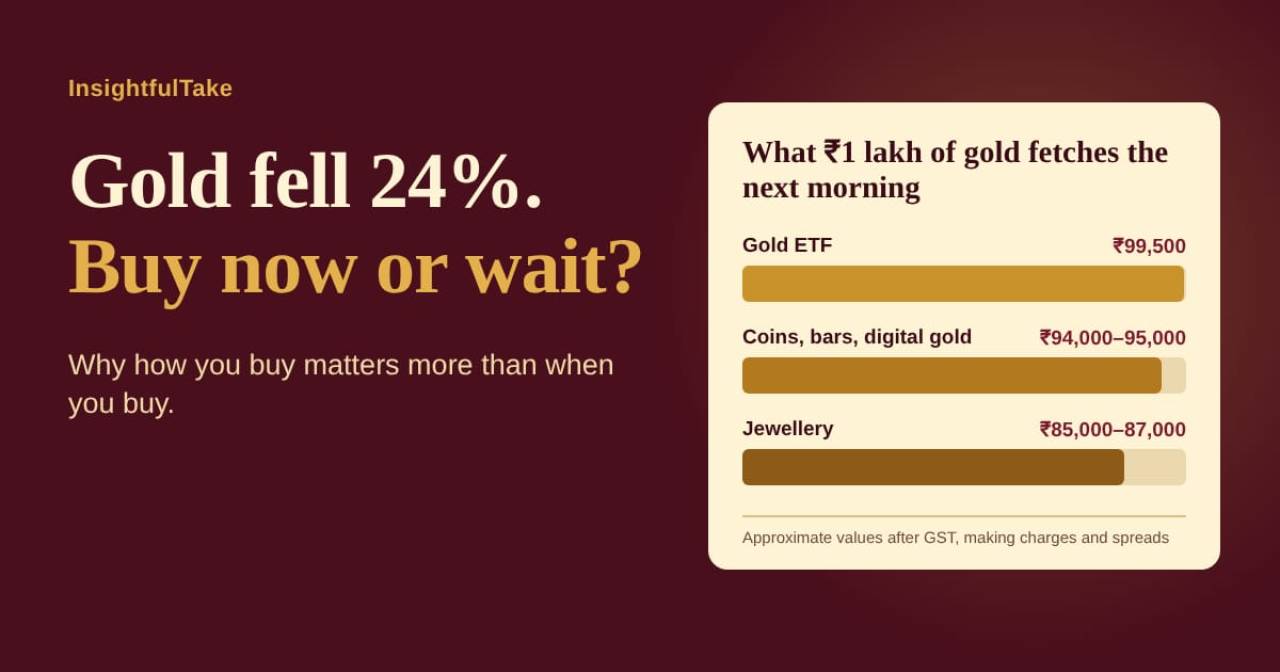
Spend ₹1 lakh on gold today and see what it fetches the next morning, and the outcome varies by route. A gold exchange-traded fund (ETF) leaves you with about ₹99,500, since only brokerage and a small expense ratio bite. Coins, bars and digital gold land in the ₹94,000–95,000 band once GST and dealer spreads are taken out. Jewellery fares worst, returning roughly ₹85,000–87,000 because making charges and GST swallow a sizeable slice before you even leave the shop.
That gap matters more than any single day's price move. A buyer who loses five to fifteen per cent on entry needs a sizeable rally just to break even. This is why financial experts stress that how you buy can matter as much as when you buy.
Gold's Recent Returns Need a Reality Check
Gold's recent performance has been impressive, but investors should be careful about extrapolating it into the future. The metal doubled between the start of 2024 and the end of 2025, a run that flatters its long-term record.
Over ten years, annualised returns sit in the high teens, but financial planners caution that this performance partly reflects an exceptional period rather than a guaranteed trend.
Gold is best understood as a portfolio stabiliser. It tends to hold up when equity markets wobble, the rupee weakens or geopolitical tensions rise. However, it pays no interest, dividend or rent. Its role is to cushion a portfolio, not to carry it.
How Much Gold Should You Hold?
Most financial planners recommend keeping gold between five and ten per cent of an investment portfolio. More aggressive allocations may stretch towards 15 or even 20 per cent for investors with a higher risk appetite or a strong attachment to the metal.
There is an additional consideration for Indian households. A substantial share of family wealth is already held in jewellery tucked away in lockers. That gold counts too.
If your household already owns a considerable quantity of ornaments, adding more through financial products could push your gold allocation beyond a sensible limit without you realising it.
Should You Buy Gold Now or Wait?
Timing the gold market is difficult. Nobody can say with certainty whether prices have bottomed out or will fall further.
The festive season, particularly Dhanteras and Diwali, traditionally encourages gold purchases regardless of prevailing valuations. But buying simply because prices have corrected can be as risky as buying during a rally.
A more measured approach is to stagger purchases. Divide the amount you intend to invest into several instalments spread over a few months. This reduces the risk of committing all your money at an unfavourable price.
Systematic investments through gold funds offer a convenient way to follow this approach. They also remove some of the temptation to guess the market bottom.
Gold ETF, Digital Gold or Jewellery: Which Is Better?
The right way to buy gold depends on why you are buying it.
For investment purposes, gold ETFs and gold fund-of-funds are generally among the more cost-effective and transparent options. ETFs are traded on stock exchanges and offer relatively easy entry and exit. Gold fund-of-funds are suitable for people without a demat account, although they involve an additional layer of costs.
Digital gold is convenient for small, frequent purchases. However, it operates outside direct market regulation, making it important to examine the platform, storage arrangements and applicable charges before investing.
Physical coins and bars offer the comfort of owning tangible gold, but buyers must account for GST, dealer margins and resale deductions.
Jewellery, meanwhile, should primarily be purchased for wearing, gifting or cultural occasions, not as an investment. Making charges, wastage deductions and GST can significantly reduce its resale value.
Sovereign Gold Bonds (SGBs), once popular because they offered annual interest alongside gold-linked returns, are no longer available through fresh government issuances. Existing bonds can still be bought and sold on stock exchanges, although liquidity and market prices may vary.
Indian Gold Demand Is Changing
The correction in gold prices comes amid a noticeable shift in buying patterns.
Jewellery demand has softened as prices have climbed. Many households are reducing the weight of their purchases or switching to lighter and lower-carat pieces to manage costs.
At the same time, money has flowed into gold ETFs, with inflows rising sharply during the price surge. This suggests that financial investors, not just wedding shoppers and festive buyers, are increasingly influencing gold demand.
The shift towards financial gold can be positive when it reflects planned portfolio diversification. It becomes risky when investors enter the market simply out of fear of missing another rally.
Final Take
A 24 per cent correction may look attractive, but a lower price does not automatically make gold a bargain. Investors need to consider their existing exposure, investment horizon, purchase costs and the purpose behind buying.
Start by deciding how much gold your portfolio actually needs. Count the jewellery and physical gold your family already owns. Choose an investment route that keeps costs under control, and consider spreading purchases over time rather than committing everything at once.
Gold can play a useful role in protecting wealth, particularly during uncertain economic periods. But it is not a guaranteed route to quick returns.
The real opportunity may not be in buying gold at its lowest price, but in knowing how much to buy, why to buy it and when to stop.
Gold has a way of making Indians feel clever and anxious at the same time. After a blistering rally that carried 24-carat prices to a record in January 2026, the metal has slipped roughly a quarter from its peak, landing near ₹14,000 a gram by late October. For anyone who bought at the top, a ₹1 lakh purchase is now worth around ₹76,000. For anyone who has been waiting, the question is whether this is the dip to grab or the start of something deeper.
The answer starts with an uncomfortable truth: the price on the screen is not the price you realise.
Spend ₹1 lakh on gold today and see what it fetches the next morning, and the outcome varies by route. A gold exchange-traded fund (ETF) leaves you with about ₹99,500, since only brokerage and a small expense ratio bite. Coins, bars and digital gold land in the ₹94,000–95,000 band once GST and dealer spreads are taken out. Jewellery fares worst, returning roughly ₹85,000–87,000 because making charges and GST swallow a sizeable slice before you even leave the shop.
That gap matters more than any single day's price move. A buyer who loses five to fifteen per cent on entry needs a sizeable rally just to break even. This is why financial experts stress that how you buy can matter as much as when you buy.
Gold's Recent Returns Need a Reality Check
Gold's recent performance has been impressive, but investors should be careful about extrapolating it into the future. The metal doubled between the start of 2024 and the end of 2025, a run that flatters its long-term record.
Over ten years, annualised returns sit in the high teens, but financial planners caution that this performance partly reflects an exceptional period rather than a guaranteed trend.
Gold is best understood as a portfolio stabiliser. It tends to hold up when equity markets wobble, the rupee weakens or geopolitical tensions rise. However, it pays no interest, dividend or rent. Its role is to cushion a portfolio, not to carry it.
How Much Gold Should You Hold?
Most financial planners recommend keeping gold between five and ten per cent of an investment portfolio. More aggressive allocations may stretch towards 15 or even 20 per cent for investors with a higher risk appetite or a strong attachment to the metal.
There is an additional consideration for Indian households. A substantial share of family wealth is already held in jewellery tucked away in lockers. That gold counts too.
If your household already owns a considerable quantity of ornaments, adding more through financial products could push your gold allocation beyond a sensible limit without you realising it.
Should You Buy Gold Now or Wait?
Timing the gold market is difficult. Nobody can say with certainty whether prices have bottomed out or will fall further.
The festive season, particularly Dhanteras and Diwali, traditionally encourages gold purchases regardless of prevailing valuations. But buying simply because prices have corrected can be as risky as buying during a rally.
A more measured approach is to stagger purchases. Divide the amount you intend to invest into several instalments spread over a few months. This reduces the risk of committing all your money at an unfavourable price.
Systematic investments through gold funds offer a convenient way to follow this approach. They also remove some of the temptation to guess the market bottom.
Gold ETF, Digital Gold or Jewellery: Which Is Better?
The right way to buy gold depends on why you are buying it.
For investment purposes, gold ETFs and gold fund-of-funds are generally among the more cost-effective and transparent options. ETFs are traded on stock exchanges and offer relatively easy entry and exit. Gold fund-of-funds are suitable for people without a demat account, although they involve an additional layer of costs.
Digital gold is convenient for small, frequent purchases. However, it operates outside direct market regulation, making it important to examine the platform, storage arrangements and applicable charges before investing.
Physical coins and bars offer the comfort of owning tangible gold, but buyers must account for GST, dealer margins and resale deductions.
Jewellery, meanwhile, should primarily be purchased for wearing, gifting or cultural occasions, not as an investment. Making charges, wastage deductions and GST can significantly reduce its resale value.
Sovereign Gold Bonds (SGBs), once popular because they offered annual interest alongside gold-linked returns, are no longer available through fresh government issuances. Existing bonds can still be bought and sold on stock exchanges, although liquidity and market prices may vary.
Indian Gold Demand Is Changing
The correction in gold prices comes amid a noticeable shift in buying patterns.
Jewellery demand has softened as prices have climbed. Many households are reducing the weight of their purchases or switching to lighter and lower-carat pieces to manage costs.
At the same time, money has flowed into gold ETFs, with inflows rising sharply during the price surge. This suggests that financial investors, not just wedding shoppers and festive buyers, are increasingly influencing gold demand.
The shift towards financial gold can be positive when it reflects planned portfolio diversification. It becomes risky when investors enter the market simply out of fear of missing another rally.
Final Take
A 24 per cent correction may look attractive, but a lower price does not automatically make gold a bargain. Investors need to consider their existing exposure, investment horizon, purchase costs and the purpose behind buying.
Start by deciding how much gold your portfolio actually needs. Count the jewellery and physical gold your family already owns. Choose an investment route that keeps costs under control, and consider spreading purchases over time rather than committing everything at once.
Gold can play a useful role in protecting wealth, particularly during uncertain economic periods. But it is not a guaranteed route to quick returns.
The real opportunity may not be in buying gold at its lowest price, but in knowing how much to buy, why to buy it and when to stop.
























Leave a Comment