
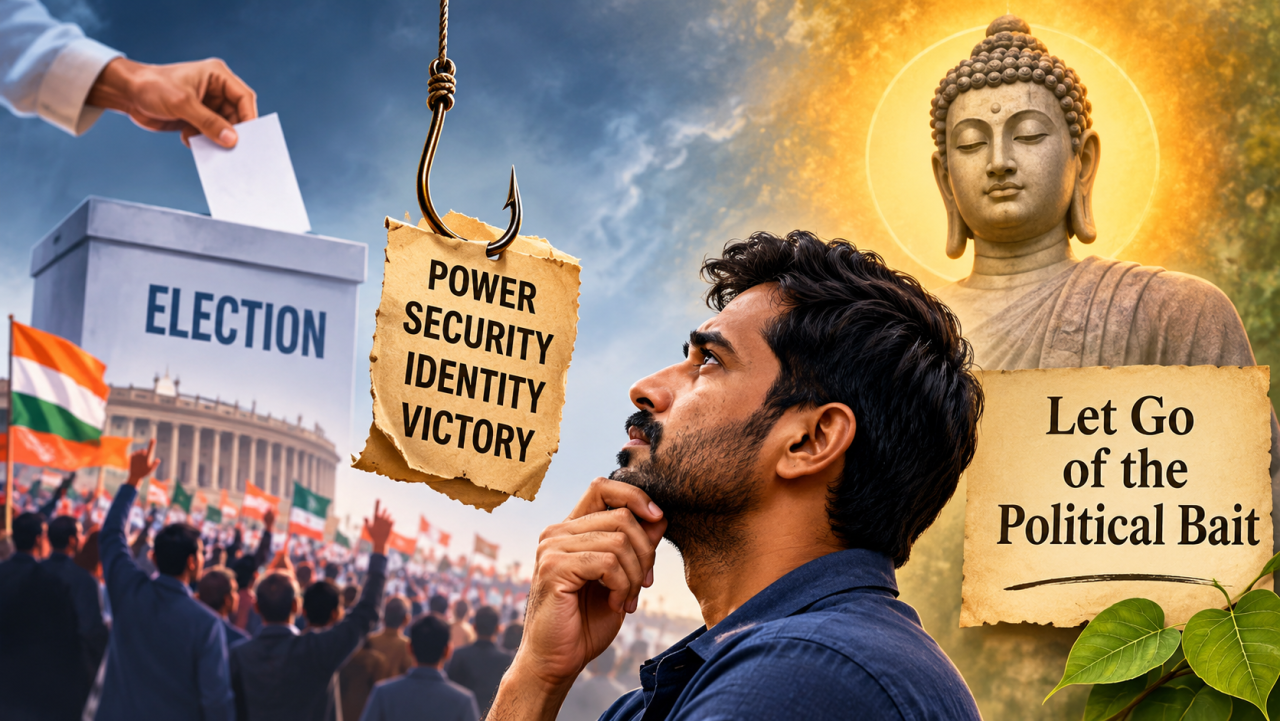
Elections end, but political anger often survives. Buddhist wisdom offers a different way to understand victory, defeat and our attachment to politics.
Now that the election is over, what have we really won, and what have we truly lost?
As the dust settles on another exhausting cycle of partisan fervour, we find ourselves counting the spoils of victory or nursing the wounds of defeat. Yet beneath the temporary euphoria of winning or the bitterness of losing lies a deeper question: why do we repeatedly submit ourselves to this machinery of political conflict?
To understand this, we must examine the very architecture of what we call politics.
The word politics traces its origins to the ancient Greek polis (πόλις), meaning a city-state or citizen community. Its deeper linguistic roots have been associated with the idea of a fortified settlement or stronghold. In classical antiquity, a politēs was a citizen whose identity and responsibilities were connected to the affairs of the city-state.
Over time, politics came to represent the organisation of collective life, governance and competing interests. But when viewed through the lens of Dharmic philosophy, these external structures can also reveal something about our internal world: our attachment to identities, our desire for belonging and our tendency to divide ourselves into opposing camps.
We build ideological fortresses to protect our beliefs, often forgetting that the walls we construct against others can also imprison our own awareness. The political opponent becomes an enemy, disagreement becomes hostility, and the pursuit of victory begins to matter more than the questions that brought us into the debate.
This compulsion to organise our lives around competing identities brings us to a profound teaching of the Buddha in the Samyutta Nikaya (SN 1.3), commonly associated with the theme of abandoning the world's bait.
In this discourse, a deity offers a verse reminding people that life is short, old age approaches and there is no permanent shelter from death. The message is simple: people should perform good deeds while they have the opportunity. The Buddha responds by directing attention towards a deeper concern: the need to abandon the world's bait.
The teaching raises an enduring question. What exactly constitutes a good deed, and how often do we examine the motives and attachments behind our actions?
This question is not exclusive to Buddhism. Philosophers such as Socrates also encouraged people to question conventional ideas of virtue, justice and the good life rather than accepting them at face value. Both traditions, in their own ways, invite us to look beyond appearances and examine the assumptions that govern our conduct.
The Buddha's teaching reminds us of the impermanence of life and the importance of liberation from worldly attachment. One commonly used translation of the verse reads:
"Life is swept along, short is the life span;
No shelters exist for one who has reached old age.
Seeing clearly this danger in death,
A seeker of peace should drop the world's bait."
The application of this teaching to modern politics is worth considering.
Elections promise change, representation, justice and a sense of collective purpose. They are essential instruments of democratic life, giving citizens an opportunity to participate in decisions that shape their future. But our relationship with politics can become unhealthy when participation turns into an obsession with winning, belonging and defeating those who think differently.
The desire to belong to a political tribe, defend an ideology at all costs or establish the superiority of one's chosen side can become another form of attachment. Political identities begin to shape personal relationships, everyday conversations and even our sense of self-worth.
The political bait, therefore, is not necessarily democracy itself. It is the emotional hook hidden inside the promise that political victory will bring lasting satisfaction, security or a sense of personal fulfilment.
The result can be a cycle of agitation. Those who win often find another battle to fight, while those who lose begin preparing for the next contest. Anger survives the election, rivalries continue and public attention shifts from issues to personalities, from policies to political loyalties.
In this cycle, the ordinary citizen can lose sight of the very concerns that made political participation important in the first place.
There is a distinction worth remembering: detachment does not mean indifference. A person can remain committed to justice, equality, accountability and democratic participation without becoming consumed by hatred or political rivalry. One can question a government without despising its supporters, and disagree with an opposition without denying its right to exist.
Perhaps this is where ancient wisdom offers something valuable to modern political life.
The Buddha's call to abandon the world's bait can be understood as an invitation to examine our attachments rather than surrender our responsibilities. It asks us to recognise how easily temporary victories, social identities and external recognition can dominate our inner lives.
After every election, the political landscape changes. Governments rise and fall, leaders celebrate or retreat, and parties begin preparing for the next contest. But what happens to the individual who has invested so much emotion in the outcome?
What have we really gained if victory leaves us more hostile? What have we really lost if defeat makes us incapable of accepting disagreement?
Perhaps the more meaningful victory is not the defeat of a political opponent but the ability to remain thoughtful, compassionate and independent in the middle of political turmoil.
Elections will continue. Political disagreements will remain part of democratic society. But we do not have to surrender our peace of mind to every political contest.
The question, then, is not simply who won the election. It is whether we have recognised the bait, understood the hook and retained the freedom to walk away from the anger it creates.
About the Author: Joe Singleton is an American author, spiritual journalist and practitioner of the Eastern Yogic Wisdom Traditions.

















Leave a Comment