
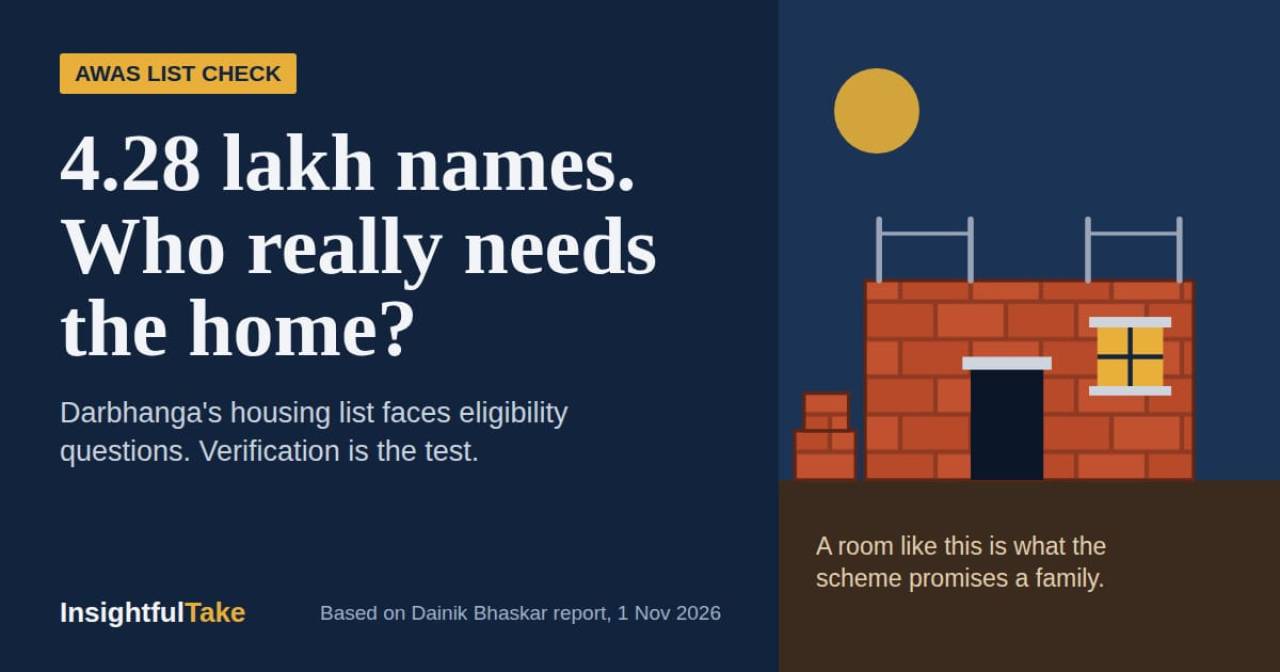
More than 4.28 lakh names, serious eligibility questions and a crucial test of whether Darbhanga's housing verification system can deliver justice.
A report published by Dainik Bhaskar on 1 November 2026 has raised questions over the selection of beneficiaries under the Pradhan Mantri Awas Yojana (PMAY) in Bihar’s Darbhanga district. According to the newspaper, 4,28,058 people across 18 blocks have been selected under PM Awas Plus 2.0. It also claims that a substantial number of those included in the list may not meet the scheme’s eligibility conditions.
Citing unnamed sources, the report estimates that 40 to 50 per cent of the selected applicants could be ineligible. However, these claims have not been independently verified by InsightfulTake and should not be treated as established findings.
The allegations nevertheless raise an important question: how effectively does the welfare system verify beneficiaries before public money is committed to housing assistance?
The Allegations and Their Limits
The newspaper report suggests that some applicants may already own permanent houses, vehicles or land, while others may have received housing assistance under earlier government schemes.
It also refers to suspected irregularities in Sadar and Bahadurpur blocks, including cases in a village under Bajitpur panchayat.
The estimated 40 to 50 per cent ineligibility figure is significant, but it is based on anonymous sources rather than publicly available verification records. Without household-level inspections or confirmation from district authorities, the estimate cannot be treated as an accurate measure of irregularities.
Even if the actual number of questionable entries is considerably lower, the scale of the beneficiary list makes the issue important. A small percentage of incorrect entries in a list containing more than four lakh names could still affect thousands of households.
The district administration needs to respond with verifiable information rather than leave the allegations unanswered.
Occupation Alone Cannot Determine Eligibility
One aspect of the report requires particular caution. It mentions anganwadi workers, ASHA workers and a retired teacher among applicants in parts of Bahadurpur block.
However, employment alone does not establish whether a household qualifies for housing assistance.
Anganwadi and ASHA workers, for instance, often receive modest honorariums. Their association with government-supported services does not necessarily mean they have a permanent house or sufficient household income.
Eligibility must be assessed against the scheme's prescribed housing and economic criteria, including applicable exclusion conditions. A person's occupation cannot become a substitute for a proper assessment of their household circumstances.
The objective should be to identify genuinely ineligible applicants without excluding deserving families through assumptions or arbitrary classifications.
A Massive List, a Difficult Verification Exercise
The scale of the selection exercise makes verification especially important.
According to the newspaper's block-wise figures, Baheri has 37,825 selected names, Biraul 37,727 and Bahadurpur 34,071. Kiratpur, by comparison, has approximately 12,000 names.
The figures published in the newspaper's block-wise table reportedly add up to 4,28,018, which is 40 fewer than the 4,28,058 figure mentioned in its headline. This discrepancy also needs clarification from the authorities.
With thousands of applicants in individual blocks, the administration faces a substantial verification challenge. Household surveys, data entry and the compilation of beneficiary lists involve multiple levels of officials and field workers. Errors can enter at any stage, whether through incorrect information, inadequate field inspections or deliberate manipulation.
That is precisely why verification cannot be treated as a routine formality. The credibility of the entire exercise depends on whether the administration can identify and correct mistakes before final benefits are approved.
Why Waiting for Complaints Is Not Enough
The newspaper quoted the District Development Commissioner as saying that no complaint had been received so far. The official reportedly added that action would be taken if complaints were submitted and that the beneficiary list would be read out in Gram Sabhas.
Public scrutiny through Gram Sabhas is an important part of local accountability. Residents often have better knowledge of household circumstances than officials working with administrative records. They may know whether an applicant already owns a permanent house or whether a deserving family has been left out.
But a verification mechanism that depends primarily on complaints has limitations.
The poorest households are often the least equipped to challenge irregularities. They may lack information about the selection process, access to officials or the confidence to raise objections against influential people in their villages.
At the same time, applicants with stronger local connections may be better positioned to protect their inclusion or influence objections against others.
A fair verification system must therefore go beyond waiting for complaints. Officials need to conduct independent checks, particularly where specific allegations or inconsistencies have emerged.
What Is at Stake?
The purpose of a rural housing scheme is to provide secure homes to families that genuinely need them. The number of beneficiaries and the funds available for assistance are not unlimited.
If an ineligible household receives assistance, a deserving family could lose an opportunity. Equally, wrongly excluding an eligible household defeats the purpose of the scheme.
There is also a larger question of public trust. When residents see apparently well-housed families included in beneficiary lists while genuinely vulnerable households remain excluded, confidence in government welfare programmes suffers.
It is important to remember that a selected list is not necessarily a final allotment list. Verification and correction are integral to the process. The real test is whether these safeguards work transparently and without political or local pressure.
What Darbhanga Administration Should Do
The allegations offer the district administration an opportunity to demonstrate that beneficiary selection is based on evidence rather than influence or procedural convenience.
A credible verification exercise should include:
- Independent sample audits: Conduct random household-level checks across blocks and publish the findings.
- Panchayat-level disclosure: Display beneficiary lists prominently in every panchayat and provide residents with a reasonable period to raise objections.
- Accessible grievance mechanism: Clearly publicise the names and contact details of responsible officials, along with a simple procedure for submitting complaints.
- Proactive field inspections: Recheck households where specific allegations or discrepancies have been reported.
- Public disclosure of corrections: Publish the number of beneficiaries retained, removed or added after verification, with reasons wherever legally permissible.
- Administrative accountability: Examine cases where negligence, manipulation or deliberate inclusion of ineligible applicants is established.
The administration should also clarify the discrepancy in the published block-wise figures and make the applicable eligibility and exclusion criteria accessible to residents.
The Real Test Is Fairness
Whether Darbhanga's beneficiary list contains thousands of questionable entries or only a limited number of errors, the allegations deserve a transparent response.
A housing scheme cannot be judged only by the number of names it adds to a list. Its success must also be measured by whether the right families receive assistance and whether those wrongly excluded have a fair opportunity to challenge the decision.
For Darbhanga, the immediate task is not to defend or dismiss the allegations. It is to establish the facts through verifiable records, independent inspections and public scrutiny.
A welfare scheme earns public trust not simply by selecting beneficiaries, but by ensuring that every deserving family gets a fair chance at a home.
Source note: This analysis draws on a report published by Dainik Bhaskar, Darbhanga edition, on 1 November 2026. The newspaper's allegations and estimates have not been independently verified by InsightfulTake.



















Leave a Comment