

Fresh clashes beyond the Meitei-Kuki divide expose Manipur's deepening crisis and raise a difficult question: why is lasting peace still out of reach?
On the night of October 18, a music concert in Khangabok village in Manipur’s Thoubal district ended in violence and death. Stone-pelting near the venue escalated into clashes, with houses and vehicles set ablaze in Khangabok and neighbouring Sangaiyumpham. The district magistrate imposed restrictions, directing residents of both villages to remain indoors from 11 pm.
The dead man, 23-year-old Rakesh Laishram, was a Meitei Hindu from Khangabok. According to media reports, residents on both sides blamed each other for the violence, while the administration described the incident as a local dispute rather than a communal clash.
What makes the incident particularly disturbing is that it was not part of the Meitei-Kuki conflict that has torn Manipur apart since May 2023. This time, the violence involved two communities within the valley: Meitei Hindus and Meitei Muslims, commonly known as Pangals, who have lived alongside each other for generations.
The same weekend also witnessed an IED blast in Imphal West and an ambush targeting villagers. Police counted four deaths across these incidents.
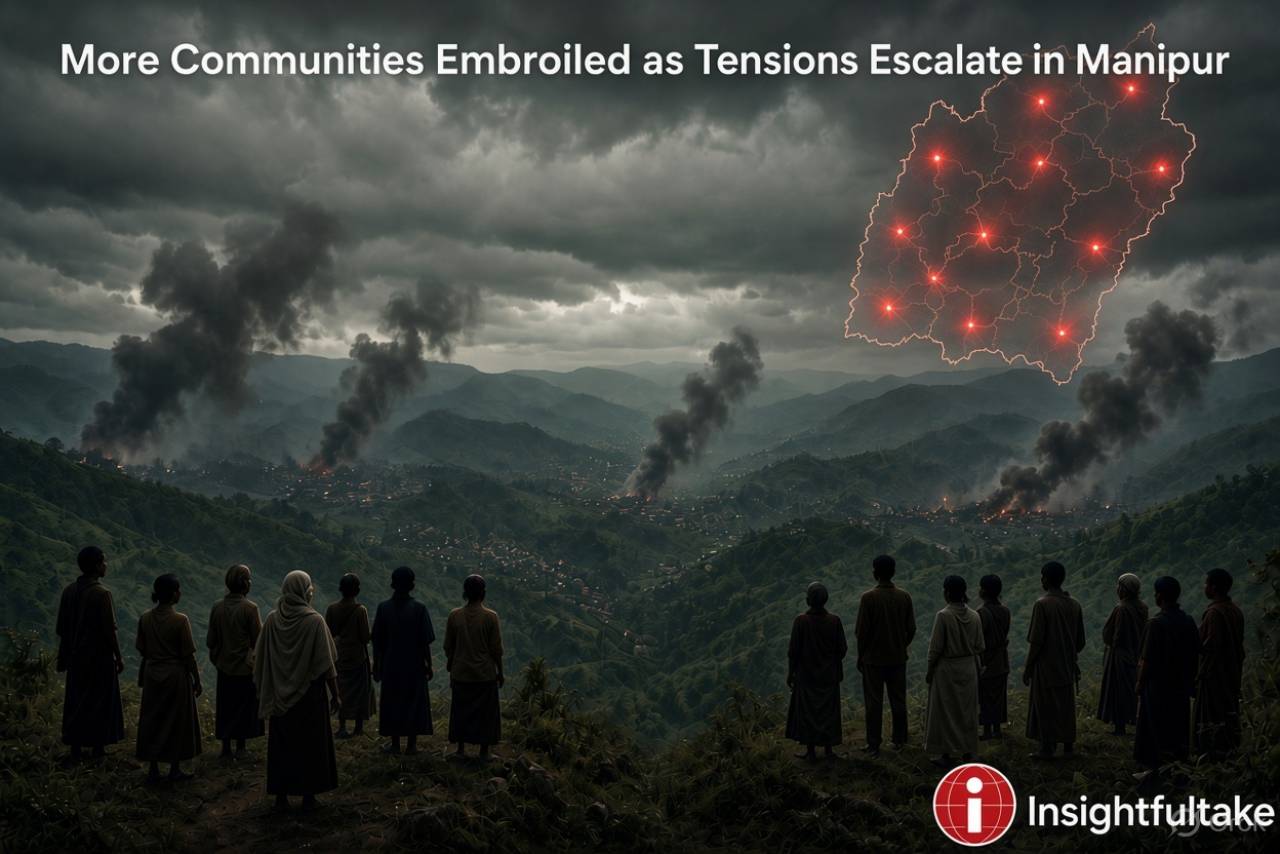
Manipur's violence is no longer confined to a single conflict or one dividing line. New fault lines are emerging, raising serious questions about the state's security situation and the failure to restore lasting peace.
Three Years of Unfinished Business
The ethnic conflict between Meiteis and Kukis has claimed more than 260 lives and displaced thousands since May 2023. Communities remain divided across areas increasingly controlled along ethnic lines, with security forces deployed in buffer zones to prevent further clashes.
Yet, more than three years after the violence began, normalcy remains elusive. Thousands of displaced people continue to struggle with uncertain futures, while the political and administrative questions at the heart of the conflict remain unresolved.
For critics of the Union government, the October violence is evidence of what happens when a deep wound is repeatedly covered without being treated.
Their principal charge is political neglect. Prime Minister Narendra Modi visited Manipur only in September 2025, more than two years after the violence erupted. Opposition leaders, particularly from the Congress, criticised the visit as symbolic, arguing that a brief appearance accompanied by development announcements could not substitute for a sustained political effort to restore peace.
Critics also questioned the effectiveness of President's Rule, imposed in 2025, arguing that the change in administrative control did little to address the mistrust and insecurity experienced by ordinary residents.
A Government Restored, but No Political Settlement
A BJP-led government returned to power in Manipur on February 4, 2026, bringing an end to President's Rule. However, the restoration of an elected government did not resolve the central political disagreement.
Kuki-Zo organisations had sought a written commitment on a separate Union Territory for the hill districts. Such an assurance was not forthcoming. Peace negotiations between Meitei and Kuki-Zo representatives consequently made limited progress, with the demand for Union Territory status remaining a major obstacle.
The political tensions continued after the formation of the Khemchand-led government. Kuki-Zo organisations announced a social boycott of the deputy chief minister who joined the new administration, reflecting the continuing divide between political representation and community acceptance.
In other words, a government was restored, but a mutually acceptable political settlement remained missing.
Some independent reporting has raised concerns about the emergence of additional fault lines. The Reporters' Collective has argued that a second phase of conflict is developing, this time involving Kuki-Zo and Naga communities. Its reporting has also questioned whether the Union government's approach to peace has placed excessive emphasis on militarisation.
If these assessments are correct, Manipur's latest violence cannot be viewed as a collection of unrelated incidents. It points to a wider crisis in which unresolved grievances continue to generate fresh tensions.
What Critics Say Delhi Has Failed to Understand
The criticism of the Centre rests on three broad arguments.
The first concerns timing. Critics argue that sustained political attention came too late. By the time the highest levels of government intervened visibly, the conflict had already destroyed lives, displaced families and deepened divisions between communities.
The second concerns the nature of the response. Security deployments, administrative restrictions and relief packages may be necessary, but they cannot independently resolve disagreements over territory, political representation and security arrangements.
The third is the collapse of public trust. When displaced families remain in relief camps and communities question the neutrality of state institutions, the government's ability to prevent violence becomes increasingly limited.
In such an atmosphere, even a local disagreement can acquire a wider communal dimension. A stone thrown near a music concert can become the beginning of another tragedy.
The Government's Defence
The Centre and its supporters reject the suggestion that the government has remained inactive.
Prime Minister Modi told the Rajya Sabha that the roots of the Manipur conflict were deep and that both the Union and state governments were engaging with different stakeholders. He also pointed to Home Minister Amit Shah's visit to the state and referred to the history of President's Rule being imposed in Manipur ten times under previous Congress governments.
In September 2025, the Centre signed a one-year tripartite agreement with the Manipur government and Kuki-Zo groups, aimed at restoring peace.
Chief Minister Yumnam Khemchand Singh also described his March 2026 meeting with a Kuki-Zo Council delegation as a positive beginning towards rebuilding trust.
Supporters of the government's approach argue that an ethnic conflict of this complexity cannot be resolved through administrative orders or political announcements. They also caution that pushing through a territorial settlement without wider acceptance could create fresh tensions and potentially trigger another round of violence.
There is an argument here worth considering. Peace cannot be imposed simply by restoring an elected government or increasing the presence of security forces. It requires negotiations that address the concerns of all communities.
However, the difficulty of the task cannot become a justification for the absence of measurable progress.
Manipur Needs More Than Security Deployments
Both the government and its critics have valid points, but the larger question remains unanswered: how long can Manipur continue living with unresolved conflict?
Dialogue has restarted, governments have changed, and security arrangements remain in place. Yet, the latest violence in Thoubal demonstrates that insecurity has spread beyond the original Meitei-Kuki fault line.
Manipur needs a credible disarmament process, an inclusive political roadmap, accountability for those responsible for killings and violence, and a serious rehabilitation programme for displaced families. Equally important is restoring public confidence in the neutrality of the administration and security institutions.
The Centre must also demonstrate that its engagement goes beyond periodic visits, announcements and statements of concern.
The killing of a 23-year-old man in Thoubal should not be dismissed as another local dispute. It is a warning that the consequences of Manipur's unresolved crisis are spreading into communities that were not at the centre of the original conflict.
Without political reconciliation and public trust, the next music concert, football match or election rally could become another flashpoint.
Manipur does not need another round of assurances. It needs a credible path to peace. And Delhi cannot afford to look away.












Leave a Comment